
Scroll XVII – The Unwritten Decrees: The Orders They Stopped Obeying
Year: 1446 BCE — Waset (Luxor), The Palace, The Temple Offices, and The Northern Garrison Roads
Translated and restored for the modern traveler.
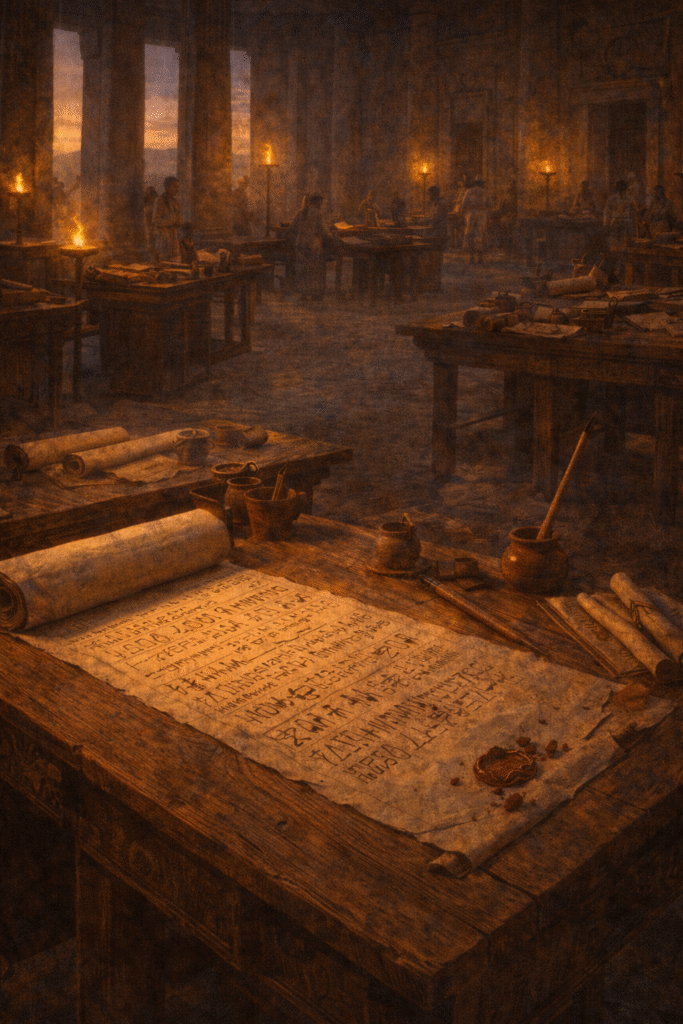
Prologue — Power Slips Quietly
Power never disappears in a single moment.
It does not shatter.
It does not fall like a vase
broken by one careless touch.
It slips.
Silently.
Incrementally.
In gaps so small
you almost convince yourself
you imagined them.
A missing signature.
A delayed courier.
A nod given to the wrong person.
A room that goes still
when you walk in
—not from reverence,
but from recalculation.
This Scroll is not about betrayal.
It is about the subtle reshaping
of a world that once moved
at my command.
It is the story
of decrees
that were never openly defied—
only quietly
unfollowed.
The beginning
of a new center of gravity.
The shifting
of the court’s heartbeat.
The truth
that a rising hawk
calls winds toward him
even without spreading
his wings.
This is the Scroll
of political erosion—
the kind no one warns you about,
because it happens
in silence.
PART I — The First Decree That Drifted
It was a minor matter.
A simple order.
I had instructed the treasury
to increase grain rations
for a village south of Abydos
that had suffered
a poor harvest.
I wrote the decree myself—
ink dark,
lines clean.
My seal pressed firmly
into the wax.
It should have reached
the local governor
within ten days.
Twenty days passed.
No acknowledgment.
No response.
No confirmation.
I summoned the chief courier.
“Where is my decree?”
He bowed,
eyes flicking briefly
toward Thutmose’s wing
of the palace
before returning to me.
“Majesty,” he said,
“It was sent.”
“Then why has it not been enacted?”
Again,
that flicker of hesitation.
Finally:
“I do not know.”
But I did.
Because the truth
presented itself later
in the most mundane of ways:
A palace clerk—
barely more than a boy—
dropped a pile of reed-paper
as he hurried across a courtyard.
Scrolls scattered everywhere.
As servants helped gather them,
I noticed one open on the ground.
My decree.
Not sent.
Not delivered.
Not lost.
Set aside.
Not ignored—
that would have been rebellion.
Simply…
not acted upon.
I looked at the clerk.
“Why was this not sent?”
He swallowed.
“I—
I was told
to wait.”
“By whom?”
He hesitated.
Then whispered:
“A superior…
who wanted to see
what His Majesty Thutmose
would advise first.”
A small thing.
Almost nothing.
And yet—
It was the first time
my order had taken second place
to his silence.
PART II — The Governor Who Smiled Too Long
Another time,
during the season of planting,
the governor of Mennefer
came with his annual reports.
A man of sharp wit
and sharper self-interest,
he had risen under my rule
and prospered well.
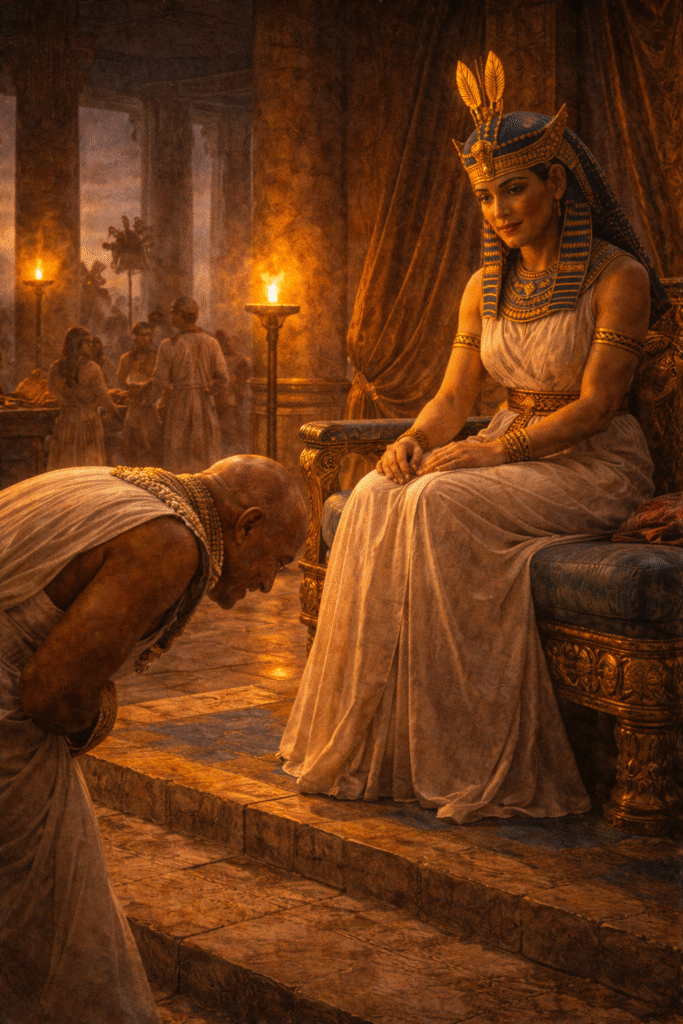
He greeted me
with full ceremony—
deep bows,
proper titles,
lavish offerings.
But when I asked
about the canal expansion
I had approved the previous season,
he smiled a bit too long
before answering.
“It is… in progress, Majesty.”
“In progress?” I repeated.
“It should have been completed months ago.”
His smile widened—
the kind of smile
men wear
when they believe
they are being clever
rather than insolent.
“There were delays,” he said.
“What delays?” I asked.
He hesitated.
Then he said the words
without saying the words:
“We required confirmation
from the young king
on certain expenditures.”
I held his gaze.
“Confirmation
for an order
I issued myself?”
He bowed his head
with exaggerated humility.
“Of course, Majesty.
We honor your word.
But we wish to ensure
all voices of the throne
are aligned.”
Not defiance.
Not refusal.
Just the new habit
of waiting
to see what Thutmose
might say
—even if he said nothing.
“Governor,” I said coolly,
“when the Two Lands speak,
it is enough
that one voice commands.”
His eyes flickered.
Shame?
No.
Calculation.
This was the moment
he measured me—
not as a queen,
but as a variable.
He bowed again,
but the bow felt different.
He had just revealed
which way the wind
was beginning to blow.
PART III — The Treasury That Forgot
It is a strange thing
to discover
that officials
can be obedient
without being loyal.
One afternoon,
I visited the treasury scriptorium
to review accounts.
Rows of scribes
sat cross-legged on mats,
brushes in hand,
inkstones beside them.
Most rose instantly
when I entered.
One did not.
Not out of rebellion—
I could see that immediately.
He froze
as if caught
in the middle
of a guilty thought.
I stepped toward him.
“Your name?”
“Ahmose, Majesty.”
“What are you writing?”
He hesitated.
“A redistribution order.”
“For what purpose?”
“For the grain surplus
of last season.”
I frowned.
“That redistribution
was authorized
two weeks ago.”
He swallowed.
“Yes, Majesty.
But the young king
asked for a review.”
“A review,” I repeated.
“He did not forbid it,”
the scribe said quickly.
“He simply…
requested time
before it proceeded.”
“Time for what?”
Ahmose’s voice
dropped to a whisper.
“For the generals
to give their opinion.”
Grain.
Not war.
Grain.
The most basic thread
that holds Egypt together.
And now
it waited
for the consultation
of military men
instead of the decree
of its ruling Pharaoh.
Not defiance.
Not refusal.
Just redistributed loyalty.
A recalibration
of who might matter
more tomorrow
than today.
I dismissed Ahmose gently—
this was not his scheme,
only his fear.
But when I left the treasury,
the air felt different.
Close.
Dry.
Thin.
The kind of air
that precedes
a shift in weather
no one wants to name.
PART IV — The General Who “Misread”
There came a time
when a general’s mistake
was too obvious
to be accidental.
A regiment
from the southern frontier
was due for rotation.
I issued a decree—
clear, specific,
bearing my full titulary—
ordering their return
and replacement.
Ten days later,
they had not moved.
I summoned the general in charge.
He stood in the great hall,
broad-shouldered,
smelling faintly of sweat
and dust.
“General,” I said,
“why have my orders
not been executed?”
He bowed.
“Majesty,
we believed
the decree
was meant as guidance.”
Guidance.
Not command.
“Explain,” I said.
He straightened slightly.
“We thought
His Majesty Thutmose
might prefer
to keep the regiment
in place
until his next inspection.”
“Did he say so?” I asked.
“No, Majesty.”
“Did he hint so?”
“No, Majesty.”
“Then why did you assume so?”
He hesitated.
And for the first time,
a general looked at me
as if the truth
might injure him
worse than a blade.
“Because,” he said quietly,
“men in the camps
listen for the footsteps
of the one
they believe
will walk among them next.”
Not rebellion.
Not conspiracy.
Just belief.
Belief
is the most dangerous currency
in a kingdom.
It buys more
than orders ever can.
I dismissed him
and dismissed the council.
When I stood alone
in the great hall,
the carved kings on the walls
seemed to watch me
not with judgment—
but with recognition.
They had known this, too.
All rulers do.
At some point,
those who obey
begin to obey
someone else.
PART V — The Day the Priests Deferred
Of all the subtle shifts,
the most chilling
was the smallest.
A simple ritual.
A simple question.
A moment
that should have passed
without meaning.
It did not.
One morning,
in the inner court of Karnak,
I attended a purification rite.
The high priest of Amun
stood before the sacred pool,
censer in hand,
robes brilliant with embroidered gold.
We spoke the opening invocations
together.
Then came the customary moment
when the priest asks:
“Whom does the god bless first?”
For twenty years,
the answer had been scripted,
unquestioned:
“Maatkare Hatshepsut,
Beloved of Amun,
Chosen of the Two Ladies.”
This time,
the priest paused.
A pause
so brief
that any other listener
would have missed it.
But I heard it.
He looked to me—
and then
his eyes flicked
ever so slightly
toward Thutmose.
He caught himself.
He turned back.
He spoke my name first.
He honored the rite.
But the flicker
was real.
In that suspended heartbeat,
I understood:
They were preparing themselves
for a future
in which my name
would no longer lead the list.
Not defiance.
Not disrespect.
Just readiness.
The readiness
of a temple
to pivot
when the wind changes.
The readiness
of a priesthood
to survive
whoever holds the throne.
The readiness
of memory
to forget
its present
as it kneels
to its future.
PART VI — The Evening of Three Bowls
One evening,
in the palace kitchens,
I walked unannounced.
I liked seeing
how the palace truly lived—
not the way it appeared
in murals
and ceremony.
Servants scrambled,
startled,
but then relaxed
when they realized
I was not there
for reprimand.
A cook—
broad, flour-dusted—
offered me three bowls
to taste:
Stew.
Bread.
Dates dipped in honey.
All excellent.
Then he said,
smiling:
“We prepared a fourth bowl
for His Majesty Thutmose.”
I nodded.
He continued:
“We send his meals
separately now—
the men want to ensure
he eats well
after his campaign.”
I paused.
“What about the meals
sent for me?”
The cook blinked,
confused.
“We always send yours, Majesty.
But…”
He hesitated.
“…the younger servants
carry his first.”
His first.
Not out of disrespect.
But out of admiration.
That is how power moves—
not in proclamations,
but in the hands
of ordinary people
who decide
without planning
to rearrange the world
in small,
quiet ways.
PART VII — The Modern Traveler in Administrative Shadows
Traveler,
when you walk Egypt with us—
through palaces,
storehouses,
scribal halls,
temple corridors—
understand this:
These spaces
remember more
than triumphs.
They remember subtlety.
The desks
where decrees sat waiting
for the opinion
of another.
The doors
courtiers closed
when conversations shifted.
The hallways
where footsteps slowed
as someone recalibrated
their loyalties
in real time.
If you stand long enough
in these quiet places,
you may feel
what I felt:
A kingdom
that still obeyed me—
but no longer
responded
to my voice
first.
If you have ever felt
your authority shifting—
not being taken,
but slowly, quietly
transferred…
If you’ve watched people
begin to seek
someone else’s direction
even while standing
in your presence…
Then you understand
the heart of this Scroll.
Walk these halls with us.
See where the decrees sat.
Hear the whispers
of scribes
reordering loyalties.
Let us guide you
through the places
where silence
spoke louder
than law.
Journey with ENA.
Some truths
live in the spaces
between orders.
PART VIII — The Decision in the Garden of Sycamores
One afternoon,
after a long day
of strained councils
and half-answered questions,
I went to the garden
where I once taught Thutmose
the shape of Egypt
in lines drawn on sand.
He found me there—
walking among the sycamores,
whose leaves danced
in low afternoon light.
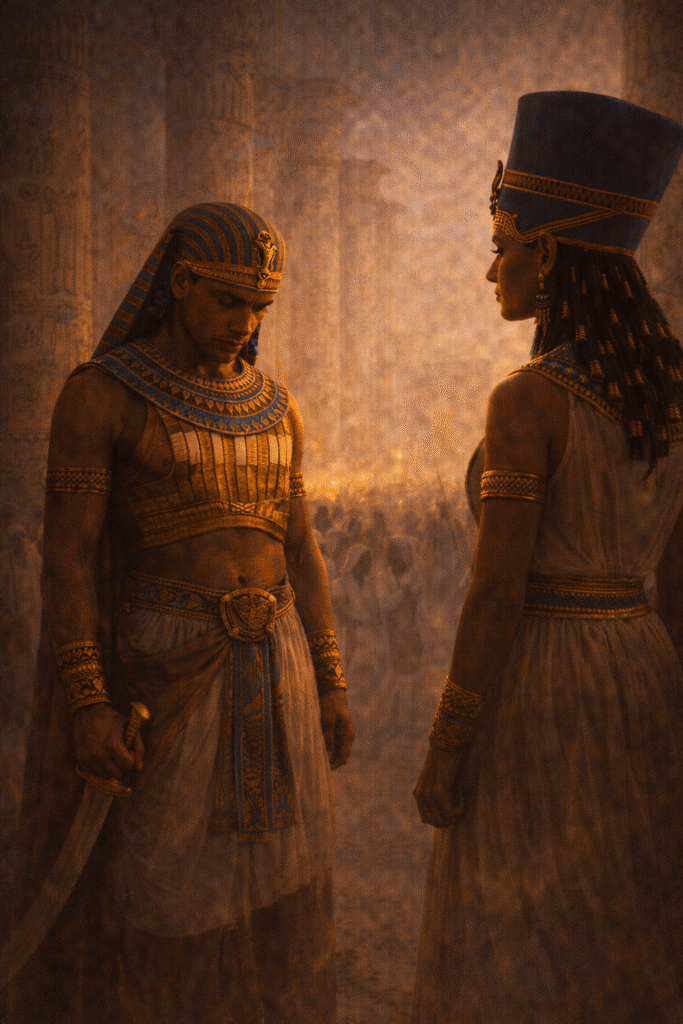
“holy mother,”
he said softly,
“you sent for me?”
“I wished to speak,”
I said.
He approached slowly.
Cautious.
Concerned.
“You feel it too,”
I said.
He inhaled.
“Yes.”
“They listen to you first now,”
I said.
He did not deny it.
“They obey me,”
I continued,
“but they follow you.”
He closed his eyes briefly—
not in satisfaction,
but in pain.
“I did not ask for this,”
he said.
“No,”
I agreed.
“The world offered it.”
He opened his eyes.
“What would you have me do?”
I looked at him—
this young man
I had raised,
shaped,
guided.
“The truth?”
I asked.
“Yes,” he whispered.
“Do nothing.”
He stared at me.
“Nothing?”
he repeated.
“Let them come to you,”
I said.
“Let them bend
the world around you
in their own time.
Do not force it.
Do not rush.
Do not take
what will soon
be freely given.”
“But why?”
he asked,
stricken.
“Because,”
I said softly,
“a kingdom shifts
most cleanly
when no hand
pushes it.”
He looked away.
“Is this…
the beginning of your end?”
he asked.
“No,”
I said with a small smile.
“It is the beginning
of your beginning.”
PART IX — The Scribe’s Final Whisper
Later that night,
a senior scribe
visited me privately.
He carried
a small wooden palette—
the same one
another scribe
once placed before me
years ago.
This one
had a different message
carved into its grain:
“Obedience
follows confidence.”
He bowed deeply.
“Majesty,”
he said,
“the court
is preparing itself.
Not against you.
For him.”
“I know,” I said.
The scribe hesitated.
“May I speak freely?”
“Yes.”
“You built something
so stable
that even your own transition
will not break it.”
I looked at him
for a long moment.
Then said:
“That is the only reason
I ever ruled.”
PART X — The Ancient Questioner’s Desk
A student asked:
“Why did they stop obeying her orders?”
A historian replied:
“They did not stop obeying.
They stopped prioritizing.”
Another asked:
“Was she betrayed?”
The scribe wrote:
“No.
She was outgrown.”
A traveler wondered:
“Could she have forced loyalty?”
He answered:
“Yes.
And the kingdom
would have paid for it.”
A final question came:
“What breaks a reign?”
The scholar smiled sadly:
“Not rebellion.
Reorientation.”
The Scroll ends here—
in the soft spaces
between orders
and actions.
If you felt the tension
of commands obeyed slowly,
of loyalty shifting quietly,
of people turning
not with their mouths
but with their instincts…
then you understand
the deepest truth
of this part of her reign.
Come stand in the halls
where decrees waited.
Walk the gardens
where truth was spoken softly.
Stand in the rooms
where power
did not fall—
it drifted.
Journey with ENA.
Some changes
arrive on whispering feet.