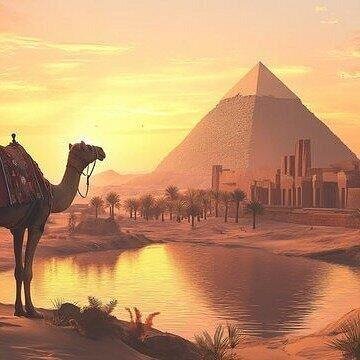
Scroll XV – The Last Full Sun: My Final Years of Peace
Year: 1451 BCE — Waset (Luxor), The Banks of the Nile
Translated and restored for the modern traveler.
Prologue — The Soft Light Before Departure
Every life has a season
when the sun hangs a little lower
but still shines warm.
When each day feels like a blessing—
soft, steady, unhurried—
and yet some delicate instinct whispers:
This will not last.
These were the years
when Egypt basked in my reign
as if wrapped in linen
fresh from the river’s wash.
No famine.
No plague.
No war at the borders.
Granaries swollen with grain.
Temples humming with devotion.
Trade caravans flowing
from Nubia to Sinai
under an unbroken sky.
It was a peace
so deep
that even the stones
seemed to breathe more slowly.
And though I sensed
the shifting winds at court,
though I heard
the soft crack in ritual intonations,
though I felt
the unavoidable approach
of Thutmose’s ascension…
still,
these years were beautiful.
This is the Scroll
of the last full sun—
bright, warm, gentle—
before the long shadow
of memory began to lengthen.
PART I — Morning on the Water
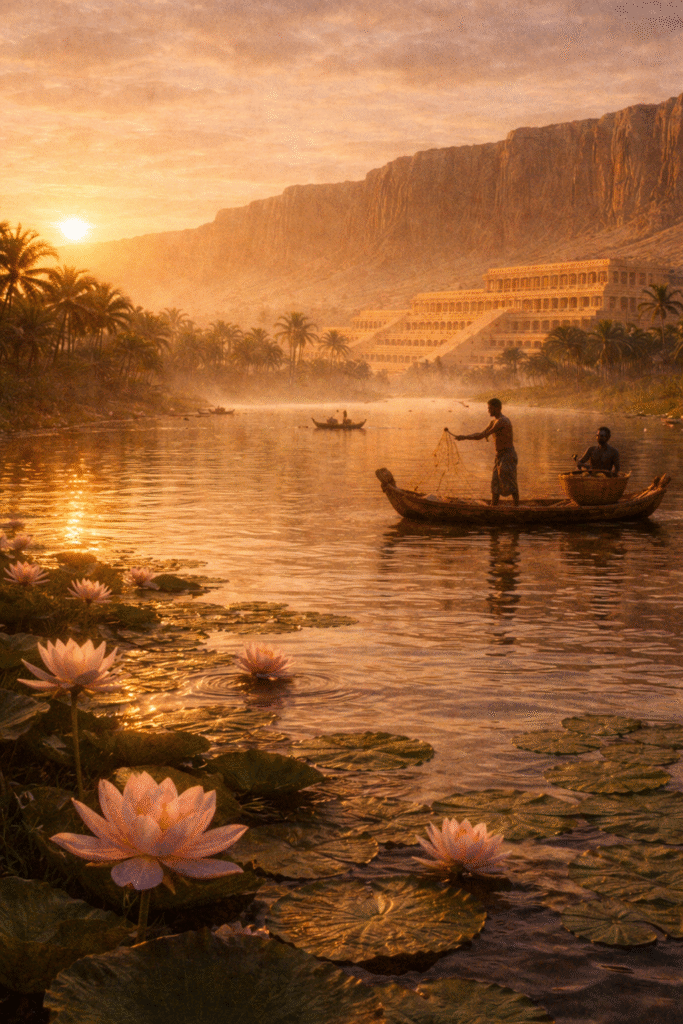
If you have ever risen
before the Nile stirs,
you understand why our ancestors
called dawn a blessing.
Mist clung to the reeds.
The air tasted like cool stone.
Fishermen’s boats
rocked gently at their moorings—
not yet awake enough to drift.
On such a morning,
I took a small craft
from the palace quay
to the far bank of the river.
No royal barge.
No trumpets.
No procession.
Just me,
a single oarsman,
and the scent of wet papyrus.
The oars dipped and rose,
cutting circles into the water
that shimmered behind us like memories.
I looked toward the cliffs—
the same cliffs
that cradled
Deir el-Bahari.
My temple.
My monument to breath and eternity.
The terraces glowed pink
under the first touch of sun,
like a face just awakened.
Each time I saw it,
my chest tightened
with a complicated mix
of pride and something softer.
I had built it
for the goddess.
For the people.
For myself.
But now?
Now I saw it also as something
I might soon have to leave behind.
I touched the cool wooden rail.
“All things flow,”
I whispered to the river.
“Even queens.”
The river,
being a river,
answered only with movement.
PART II — The Days of Harvest
The harvest festivals
during these years
were some of the most joyous
in all my reign.
The Nile had been generous.
The fields near the delta
green and thick.
The grain tall.
The flood predictable.
The people danced
to the beat of wide drums,
anklets jingling,
children weaving necklaces
of blue lotus and reeds.
Families carried baskets
overflowing with onions,
garlic,
bread,
beer jugs,
dates sticky with sugar.
Women sang in rounds,
voices weaving through the air
like birds calling across water.
Even the animals
seemed more content—
cattle chewing lazily,
cats sprawled in shade,
dogs trotting with wagging tails.
Peace has a sound.
It is laughter
unaccompanied by fear.
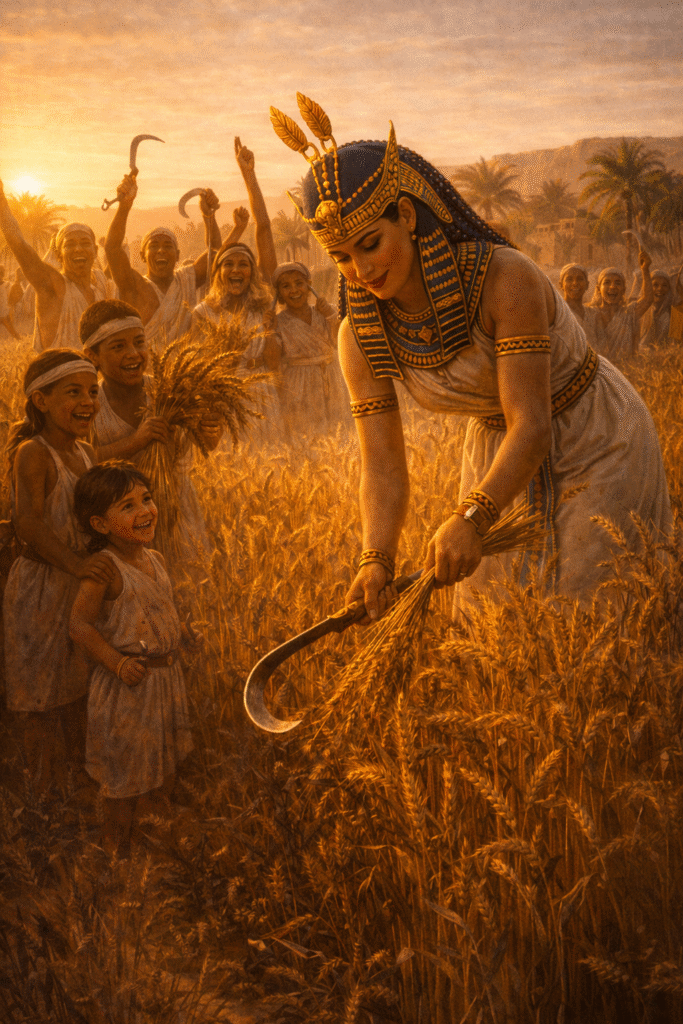
In the royal fields,
I joined the harvesters—
not because it was required,
but because I wanted
to feel the pulse of Egypt
beating in the hands
of those who fed her.
A woman named Merit,
her hair bound with a strip of red linen,
handed me a curved sickle.
“Your Majesty,” she said,
“it brings us luck
when the Pharaoh cuts the first stalk.”
I smiled.
“I should not steal all your blessings.”
“Blessings multiply,” she replied,
pressing the tool into my hand.
So I bent low
and swept the sickle
through tall grain
that whispered as it fell.
The workers cheered.
Children clapped.
Merit wiped her brow
and smiled at me like a sister.
“We remember this,” she said.
“Whatever comes,
we remember.”
It was then
that I understood—
Legacy begins
not with monuments
but with people
who carry your name
in their daily bread.
PART III — Afternoons in the Scupltor’s Hall
During these peaceful years,
I often visited
the sculptors’ hall
near the palace workshop.
The scent there
was always the same—
stone dust,
fresh pigment,
cedar,
and sweat.
Artisans worked
with the devotion
of priests.
I would walk slowly
between rows of statues—
some completed,
some half-shaped,
some still in the imagination
of the sculptor.
One afternoon,
I found an old craftsman
named Menkh.
He sat cross-legged
beside a modest block of limestone,
chiseling a small statue
of the goddess Hathor.
Curious,
I knelt beside him.
“May I see?”
He offered the piece.
The face was serene—
soft cheeks,
full lips,
eyes half-lidded
in gentle power.
“You carve her beautifully,” I said.
He bowed his head.
“I carve her
as I remember her,” he said quietly.
I raised an eyebrow.
“You have seen her?”
“In dreams,” he replied.
“Before sunrise.
And when my wife died.”
There was no jest in him.
Only reverence.
He looked up at me then.
“Majesty,” he said,
voice low,
as if afraid to speak too loudly,
“I wish to carve you.
Not as a king.
Not as a conqueror.
As yourself.”
His words
surprised me.
Most sculptors
preferred to shape me
in full regalia—
false beard,
nemes headdress,
broad collar.
They wanted to capture
the symbol.
He wanted to capture
the woman.
“What would you carve?” I asked softly.
“The way you look,” he said,
“when you think no one sees you.”
I felt him study my face carefully,
like an astronomer
mapping the sky.
That afternoon,
he carved the first lines
of what would become
the most human likeness
of me ever made.
Not divine.
Not glorious.
Not crowned.
Just me.
Years later,
long after my reign ended,
this statue would be hidden
behind a sealed panel
instead of destroyed—
protected by someone
who understood
what Menkh was trying to preserve.
But that is a story
for another scroll.
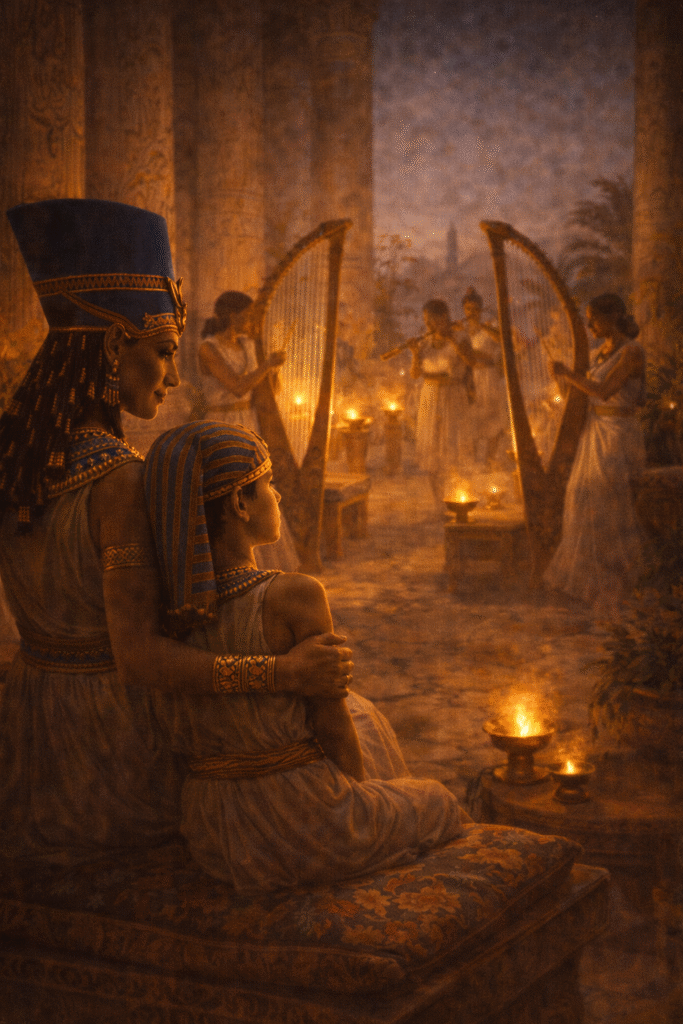
PART IV — Evenings of Music and Incense
As the sun lowered
over the western hills,
the palace
filled with instruments.
Harpists.
Flutists.
Lute players
whose fingers danced
like sunlight on water.
Music drifted
through open windows,
flowing over courtyards
and gardens
and training grounds.
Thutmose often joined
these evening gatherings—
not as a prince
or a co-ruler,
but as a young man
who needed
one hour
that belonged to neither duty
nor destiny.
He sat cross-legged on cushions,
lean and strong,
his expression softening
in the presence of melodies.
One night,
as a singer finished
a love ballad
about two souls divided
by the Nile’s floodwaters,
he leaned toward me.
“You should have a song,” he said.
I raised an eyebrow.
“A song?”
“Yes,” he said.
“Something to honor your years—
your peace—
your strength.”
“There are hymns for that,” I replied.
“Hymns are for gods,” he said.
“You are… more than that.”
It was the closest
he had come to expressing
his affection
in years.
I touched his hand briefly.
“When you are king,” I said quietly,
“you will understand
that silence
is its own song.”
He looked down,
not in shame,
but in comprehension.
We sat together
for the rest of the evening,
listening to flutes weave
through the cooling air.
Sometimes we spoke.
Sometimes we didn’t.
Both were enough.
PART V — The Year of Perfect Floods
In the nineteenth year of my reign,
the Nile performed
a rare miracle:
The flood level
was perfect.
Not too high.
Not too low.
Just right.
Farmers danced
at river’s edge,
praising Hapi
for his generosity.
The high priest
declared it
a sign
of divine approval.
This abundance
allowed Egypt
to complete
three great works
in a single year:
- The southern obelisk pair
finally polished. - A new chapel
in the rear of Karnak
begun. - A second terrace
at Deir el-Bahari
completed with vivid color.
On the opening day
of the new terrace,
I stood on the upper level
and looked down
at crowds gathered
along the colonnade.
Color glowed everywhere—
red, blue, gold,
the palette of eternity.
Priests chanted.
Women threw lotus blossoms.
Children waved palm fronds
with reckless joy.
As the sun reached zenith,
it struck the painted walls
at the perfect angle,
and for one instant,
the entire terrace
shone
as if lit
from within.
I closed my eyes.
This—
this moment—
was peace.
Not the absence of conflict.
The presence of alignment.
Egypt
in harmony
with itself.
I knew
I would not keep this forever.
But that did not diminish
its beauty.
PART VI — A Modern Traveler’s Last Full Sun
Now, traveler—
let me bring you
into this moment.
Stand at Deir el-Bahari
in late afternoon
when the cliffs glow amber
and shadows stretch long.
Close your eyes.
Feel the warmth
on your forehead.
Hear the faint echo
of long-ago chanting.
Smell the perfumed air
of ancient incense.
This is what
her last full sun
felt like.
A peace
so complete
you only notice
how delicate it was
in hindsight.
If you pause long enough,
you might feel
the soft breath of a world
that had not yet begun
to take her name back.
A world
that still adored her.
A world
that believed
things would always remain
as they were.
Even though they wouldn’t.
If this peace
has touched you—
if you’ve felt the glow
of a moment you knew
could not last forever—
then you understand
this Scroll.
Walk with us
to the terraces of Deir el-Bahari.
Stand in the harvest fields.
Drift along the morning Nile.
Listen to the music
in the palace courtyards.
Let us show you
her Egypt
at its most beautiful.
Journey with ENA.
Let the last full sun
warm you too.
PART VII — The Quiet Realization
It was during one of these peaceful years
that I first noticed
how deeply
Thutmose had changed.
Not in height
or strength
or command—
those had been visible.
It was his eyes.
He studied the world
as a man does
when preparing
to inherit it.
During councils,
he leaned forward now,
elbows on knees,
brows furrowed
in concentration.
During rituals,
he spoke the invocations
with a confidence
that no longer echoed mine.
During diplomatic meetings,
he listened
with the calm intensity
of a strategist.
One evening,
after a long meeting
with the treasury officials,
he walked beside me
down a corridor.
“I could take on more,”
he said suddenly.
I knew
what he meant.
And I also knew
he wasn’t asking
out of impatience.
He was asking
because he was ready.
“Yes,” I said.
“You could.”
He exhaled—
not in relief,
but in acceptance.
Then he asked:
“Do you worry for what comes
after you?”
I stopped walking.
The air felt still.
“No,” I said truthfully.
“I worry for what comes
for you.”
He blinked,
surprised.
“Why me?”
“Because you will inherit
the burden
of my choices.”
He lifted his chin slightly.
“I carry them willingly.”
“I know,” I said.
“And that is why
you will be
a better king
than many expect.”
The faintest smile
touched his mouth.
But behind it
was a sadness
I did not yet understand.
Not fully.
But I would.
PART VIII — The Last Sunset Without Unease
I remember
one sunset
with painful clarity.
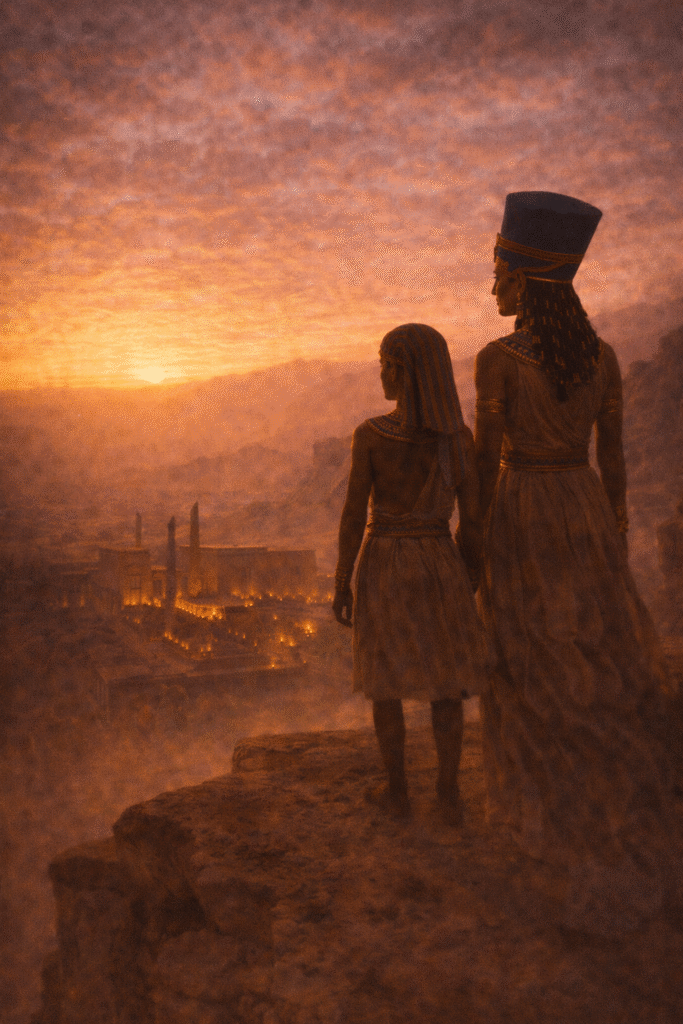
We were on the western hills
above the temple—
Thutmose and I—
overlooking the terraces
of Deir el-Bahari.
The cliffs glowed
like burning honey.
The valley
spread below
in shades of gold and rose.
Thutmose stood beside me,
arms folded,
eyes narrowed at the horizon.
“You built well,” he said quietly.
“I built for eternity,” I replied.
He tilted his head slightly.
“Nothing lasts forever.”
“Stone tries,” I said.
He glanced at me—
half amused,
half reverent.
“You know,” he said,
“they will remember you.”
“Yes,” I answered,
“but not always kindly.”
He was silent for a while.
Then he said something
I did not expect:
“I will remember you kindly.”
The cliffs swallowed his words,
but the air held them.
That was the last sunset
we shared
without unease.
The last
before our roles
began to diverge
in ways neither of us
could stop.
The last
before the veil,
already thin,
began to lower in earnest.
But in that moment—
the moment of pure sun—
we were simply
two rulers
watching Egypt breathe.
Just a queen.
Just her successor.
Just two hawks
sharing the same sky
a little longer.
PART IX — The Ancient Questioner’s Desk
A novice once asked a temple scribe:
“Were Hatshepsut’s last years unhappy?”
The scribe replied:
“No.
They were tender.”
Another asked:
“Did she know the end was coming?”
He answered:
“She knew the light
would one day soften.”
A traveler wondered:
“How did Egypt feel in those years?”
The historian wrote:
“Like a song
held on its last perfect note.”
A final question came:
“What was her greatest gift in that time?”
The scribe smiled:
“Peace—
given fully,
held gently,
released wisely.”
The Scroll ends here…
in golden light
and quiet breath.
If you felt the warmth
of these years,
if you walked with her
through harvest fields,
if you stood with her
on the cliffs at sunset…
then you carry
the memory of her peace.
Come walk the places
where her last full sun
still shines.
Come feel the Egypt
she knew
before the shadows deepened.
Journey with ENA.
Let the last full sun
touch you, too.