
Scroll XIX – The Quiet Before the Ruin
Year: 1443 BCE — Waset (Luxor), The Palace of the Southern Sanctuary, Karnak, and Deir el-Bahari
Translated and restored for the modern traveler.
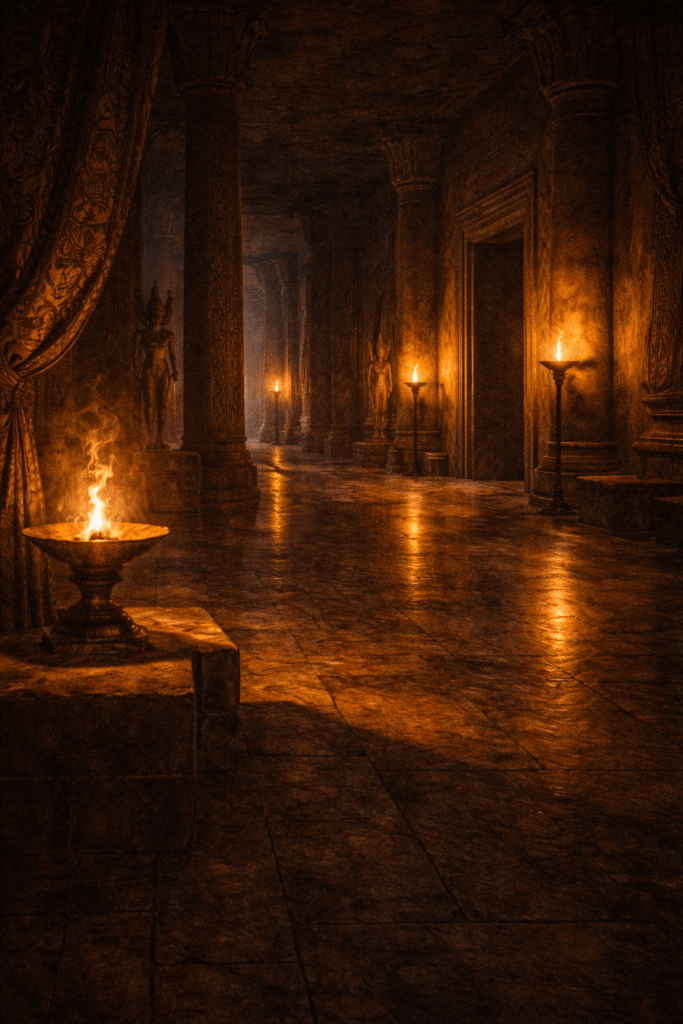
Prologue — A Palace That Forgot to Breathe
Before ruin comes noise—
cracks, shouts, breaking stone,
the loud collapse
of what once stood firm.
Before ruin,
comes quiet.
The kind of quiet
that does not soothe,
but unsettles.
A quiet of withheld breath.
Of turned glances.
Of doors that close
just fast enough
to pretend they were never open.
It was during this quiet
—this elegant,
terrifying quiet—
that I understood:
History does not erase in storms.
It erases in stillness.
This scroll is the stillness.
PART I — The Bow of Polite Distance
It began with a bow.
A bow done correctly,
slowly,
with perfect ceremonial form.
But with no heart.
The kind of bow
that shows respect
only because tradition demands it,
not because the man performing it
still feels the instinct to offer it.
The noble’s name was Sedjem.
He had once greeted me
with genuine warmth—
a man proud to serve his queen.
But now,
as he approached me
in the audience hall,
his bow felt mechanical.
His spine bent.
His head lowered.
His hands crossed.
Everything perfect.
And yet—
his eyes never met mine.
They flicked past me
toward the doors
to the council chamber
where Thutmose would soon appear.
He waited.
Not for my approval.
For his.
I dismissed him calmly.
Inside,
something ached
—not from hurt,
but from recognition.
The court had started
to re-tune itself
to a different frequency.
A different center.
A different sun.
PART II — The Corridor of Half-Conversations
A palace is never silent.
Not truly.
Its walls carry whispers:
scribes arguing over ink,
servants gossiping about nobles,
guards murmuring as they shift position.
But in these months,
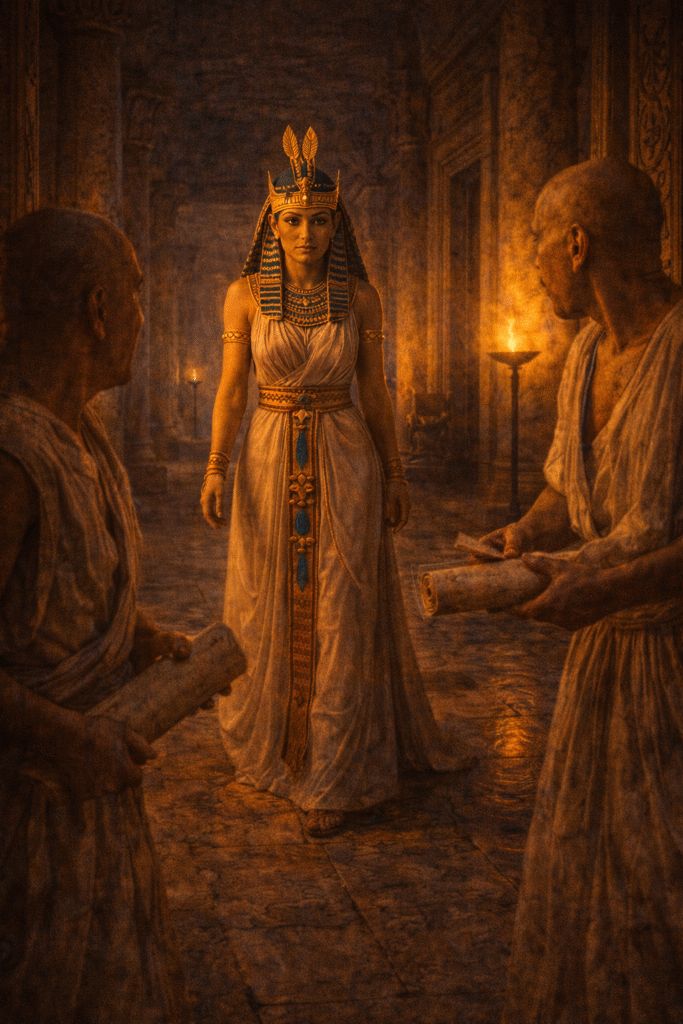
I began to walk corridors
where conversations stopped
just a little too late.
Voices hushed
not because of reverence—
but because of danger
they believed was near.
One afternoon,
as I walked toward the council chamber,
I heard two scribes:
“…if the young king approves,
the allocation will—”
The moment they saw me,
they froze.
The older scribe
bowed deeply,
hands trembling.
“Majesty,” he said quickly,
“we were only discussing—”
“I know what you were discussing,”
I said softly.
He swallowed,
deflated.
Not rebellious.
Not cruel.
Afraid.
Afraid of being caught
aligning too early
with the new center of power.
Afraid of being caught
aligning too late.
PART III — The Meal Trays That Shifted in Order
It was a small thing.
But small things reveal everything.
For years,
my meals were prepared first—
as custom dictated.
The Pharaoh receives
before the co-ruler.
The sovereign
before the successor.
Then one evening,
as I entered the royal dining court,
I noticed something subtle:
A servant
carrying two trays.
The first tray—
carefully arranged,
fresh bread and roasted fish,
dates glistening with honey—
he placed at Thutmose’s seat.
The second tray—
mine—
came seconds later.
No disrespect.
No insult.
Just…
sequence.
“Why does the young king’s meal
go first?” I asked.
The servant flinched.
“Majesty,
the kitchen said—
they said—
it is easier
to carry the heavier tray first.”
A lie.
The trays weighed the same.
What had changed
was the instinct
of the palace.
They were preparing for a world
in which Thutmose’s needs
would always come first.
And they were practicing early.
PART IV — The Petitioners Who Waited for Another
Petitions were once brought to me—
matters of land,
inheritance,
family disputes,
canal repairs,
temple grievances.
But gradually,
people began asking:
“Should we present this
to His Majesty Thutmose instead?”
The first time I heard it,
it stung.
The fifth time,
it chilled.
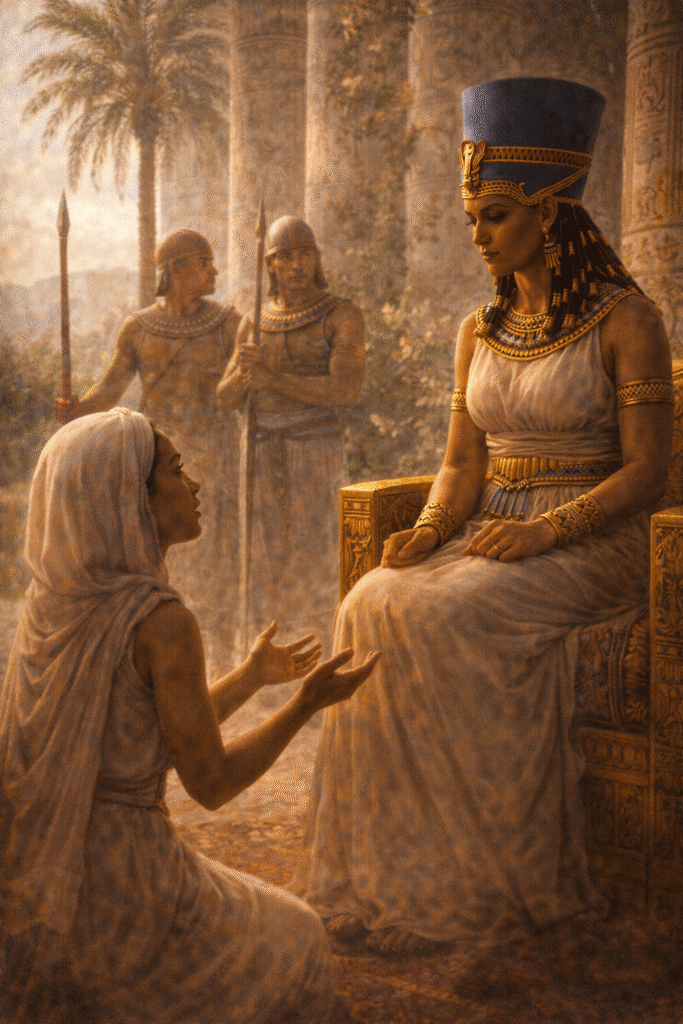
A woman from the Delta
came with a complaint
about a corrupt landlord.
She knelt before me,
hands wringing her linen shawl.
“What troubles you?” I asked.
She hesitated.
“Majesty…
I was told
the young king
handles matters of justice
with…
more speed.”
Her eyes flicked up in fear.
“I mean no offense.”
I reached gently
and touched her shoulder.
“You offend none,” I said.
“You speak truth
as you were told it.”
Her body sagged in relief.
I resolved her case
in a single afternoon.
But the unspoken message
hung in the air:
Justice is shifting rooms.
PART V — The Priests Who Polished Only One Throne
In the grand festival hall,
two thrones stood side by side.
Mine—
larger,
older,
carved with the stories
of my reign.
Thutmose’s—
newer,
smaller,
but increasingly central
in the minds
of the priesthood.
Normally,
both thrones
were polished
before ceremonies.
But one morning,
entering early,
I found three priests
polishing only one.
Not mine.
The smaller throne
glowed with gold and oil,
its surface shining
as if awaiting
the rising sun.
My throne
sat untouched.
I stepped closer.
“Has something changed
in the ritual?”
The priests froze.
“No, Majesty,”
the eldest said.
“We simply…
started with his throne today.”
“And will you finish mine?”
“Of course, Majesty.”
But the truth
was already carved
into the moment.
In their minds,
they had begun
choosing the order
of importance.
A small thing.
But thrones
have long memories.
PART VI — The Rooms That Remembered Our Distance
Thutmose and I
still met often.
Still ruled together.
Still shared councils.
Still shared
moments of quiet reflection
in the gardens.
But something
had shifted.
Not hostility.
Not resentment.
Distance.
The distance
that comes
when two rivers
flow parallel
but no longer converge.
One afternoon,
during a meeting
with governors from the south,
Thutmose answered
a question
before I opened my mouth.
Not rudely.
Not arrogantly.
Reflexively.
The governors
nodded to him first.
Then slowly,
almost ceremonially,
to me.
As if I were
the second thought
after the answer.
Later
in the corridor,
Thutmose caught up with me.
“holy mother,”
he said quietly,
“I meant no disrespect.”
“I know,”
I answered.
“But some rooms
now believe
you are meant
to speak first.”
He lowered his gaze.
“And do you believe that?”
“No,”
I said.
“I believe
that Egypt is teaching me
to listen
to my ending.”
PART VII — Deir el-Bahari at Dusk
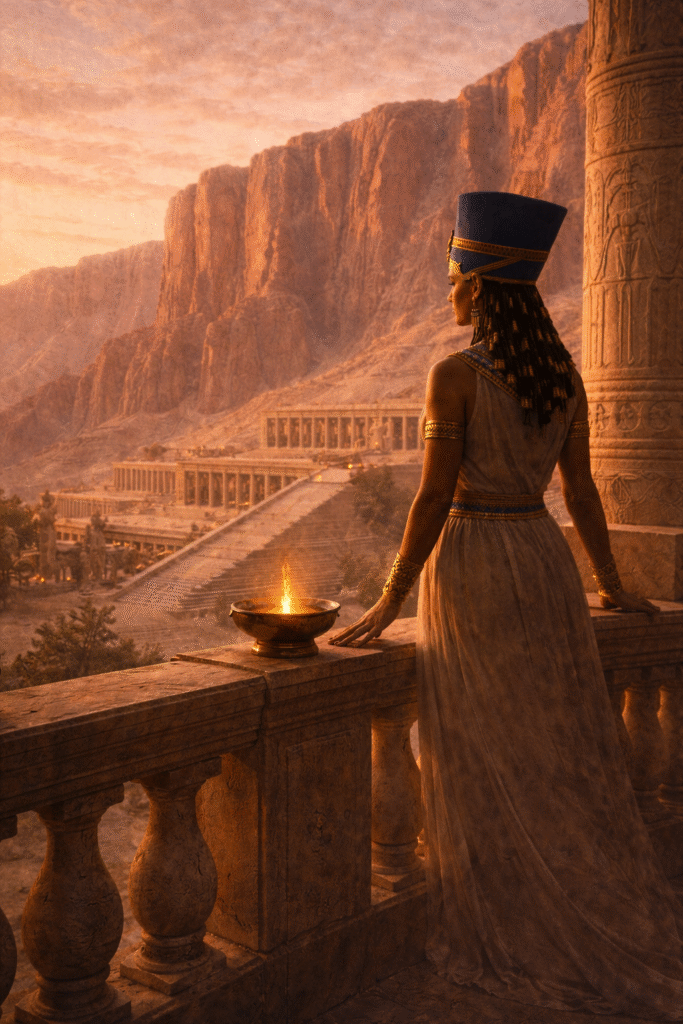
During these strange months,
I often retreated
to Deir el-Bahari at dusk.
Not to oversee repairs.
Not to greet priests.
Not to inspect reliefs.
To breathe.
The cliffs
turned rose-colored
each evening.
The terraces glowed
like embers.
The air cooled
and softened.
There,
alone among the columns,
I could hear myself
without the distortion
of court.
One evening,
as I walked
the upper colonnade,
I placed my hand
against a limestone column.
It felt cold.
Not empty—
stone never is—
but indifferent.
Once,
these walls
sang my name
in color.
Now,
they held their breath.
Waiting.
Preparing.
I realized then:
It was not
that the world
was turning against me.
It was turning
toward him.
And that
is a different kind of grief.
Not betrayal.
Not loss.
Transition.
PART VIII — The Inquiry That Was Not Asked
One day,
a scribe hurried into my chamber.
He bowed deeply.
“Majesty,
the general of the western garrison
requests approval
for a new defensive schedule.”
“Then bring me the scroll.”
He hesitated.
“It was delivered…
to His Majesty Thutmose first.”
I felt
the smallest ripple
beneath my ribs.
“Why?” I asked.
“Majesty,
the messenger said
the general assumed
the young king
would handle all matters
of defense.”
“Assumed,”
I repeated.
“Yes,”
the scribe whispered.
“Assumed.”
A kingdom
stands on assumptions.
Change those assumptions,
and the kingdom
reshapes itself.
Without decree.
Without sign.
Without ceremony.
Just…
shift.
PART IX — The Modern Traveler in the Silent Court
Traveler,
when you stand
in Luxor Temple
or Karnak
or the palace reconstruction halls…
you may think
these places once echoed
with loud decisions.
Some did.
But many
—too many—
were decided
in silence.
Walls don’t remember noise
as well as they hold
the shape of hesitation.
When you walk with us,
listen for:
- the rooms where officials paused
before speaking - the courtyards
where bows became calculation - the hallways
where gossip died
the moment a queen approached - the thrones
polished in the wrong order - the places
where destiny shifted
without raising its voice
Egypt’s history
is not just war and monuments.
It is the silence
between footsteps.
If you’ve ever felt
a room grow colder
not because of weather
but because of politics—
If you’ve ever sensed
people waiting
for someone else to speak
before you—
If you’ve felt
the air tighten
as a world slowly reorients
around another—
Then you understand
this Scroll.
Walk with us
to the silent chambers,
the still courtyards,
the walls that held
the quiet before the ruin.
Journey with ENA.
Some truths
are spoken only in stillness.
PART X — The Scribe Who Told the Truth Quietly
One night
—late,
the palace empty—
a scribe came to me.
He was young.
Hesitant.
Hands stained with ink.
He bowed deeply.
“Majesty,”
he whispered,
“I fear the court
is rearranging itself
in ways
you may not see.”
“I see,”
I said softly.
“More than they think I do.”
He looked relieved—
and devastated.
“Majesty…
they wait for the young king
before they finalize anything.
Even matters
you yourself approved.”
“I know.”
He swallowed.
“And some scrolls
that bear your seal
are…
being held
until they see
whether he concurs.”
A flicker of warmth
touched his face—
the warmth of honesty
spoken at personal risk.
“I thought you should know,”
he whispered.
“Thank you,”
I said.
“You are loyal.”
He shook his head.
“I am afraid, Majesty.
And fear
makes honesty
feel like loyalty.”
He bowed and left.
And I understood:
The ruin was not coming
in the form of swords
or coups
or rebellion.
It was coming
in the form
of polite, silent,
incremental preference.
The quiet
had become
direction.
PART XI — The Last Evening Before the Shift
There came an evening
when Thutmose joined me
on the rooftop terrace.
The city lights
glimmered along the Nile.
The air smelled
of lotus and dust.
We stood together
for a long time
without speaking.
Then he said:
“They look to me now.”
“Yes,”
I answered.
“They come to me
with questions
they once brought
to you.”
“Yes.”
He swallowed.
“I did not ask for this.”
“I know,”
I said.
“But you did not refuse it.”
He looked at me sharply.
“Should I have?”
“No,”
I answered.
“The Nile does not apologize
for flowing forward.”
Silence.
Then—
softly:
“Will you hate me for this?”
I turned to him fully.
“I could never hate you.”
“But you hurt.”
“I hurt because the world shifts,
not because you rise.”
He looked away,
eyes shining
with something
he tried to hide—
not triumph,
but grief.
“holy mother,” he whispered,
“what comes next?”
I looked at the horizon.
“The quiet,”
I said,
“before the ruin.”
He closed his eyes.
We stood there
until the sun set.
Two shadows lengthening.
One future rising.
One past preparing.
PART XII — The Ancient Questioner’s Desk
A pupil asked:
“Did they overthrow her?”
The historian replied:
“No.
They simply looked around
and realized
they already had.”
Another asked:
“Was Thutmose cruel?”
The scribe answered:
“No.
He was inevitable.”
A traveler wondered:
“Why does silence scare rulers?”
The old master wrote:
“Because silence
is the sound
of shifting loyalty.”
A final question came:
“What is the quiet before the ruin?”
He smiled sadly.
“It is the moment
when the world
still calls you ‘Majesty’
but no longer means it.”
The Scroll ends here—
not in collapse,
not in violence,
not in betrayal.
In stillness.
In courtyards
where footsteps soften
when you approach.
In hallways
where conversations die
half a second late.
In temples
where your throne
shines second.
If you felt that chill—
if you’ve ever sensed
people waiting
for a world
you were no longer part of—
then you know this moment.
Walk with ENA
to the places
that remember this quiet.
Some ruins begin
long before the walls fall.