
Scroll XIII – The Shadow at Court: Whispers Behind the Columns
Year: 1456 BCE — Waset (Luxor), Karnak and the Royal Palace
Translated and restored for the modern traveler.
Prologue — When Sunlight Turned Thin
The crisis of a reign
never begins with a shout.
It begins with a quiet shift—
a moment so subtle
that the untrained eye
mistakes it for nothing.
A hesitation in a greeting.
A pause in a priest’s chant.
A noble who bows
a fraction too shallow.
A general whose messenger arrives
too late
and with too many excuses.
These are not rebellions.
These are tremors.
And tremors become
what mountains become
when the earth decides to move.
This is the Scroll
of the year I learned
that the foundations beneath my rule
were not as solid
as the obelisks I raised.
It is not the Scroll
of my fall.
That comes later.
This is the Scroll
of the moment I realized
that shadows had learned
to speak with voices
louder than light.
PART I — The Day the Priests Hesitated
The first sign
came from the priests of Amun.
Not in their prayers,
which remained smooth,
practiced,
unbroken.
But in the moment
after the incense was lit
and before the hymn began.
A pause.
A breath.
A silence so slight
a visitor would miss it.
But I was no visitor.
I had been raised
within temple corridors,
had walked their sanctuaries
since girlhood.
I knew the rhythm of ritual
the way a harpist knows the strings.
This pause
was not part of the song.
I said nothing.
Not then.
But I watched.
And the next morning,
when the priests processed
with the barque of Amun
through the court of the festival,
I noticed something else:
The high priest’s eyes
slid toward Thutmose
more often
than they slid toward me.
Not in open preference.
Not in rudeness.
In calculation.
A shifting of gravity
so small
only the ones most sensitive
to balance
could feel it.
I felt it.
The oracle’s warning
stirred in my bones.
PART II — Whispers Behind the Carved Kings
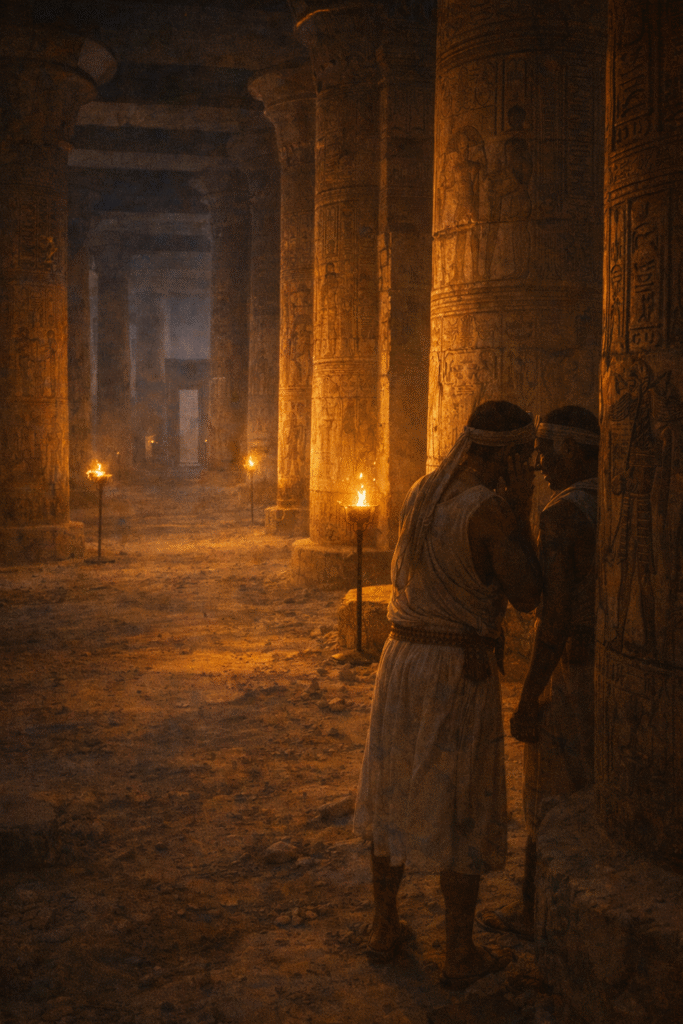
Karnak’s Hypostyle Hall
is a forest of giants.
Columns rise like cedar trunks
carved from stone,
casting shadows
long and cool
across the temple floor.
It is a place
where whispers travel slowly
and die quickly.
Except when they are meant
to be overheard.
One afternoon,
after meeting with the temple astronomers,
I walked alone
through the southern colonnade.
Sunlight filtered through the clerestory,
falling in stripes of gold
on dust and stone.
I paused near a column
carved with the image
of Thutmose I,
my father,
smashing enemies
beneath his sandal.
A fitting place
to gather my thoughts.
Then—
voices.
Low.
Urgent.
Barely audible.
“…she will not step aside…”
“…the boy grows stronger each season…”
“…the generals talk among themselves…”
“…Amun’s will is not forever clear…”
Not soldiers.
Not foreign envoys.
Not merchants.
Priests.
High-ranking ones.
I did not move.
If I stepped into view,
they would bow
and smother their whispers
beneath obedience.
Instead,
I listened.
“…if the god shows a sign—
a real sign—
the people will not resist…”
“…but she commands the court…”
“…commands the stories…”
“…commands the very stone…”
“…stone can be cut…”
My hand tightened on my staff.
Not in fear.
In the sharp, cold clarity
that comes when truth
reveals itself without ceremony.
They were not planning a coup.
Not yet.
They were planning
a world in which I was no longer
the center of gravity.
And planning
is the shadow
from which action emerges.
When the voices quieted,
I stepped into the open
deliberately loud.
The priests turned
as though stung,
bowing deeply.
“May Amun bless you,”
the eldest said,
his voice steady.
But his eyes
could not hide their surprise.
Or their tension.
Or their questions.
“May he bless us all,” I replied.
And I walked past them
with the calm
of one who knows
that shadows grow longest
when the sun
is beginning to lower.
PART III — The General Who Forgot Respect
The army had always been loyal.
It was the gift of my father,
Thutmose I,
whose campaigns carved Egypt
into the empire it became.
His veterans respected me
as the daughter of a warrior
and the leader
who brought prosperity
instead of endless war.
But armies are practical.
They do not worship history.
They worship strength.
And one afternoon,
during a council of war
regarding a minor rebellion
near Sinai,
I saw the first crack.
Commander Hapu,
a thick-shouldered man
with a jaw like carved granite,
entered the council chamber
without lowering his gaze.
Protocol demanded
that he bow to me
first.
Instead,
he bowed quickly to Thutmose.
Then he bowed to me.
Not shallowly.
Not rudely.
But second.
The room shifted.
Scribes froze.
Officers stiffened.
Thutmose inhaled sharply,
as if realizing too late
that he had become
a symbol
without intending it.
I said nothing.
But after the meeting,
as we walked together
through the palace colonnade,
I turned to him.
“Your commander,” I said quietly,
“forgets the order of things.”
Thutmose looked away.
“He respects you,” he said.
“He simply sees me
growing into my position.”
“And does he see me
growing out of mine?” I asked.
Thutmose did not answer.
He did not need to.
The silence was enough.
PART IV — The Night the Messenger Arrived Late
One evening,
as the palace lamps flickered
and the scribes dimmed their wicks,
a messenger arrived
from the northern frontier.
Drenched in sweat,
sand caked to his sandals,
he knelt before me
with a scroll.
“Forgive the delay, Majesty,” he said.
“The report was…
intercepted.”
“By whom?” I demanded.
He hesitated.
“General Rahotep’s scribe
kept it back
for review
before release.”
Thutmose stiffened beside me.
“That is not protocol,” he said.
“No,” I answered.
“It is not.”
The messenger swallowed.
“He said…
that matters of war
should be weighed
by the rightful king.”
He meant Thutmose.
Not me.
Not the ruling Pharaoh.
The words
landed like a stone
in my chest.
Thutmose looked horrified.
“holy mother,” he whispered,
“this was not my doing.”
“I know,” I said.
And I did.
But intent
does not erase implication.
Later that night,
alone in my private chambers,
I unrolled the intercepted scroll.
The ink was fresh.
The handwriting neat.
The contents clear.
A minor skirmish.
A small victory.
Nothing dangerous.
But the fact
that they had withheld it—
That was the danger.
Not the message.
The act.
Power
is often stolen
not through rebellion
but through small rearrangements
of information.
Control the flow—
control the throne.
PART V — The Shadow in the Hall of Mirrors
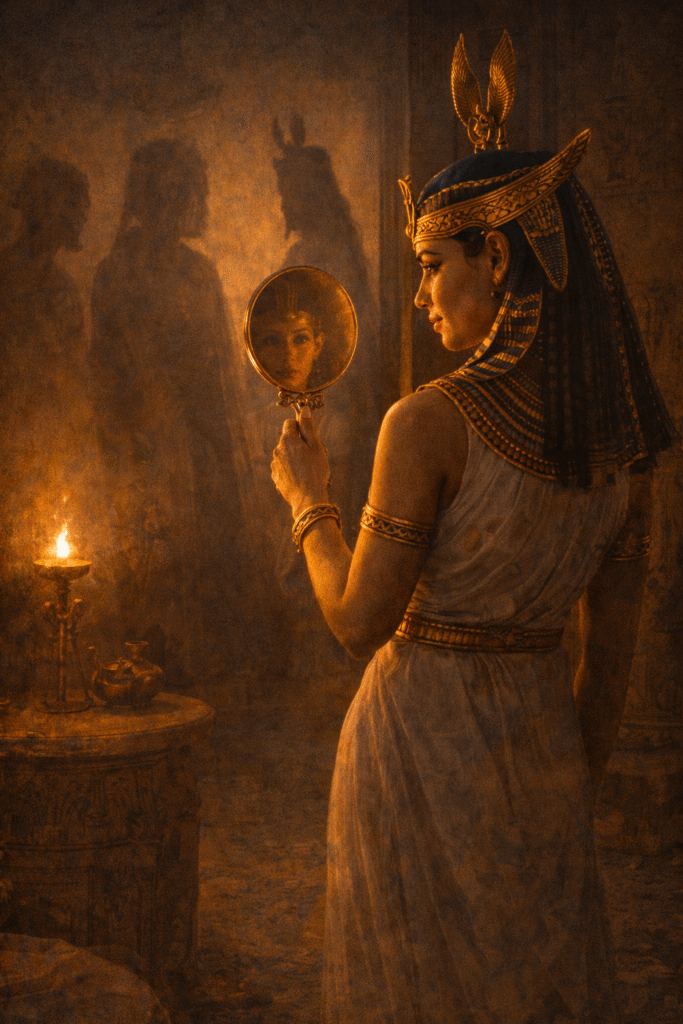
The palace mirrors
are not like your modern glass.
They are polished copper—
soft, warm, imperfect.
They warp the face slightly,
stretching the truth
just enough to remind you
that you are being watched
through someone else’s eyes.
One evening,
while preparing for a council,
I looked into such a mirror
and saw behind me
the faintest flicker of movement.
When I turned,
there was nothing.
But the feeling
did not leave me.
I began to walk more slowly
through the palace halls.
Listened for footsteps
that ceased
just when mine did.
And gradually,
I realized:
I was being observed.
Not by spies.
Not by assassins.
By opportunists.
Men who wanted to know
whether the oracle’s warning
was beginning to unfold.
Men who watched my posture,
my breath,
the way I lifted my hand
during ceremonies.
Men who measured me
not with reverence
but with calculation.
A queen
is never more alone
than when her throne
is still stable
but her future
is being studied
like prey.
PART VI — Thutmose Begins to See
It is easy to think
that Thutmose encouraged
the whispers.
He did not.
Not then.
He saw them
and was troubled by them.
One afternoon,
after the generals’ council,
he sought me out
in the garden of sycamores.
“holy mother,” he said,
voice low,
controlled,
“I do not want them
to speak of you as if—”
“As if I am temporary?” I finished.
He inhaled sharply.
“Yes.”
I studied him.
He was young,
but no longer a child.
He had the shoulders
of a soldier
and the eyes
of a man beginning to understand
how power shifts
with or without consent.
“Thutmose,” I said,
using neither his title
nor mine,
“you cannot stop the wind.
You can only choose
how you stand in it.”
He clenched his jaw.
“I stand with you,” he said.
“I know,” I answered.
“But you are also the future.”
He shook his head.
“That is not what I asked to be.”
“But it is what you are.”
And for the first time,
I saw fear in him.
Not fear of me.
Fear of the role
the world was forcing upon him.
Fear
that he might someday become
the blade
that cuts the name
of the one who raised him.
Fear
that destiny
is not kindness.
PART VII — The Festival of Half-Voices
The next Festival of Opet
was the moment
the shift became undeniable.
As Thutmose and I
processed through Karnak
side by side,
the crowd cheered
as always.
But now,
the cheers
were uneven.
Where last year
my name rose louder,
now his name
wove through the voices
with increasing strength.
Not rebellion.
Not rejection.
Just…
redistribution.
People love stability.
But they also love
the certainty
of tradition.
And Thutmose
was tradition’s child.
In the great hypostyle hall,
as the columns swallowed the procession,
a noble bowing before me
let his eyes slip past me
to Thutmose
just a heartbeat longer.
A priest of the inner sanctum
whispered a blessing
to the “future king”
loud enough for all to hear.
A general tapped his fist
to his chest
toward Thutmose
before repeating the gesture to me.
Small things.
All small.
But together—
a pattern.
Shadows behind columns.
Whispers carried
on limestone dust.
A shift
not yet spoken
but already felt.
PART VIII — The Night the Stars Refused Silence
After the festival,
I went to the rooftop
where the skywatchers
kept vigil.
The night was clear.
Cool.
Sharp with possibility.
I looked at Sopdet—
Sirius—
the star of kingship
and resurrection.
She shone brightly.
But something in her light
felt brittle.
“You feel it too,”
said a voice behind me.
Thutmose.
He joined me,
standing at the parapet.
“I feel…”
he hesitated,
searching for a word
that did not betray
his own rising power.
“…a change.”
“Yes,” I said quietly.
“It is beginning.”
He turned to me.
“Do you fear it?”
I shook my head.
“I fear nothing
that truth brings.”
He swallowed.
“And what is the truth?”
“That Egypt
does not stand still.”
He bowed his head.
“Then what becomes of us?” he asked.
I looked up
at the stars
that had watched
a thousand reigns.
“We become
what we must.”
He breathed out slowly,
the weight of fate
settling into his shoulders.
For a long moment,
neither of us spoke.
The sky did the speaking.
It said:
Nothing lasts forever.
Not even queens.
Not even the absence of war.
Not even the protection
of those who love you.
But it also said:
Legacy
is not the same
as possession.
And that,
I think,
was the lesson he needed.
Perhaps the lesson I needed too.
If you can feel the tremor—
the subtle shift
in hallways
and hearts
and the balance of power…
then you understand
the truth of this Scroll.
Come walk the columns of Karnak
where whispers once traveled
like desert wind.
Let us show you
the corners where shadows gathered,
the halls where destinies
were weighed
without ceremony.
When you’re ready to witness
the quiet turning of an empire—
walk with ENA.
PART IX — The Scribe Who Warned Me Without Words
One evening,
as I reviewed tax records
in the palace library,
a senior scribe
approached my table quietly.
He did not speak.
He simply placed
a small wooden writing palette
on the table
and bowed.
I frowned.
The palette was old—
older than him,
older than me.
Upon it,
in faded hieratic script,
were four words:
“Silence hides sharpened reeds.”
An old proverb.
It meant:
The quiet ones
are the ones to watch.
I looked at the scribe.
His eyes
held sorrow.
Not rebellion.
Not fear.
Warning.
He bowed again
and left without another word.
I understood.
The danger
was not loud.
It did not shout.
It did not pound fists.
It did not proclaim intention.
It whispered.
And whispers
build worlds
faster than shouts.
PART X — The Shadow Steps Forward
The turning point
came in the Hall of Columns
during a council of temple officials.
The high priest of Amun,
an old man with skin like dry papyrus,
lifted his staff
and addressed me:
“Great Daughter of Amun,” he said,
“your reign has been blessed
with peace,
prosperity,
and divine approval.”
A murmur of agreement
swept the hall.
“But,” he continued,
“the god may now be preparing
a new shape
for the future of Egypt.”
The hall changed temperature.
Every official
felt the shift.
My heart
did not race.
It stilled.
“What shape does the god propose?” I asked,
voice steady.
He turned to Thutmose.
One man.
One gaze.
One gesture.
But it was enough.
“It is time,”
said the high priest,
“for the young falcon
to spread his wings.”
Thutmose stiffened,
as shocked as I was.
This was not his doing.
But the shadow
had spoken.
Not in secret.
Not in whispers.
In public.
In ritual.
In the house of Amun.
And the room—
the entire room—
leaned toward him
as if gravity itself
had shifted.
I stood tall.
“As long as I live,” I said,
“I serve the throne of Egypt.”
A priest in the back
bowed his head.
“That,” he murmured,
“is what we fear.”
And I knew:
The shadow
was no longer behind the column.
It stood in the hall
with a voice
and an audience.
PART XI — The Traveler Standing Where Shadows Grew
Now, traveler—
when you stand in Karnak’s halls,
especially near the southern court
where officials once met,
you may feel
a strange heaviness.
Not sadness.
Not anger.
Anticipation.
These walls remember
not only victories
and festivals
and triumphs—
but moments
when power shifted
as quietly
as sand beneath a chariot wheel.
Stand between the columns.
Close your eyes.
Listen.
You may hear
the echo of whispers.
The rustle of linen.
The cool breath
of a truth
that does not shout.
You may feel
the space tighten around you
as a hall full of men
turns their attention
from a queen
to a hawk.
You may feel
history tilt.
This is not ruin.
This is revelation.
PART XII — The Ancient Questioner’s Desk
A novice asked a historian,
“When did Hatshepsut lose control?”
The historian replied:
“She did not lose it.
Others began to reclaim
what had never been fully theirs.”
Another asked,
“Did the priests betray her?”
He answered:
“They followed the wind.
The wind changed.”
A traveler wondered,
“Did Thutmose want her gone?”
The scribe wrote:
“He wanted to rise.
He did not wish her to fall.”
A final question came:
“What is a shadow at court?”
The scholar smiled:
“It is a truth
that grows
when light grows thin.”
The Scroll ends here…
but the shift it describes
echoes forward
into every chapter that follows.
If you felt the tension,
the whispers,
the shifting devotion…
if you sensed the moment
when a throne
stood between two destinies…
then you understand
the cost of power
and the beauty of legacy.
Come walk the halls
where shadows grew.
Stand where decisions
were not spoken
but understood.
See Egypt
not as stone and ruin,
but as a living story
still unfolding beneath your feet.
Journey with ENA.
Some truths can only be learned
in the places where whispers lived.