
Scroll XII – The Boy Who Would Be King: My Years with Thutmose III
Year: 1458 BCE — Waset (Luxor), Palace of the Southern Sanctuary
Translated and restored for the modern traveler.
Prologue — Two Hawks in One Sky
There is a proverb
whispered by old falconers
in the villages near the desert edge:
“Two hawks cannot circle the same sun forever
without learning one another’s shadow.”
This was the truth
that shaped my years with Thutmose III.
I have been many things in my life —
daughter of a king,
wife of a king,
queen,
regent,
pharaoh.
But of all my roles,
none has been as misunderstood
as the years I spent guiding
the boy who would one day inherit
both my kingdom
and my silence.
This Scroll is not confession.
It is not justification.
It is memory.
Memory of a child placed in my arms
when the world expected me
to shape him gently
until he could rule.
Memory of a youth
whose discipline sharpened
faster than his patience.
Memory of the moments
we understood each other,
and the moments
we could not.
Memory of the years
when we ruled side by side,
two hawks circling the same sun,
our shadows long across Egypt.
PART I — The Child in My Care
The first time I held Thutmose III,
he was small enough
to fit in the cradle of my arm.
His father — my husband-brother,
Thutmose II —
had died too soon,
leaving a child-king
whose head could barely support
the weight of the crowns
the priests placed upon it.
When they brought him to me,
his eyes were wide,
dark,
uncertain.
A child who understood
only that the world
had suddenly become larger
than his small body could navigate.
I lifted him gently,
feeling the fragile warmth
beneath the linen.
“Do not fear,” I whispered.
“I am here.”
He would not remember this moment.
But I would.
Because this was when
my path and his
became bound.
Not by blood.
Not by affection alone.
But by duty.
Egypt needed a hand
stronger than a child’s.
And so, for a time,
I became that hand.
PART II — The Boy in the Courtyard
As the years passed,
the boy grew into himself
with surprising speed.
He was not soft.
Not hesitant.
Not timid.
He had inherited
the warrior’s instinct
of his grandfather,
Thutmose I,
whose campaigns carved the borders
that held for generations.
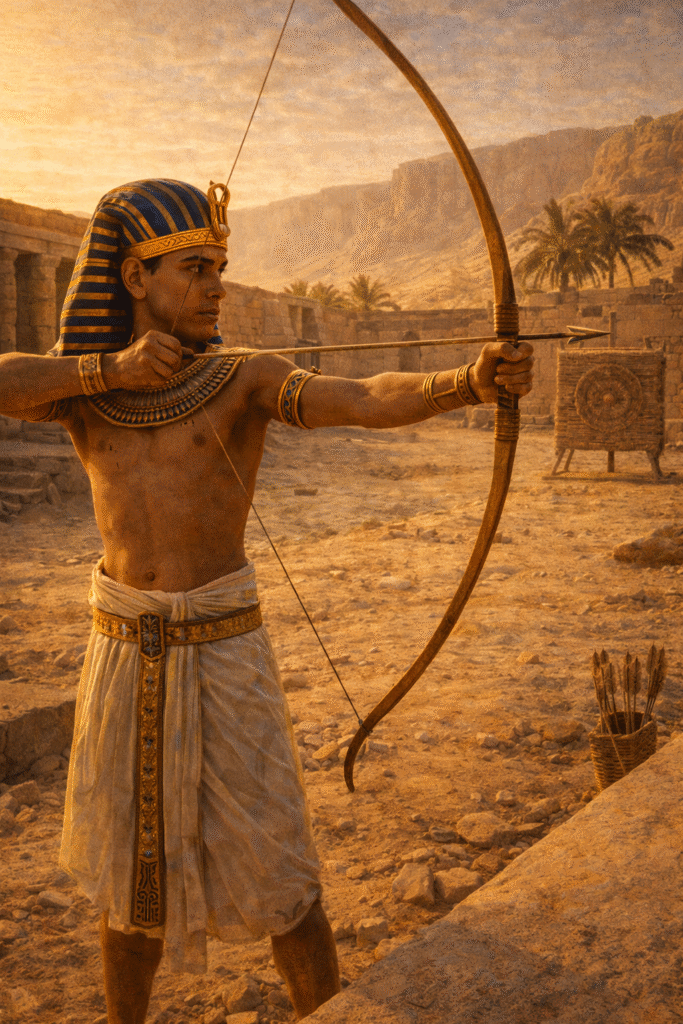
By ten,
Thutmose could draw a bow
nearly as tall as he was.
By twelve,
he could drive a chariot
around the palace course
without turning the wheels
too sharply.
By fourteen,
the generals whispered
in grudging approval:
“This boy will be a hawk.”
And I—
I watched with a mother’s gaze
and a queen’s calculation.
I saw his fire.
I saw his impatience.
I saw his hunger
for the things a child
cannot yet name.
He did not resent me,
not then.
He looked at me
with the loyalty
one reserves for a teacher,
a guardian,
a constant moon
in the sky of one’s youth.
But even then,
beneath the surface,
I sensed something unspoken:
He knew
that the throne on which I sat
was also his.
Not today.
Not yet.
But someday.
And destiny,
even in its gentlest form,
casts long shadows.
PART III — Lessons in the Garden of Sycamores
We did not always meet
in the councils
or the training grounds.
Some of our most important conversations
took place in the palace gardens,
where the sycamore trees
filtered the afternoon light
into soft gold.
It was here
that I taught him
the part of kingship
no soldier could train.
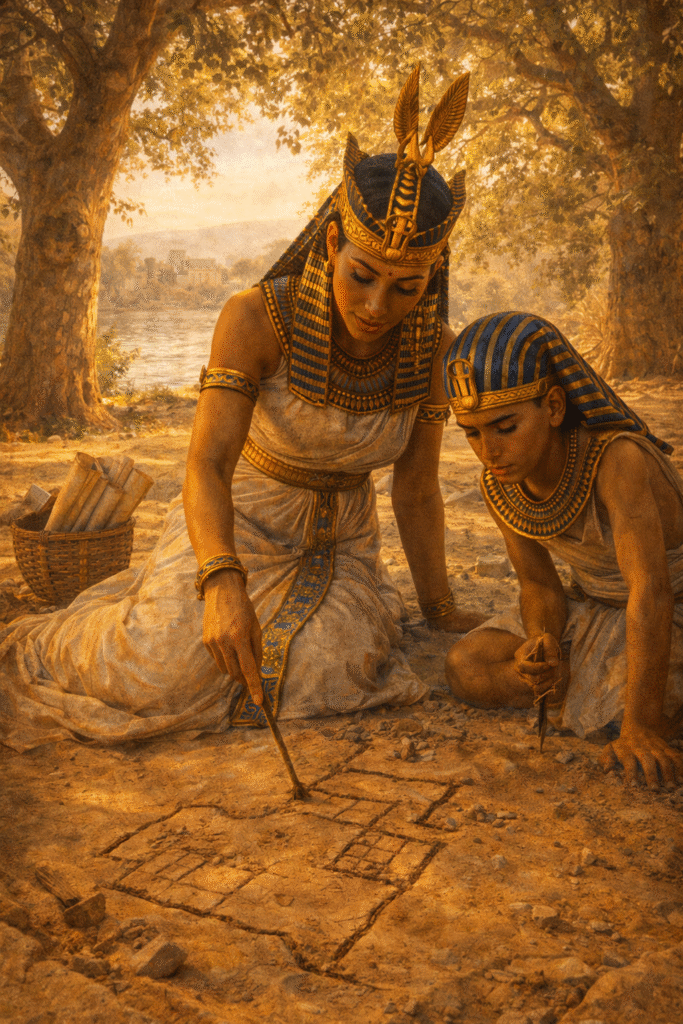
He sat cross-legged in the sand
as I drew a map
with a reed.
“See this?” I said,
marking the Nile’s bend.
“The river is Egypt.
Without it, nothing thrives.”
He nodded.
“And this?”
I drew the borders of the Delta.
“Here the floods come too quickly.
Here they come too slow.”
He frowned, thinking.
“What does that matter to armies?” he asked.
“Because armies defend the land,” I said.
“But kings defend the people.”
He looked up at me, puzzled.
“But you lead campaigns
by striking enemies.”
“Yes,” I said.
“But you rule by protecting bread.”
It was not a lesson
he understood immediately.
He was young.
He saw glory
in horses and chariots,
in spears and formation drills.
But in time,
he would come to understand
that water
could topple a kingdom
just as surely as war.
One day,
while we sat beneath the sycamore,
he asked quietly:
“Why do you draw the map as if it were yours?”
I smiled.
“It is not mine,” I said.
“It belongs to Egypt.
I am only its caretaker.”
He looked at the drawing for a long time.
“And what am I?” he asked.
I rested my hand on his shoulder.
“You,” I said softly,
“are its future.”
He did not answer.
But something in his eyes
shifted.
Understanding.
Responsibility.
Something quieter—
a question he would not yet ask:
If I am its future,
why does she rule now?
I did not press him.
Some truths must grow
in their own time.
PART IV — The Court Learns to Watch Him
By the time Thutmose reached adolescence,
the court began to watch him
with the same intensity
they once reserved for me.
Some of this was natural.
He was the heir.
He carried royal blood
in a form the nobles understood
more comfortably than mine.
But some of it
was more insidious.
Priests whispered
that the boy
had a “warrior’s spirit.”
(As if I did not.)
Generals whispered
that the boy
had a “king’s posture.”
(As if mine were borrowed.)
Nobles whispered
that Egypt “longed
for a son of blood
to sit alone.”
But Thutmose himself
did not feed the rumors.
Not then.
He came to council meetings
at my invitation.
He listened.
He asked sharp questions.
He honored the forms.
He bowed to me
before all eyes
not because he was forced,
but because he had not yet
found reason
to do otherwise.
But the courtiers…
their glances
were changing.
Once,
a noble from the Delta
bowed to me
with proper depth
but looked slightly past me
toward Thutmose,
as though acknowledging
both past and future
at once.
I saw the shift.
So did he.
We did not speak of it.
Not then.
But silence
is a kind of conversation.
PART V — The First Fracture
One afternoon,
during a training session
in the palace courtyard,
Thutmose and I
watched the young cadets
practice with wooden spears.
He stood tall beside me,
lean and muscular,
a boy shedding the last remnants
of childhood softness.
“Your Majesty,”
one of the generals said to me,
“the young men display
great discipline.”
But when he turned
to address Thutmose,
his voice shifted.
“Prince,
your future troops
will honor your command.”
It was a small thing.
A shift in titles.
A sliver in tone.
The general had not meant disrespect.
He was simply acknowledging
what he believed
to be the natural order.
But the message was clear:
When the subject is armies,
the boy commands more reverence
than the woman who rules.
Thutmose stiffened.
Not from arrogance
but from discomfort.
He turned to me,
eyes searching mine
for something he could not name.
I gave him a calm nod.
We would not humiliate the general
for a truth he believed
simple and harmless.
But after the training ended,
Thutmose lingered.
“Does it trouble you,” he asked quietly,
“when they speak to me that way?”
I considered my answer carefully.
“It troubles me,” I said,
“when they forget
that one can honor the future
without dismissing the present.”
He looked at me,
face unreadable.
“And does it trouble you,” he asked,
“that I am the future?”
I smiled,
but not unkindly.
“No,” I said.
“What troubles me
is that you still think
your future must begin
before its time.”
He lowered his gaze,
ashamed not of ambition,
but of the honesty
that had escaped him.
We said no more.
Some fractures
are too small
to repair with words.
PART VI — The Festival of Shared Crowns
As Thutmose approached manhood,
protocol required him
to join me
in more ceremonial duties.
One of the most critical
was the Offering of Unification
during the Festival of Opet.
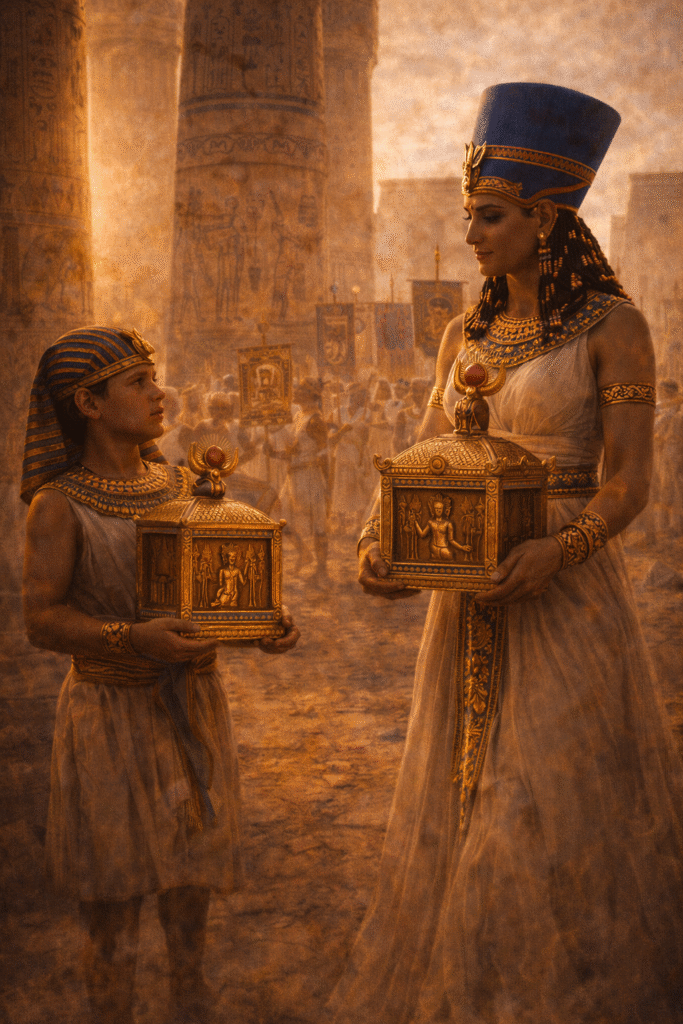
Side by side,
we carried the small shrines
that symbolized
the union of Upper and Lower Egypt.
Our steps were matched by rhythm,
our arms by posture,
our titles by tradition.
The people cheered
as if seeing
two halves of a single moon.
After the ceremony,
as we stood behind the screen
removing our ritual collars,
Thutmose exhaled hard.
“They cheer for us,” he said slowly,
“but they watch you.”
I wiped a bead of sweat
from my brow.
“They watch what is steady,” I said.
He shook his head.
“No.
They watch what they fear losing.”
His voice had changed.
It was deeper now.
Shaped by training
and expectation
and the whispering court.
For the first time,
I heard in him
a note of something
not quite resentment,
not quite longing —
an ache for a throne
that was his by blood
and mine by choice.
“You will have your time,” I said gently.
He looked at me,
jaw tight.
“Will Egypt be ready for me
when it comes?”
“You must make it ready,” I said.
“No throne answers to blood alone.”
He blinked,
absorbing the truth
and the threat of it.
That evening,
as the sky burned with sunset,
I felt the space between us
shift again.
Not wider.
Not hostile.
Just real.
Two hawks,
circling the same sun,
each aware
of the other’s shadow.
PART VII — The Day He Challenged Me
Thutmose was seventeen
when he first allowed
the edge of defiance
to break through the surface.
We were in the palace garden,
reviewing provincial reports.
He skimmed one document,
then frowned.
“Why,” he asked,
“is the governor of Mennefer
given double the grain rations
of the governor of Herakleopolis?”
“Because Mennefer suffered a canal breach
this season,” I said.
“And Herakleopolis had surplus.”
He shook his head.
“Too generous,” he murmured.
“He should learn to prepare his own reserves.”
“He lost his reserves
protecting the caravans
from desert raiders,” I replied.
“He should have guarded
his own people first,”
Thutmose snapped.
It was not the disagreement
that struck me.
It was the tone.
Firm.
Confident.
Convicted.
Man’s tone.
Not boy’s.
Several attending scribes
went very still.
I dismissed them with a glance.
When we were alone,
Thutmose pressed the point.
“If you give too much to Mennefer,” he said,
“the other governors will expect the same.
They will come to rely on your mercy
instead of their planning.”
I studied him.
“You speak like a general,” I said.
“I speak like a king,” he answered.
Silence rippled through the garden.
Wind moved the sycamore leaves,
casting shifting shadows
between us.
Finally,
I spoke:
“Then learn this truth,
king-to-be:
Sometimes the strength of a ruler
is not measured by how tightly he clenches
but by how wisely he releases.”
He swallowed,
eyes dropping.
But he was not crushed.
He was learning.
Growing.
Forming the edges
of the ruler he would become.
I did not fear this.
But I felt the ache of it.
Because one day,
the edges of his rule
would press against
the edges of my memory.
PART VIII — A Modern Traveler in the Palace of Two Hawks
Now, traveler—
look at your own life.
You have known relationships
like this one.
Teacher and student.
Parent and child.
Mentor and successor.
Leader and heir.
The years when affection
blends with friction,
when pride
mingles with fear,
when guidance
meets resistance
in a dance older than dynasties.
When you walk
through the palace ruins in Luxor,
or stand in the courtyard
where princes once trained,
pause a moment.
Look at the dust.
The sandstone.
The narrow corridors.
Two footsteps once echoed here:
One steady,
measured,
borne from duty.
One quick,
eager,
borne from becoming.
Close your eyes
and listen.
You may hear
the faint conversation of two hawks
circling the same sky.
If you feel yourself
in this story—
as the teacher,
the learner,
the guide,
or the one growing into their own power…
then you are ready
to walk these palace spaces
with us.
We will show you
the rooms where decisions were shaped,
the courtyards where futures were forged,
the gardens where truths were spoken
between two rulers
bound by fate.
When you’re ready
to walk the path of two hawks—
we’ll guide you.
PART IX — The Last Years We Ruled Together
As Thutmose reached adulthood,
the duality of our rule
became the rhythm of Egypt.
We appeared together in ceremonies.
We received delegations together.
We offered to the gods
in unified gesture.
He grew into his strength.
I deepened into mine.
But unity
is not the same
as equality.
And equality
is not the same
as harmony.
There were days
when our visions aligned perfectly—
like two voices singing
in a single chord.
There were days
when we argued quietly
behind screens
while scribes pretended
not to hear.
There were days
when he sought my council
with the sincerity
of a son
who trusts.
And days
when he bristled
at the shadow
my crown cast.
Yet through it all,
there was no hatred.
No malice.
Only two destinies
growing toward the moment
they must part.
He learned from me.
I learned from him.
He taught me
the fire of youth
can sharpen the mind.
I taught him
the patience of experience
can save kingdoms.
Together,
we ruled more strongly
than either of us
could have ruled alone.
But time,
like the river,
does not stop
because the shores
wish it to.
A day would come
when he must rule without me.
A day would come
when he would reshape
what I had built.
The oracle had warned me.
The stars had signaled it.
The court had whispered it.
I had accepted it.
But acceptance
is not the same
as readiness.
PART X — The Ancient Questioner’s Desk
A pupil once asked a scribe,
“Did Hatshepsut fear Thutmose?”
The scribe replied:
“No.
Fear is loud.
She listened to the quiet of destiny.”
Another asked,
“Did the boy resent her?”
He answered:
“He respected her more than he understood her.”
A traveler wondered,
“Why did they not rule separately?”
The historian wrote:
“Because history does not unfold
in clean lines.
It moves in braids.”
A final question came,
“What bound them together?”
The scribe smiled:
“Egypt.
Always Egypt.”
The Scroll closes…
but their story does not.
If you have ever guided someone
who would one day surpass you—
if you have ever felt pride and ache
in the same breath—
if you have ever loved someone
whose destiny brushed against your own…
then you walk beside Hatshepsut
in this Scroll.
Come stand
in the palace courts.
Walk the gardens
where a queen and a boy
shaped each other’s futures.
Feel the tension,
the tenderness,
the truth of succession.
Journey with ENA.
Two hawks still circle this sky.
Historical Context
Thutmose III was raised during Hatshepsut’s reign and later ruled independently after her death. Inscriptions and later historical records confirm his position and eventual dominance, though details of their personal relationship are limited.
The interactions and emotional dynamics in this scroll are literary reconstructions, intended to reflect the structural realities of co-rule and succession rather than to assert documented private exchanges.