Scroll XI – The Builders’ Oath: When I Ordered the Great Obelisks
Year: 1465 BCE — Waset (Luxor), Karnak Temple
Translated and restored for the modern traveler.
Prologue — When Stone Became a Prayer
There comes a time in the life of every ruler
when words are no longer enough.
Treaties fade.
Ceremonies pass.
Even victories, once sung in triumph,
become memories
drifting like incense in forgotten chambers.
But stone—
stone endures.
After the oracle warned me
that the path ahead would not remain still,
I found myself awakening before dawn
with a hunger I could not name.
It was not fear —
I do not frighten easily.
It was not ambition —
my reign was already secure.
It was not vanity —
the gods know I have little patience
for hollow monuments.
It was something deeper:
The need to speak to the future
in a language that could not be erased
by politics or time.
And in Egypt,
that language was granite.
This is the Scroll of the day
I ordered the great obelisks —
not out of glory,
but out of necessity,
devotion,
and an understanding
that the future listens best
when the present speaks in stone.
PART I — The Desire to Leave Light Behind
People think of obelisks
as monuments of ego.
But that is not their truth.
An obelisk is not a brag.
It is a beam.
A sunbeam made solid.
A prayer frozen in stone.
A promise cast upright
between heaven and earth.
When I felt the shift foretold by the oracle,
I did not think first of defense
or alliances
or decrees.
I thought of light.
Of the rising sun
touching the sharp point of granite.
Of gold leaf catching the morning fire.
Of my name,
carved deep,
enduring long after my flesh returned
to the arms of the earth.
I thought:
If the world wishes to forget me,
let them first chisel down
the sun itself.
This was not hubris.
It was clarity.
The same clarity that drew me
to Deir el-Bahari.
To Karnak.
To every place in Egypt
where the boundary between divine and mortal
grows thin.
I wished to build
not for myself,
but for the rhythm of Ma’at —
the ancient order that outlives every crown.
An obelisk is the world’s most honest symbol.
It worships the sun
while standing firm in the earth.
A ruler can aspire to nothing greater.
PART II — The Court That Pulled Two Ways
When I announced my intention
to erect two massive obelisks
for the Festival of Amun
in my sixteenth regnal year,
the reaction in the court
split like a river meeting stone.
The priests of Amun
bowed deeply.
“Your Majesty,
this offering will honor the god
and stabilize the heart of the Two Lands.”
Their eyes shone
not only with piety
but with the delight
of expanding their temple’s magnificence.
The architects nodded with awe.
But the nobles…
the older ones,
the land-rich ones,
the ones whose grandfathers
had never bowed to a female sovereign—
they forced their expressions into polite acceptance.
I recognized their thoughts:
“Obelisks?
A bold gesture.
A king’s gesture.
A gesture meant to make her memory
hard to erase.”
They were not wrong.
But they misunderstood my motive.
I did not build to clutch power.
I built because I sensed
that the story of my reign
would be contested.
Better to leave pillars of sun
than scrolls of ink.
Ink fades.
Stone resists.
Thutmose,
no longer the small boy I once guided,
stood beside the nobles
with a controlled expression.
Respectful.
Still dutiful.
But older now.
Observing more keenly.
He said nothing.
But I saw the unspoken question:
“How long will these monuments
bear only your name?”
I answered him quietly,
with a glance that carried years of truth:
“As long as they stand.”
PART III — The Journey to the Granite Womb
Obelisks begin in silence.
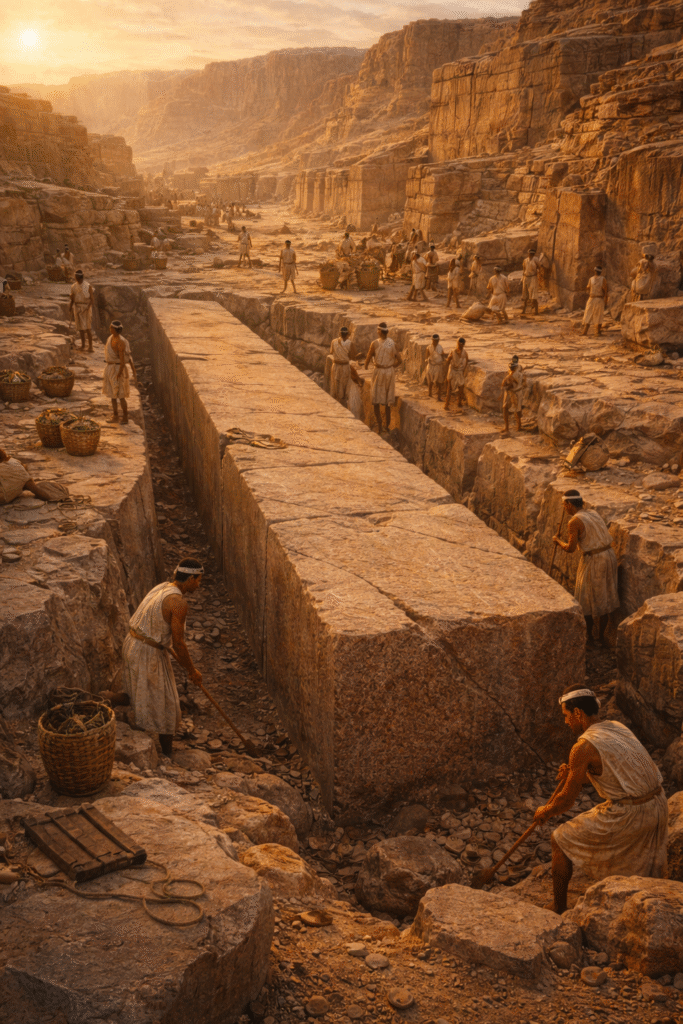
In Aswan —
the stone womb of Egypt —
the cliffs hold veins of rose-colored granite
older than any dynasty.
I traveled there
with a small, loyal retinue:
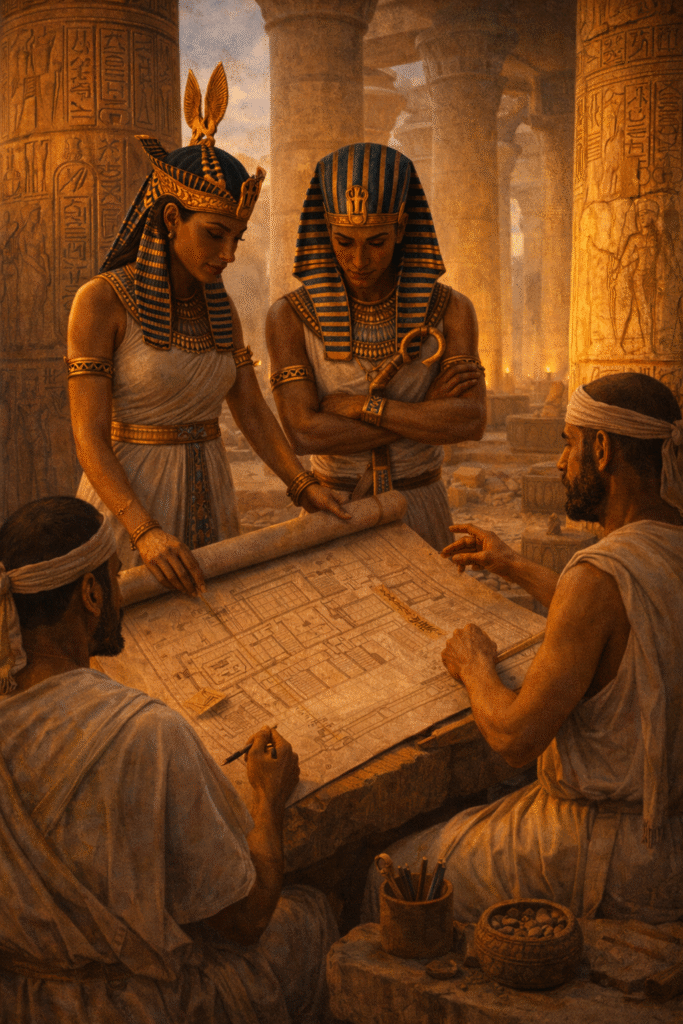
Senenmut,
my chief architect and confidant;
Nakht,
master of quarry teams;
and a handful of trusted scribes and guards.
When we arrived at the quarry,
the morning sun
was still caught in the dust
rising from workers’ footsteps.
The granite cliffs
glowed like embers beneath a thin sheen of dawn.
Senenmut led me
to the site he had chosen
for the first cut.
“Your Majesty,” he said,
running his hand
over the rough, cool stone,
“this place has waited centuries
for this moment.”
His voice carried not arrogance,
but reverence.
He understood obelisks.
He loved them like living beings.
“The obelisk,” he often said,
“is a mountain sculpted into a ray of light.”
Together,
we inspected the length of the chosen seam:
a flawless run of granite
stretching longer than four chariots.
Enough to create an obelisk
that would rise higher
than any yet attempted in Egypt.
Nakht approached,
calloused hands wrapped around his measuring cord.
“It will require
over three thousand workers,”
he said plainly.
“Ten years if the gods are kind.
Seven if they are indulgent.”
“And if they are displeased?” I asked.
He shrugged.
“Then the stone will crack.”
It was an honest answer.
Stone has its own will.
I placed my palm against the granite,
feeling its chill seep into my skin.
It felt alive.
Waiting.
Listening.
“Begin,” I said.
And the quarry erupted into purpose.
PART IV — The Sound of Eternity Being Born
Quarrying an obelisk
is holy violence.
Hundreds of men,
sweating under the sun,
pounded dolerite balls
against the granite bed
in a rhythmic, relentless beat.
Boom.
Boom.
Boom.
The sound echoed off the cliff walls,
a heartbeat older than any temple.
Each strike sent chips flying,
glittering in the light like sparks.
The trench around the obelisk
grew deeper and deeper
until the massive stone
rested like a sleeping giant
in its cradle of earth.
Water runners trotted constantly
between the Nile and the quarry,
pouring water over cracks
to cool the rock
and reveal hidden flaws.
Scribes recorded every measurement.
Priests blessed every phase.
Work gangs chanted
as the stone took shape.
For weeks,
I stood among them
in plain linen,
my gold set aside.
Queens may rule through decree,
but monuments rise
through presence.
Workers looked up in surprise
each morning
when they saw me return.
But their surprise
soon turned to pride.
To them,
my presence meant
their work mattered.
To me,
their sweat and skill
were sacred.
One afternoon,
a young quarryman,
barely sixteen,
collapsed from exhaustion.
When water revived him,
he blinked up at me,
embarrassed.
“Forgive me, Queen,”
he whispered hoarsely.
“I wanted to show
that I am strong enough.”
“You are,”
I said,
placing a hand on his forehead.
“But strength is not only in the arm.
It is in the years of work ahead.
Pace yourself.
The stone is patient.
Be patient with yourself.”
He cried —
not from weakness,
but from the release
of being seen.
PART V — The Day the Stone Moved
Months passed.
The trench deepened.
The underside of the obelisk
was smoothed.
The granite giant
lay ready for lifting.
Senenmut climbed onto a ledge
to address the workers.
“Brothers,” he shouted,
voice ringing across the quarry,
“today we attempt the impossible.
Today we raise a mountain.”
A hush fell over the gathered men.
Nakht signaled.
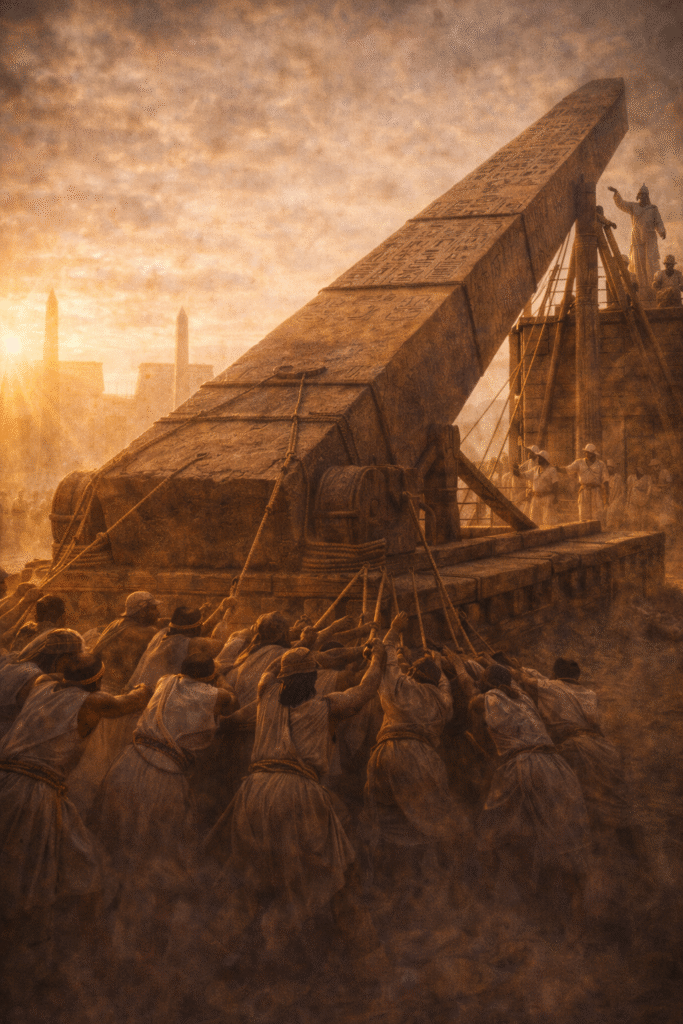
Hundreds of workers
wedged wooden levers
beneath the obelisk.
Ropes thick as a man’s arm
were wrapped around the stone
in a cradle of knots.
“Pull!” Nakht roared.
The workers heaved.
At first,
nothing moved.
Then—
a groan of stone
older than the world.
The giant shifted.
Dust plumed.
A ripple passed through the crowd.
“Again!” he shouted.
The ropes strained.
Muscles bulged.
Sandals dug deep.
Slowly,
with a reluctant grace,
the obelisk lifted
from its cradle.
A cheer erupted —
not wild,
but awestruck.
The mountain had accepted its fate:
To rise.
To stand.
To bear the morning sun
long after those who freed it
were dust.
I covered my heart with my hand
and whispered a prayer
I had not spoken since childhood:
“May this stand
when I cannot.”
PART VI — The River That Carried My Legacy
Transporting an obelisk
is a second miracle.
First miracle:
cutting it from stone.
Second miracle:
moving it across Egypt
without breaking it.
We built a massive barge—
reinforced beams,
double-thick hull,
wide enough to cradle the obelisk
along its length.
At the Aswan dock,
people gathered
to watch the loading.
Sledges creaked.
Ropes groaned.
Dozens of workers chanted in unison
as the obelisk
was eased onto the deck.
Priests lit incense
and blessed the ropes
so they would not snap.
A child asked her mother,
“Is that a whole mountain?”
Her mother replied,
“No, little one.
That is the Queen’s promise.”
The river swallowed the barge’s reflection whole
as it pushed away from the quay.
I watched it depart
with the kind of ache
one feels
when a child leaves home.
Senenmut stood beside me.
“It will reach Karnak,” he said.
I nodded.
“But will I?”
He looked at me
with the calm that comes from
knowing someone’s soul deeply.
“You already have.”
PART VII — The Builders’ Oath
Before I left Aswan,
I gathered the senior builders
beneath the shade of a sycamore.
They stood in a semicircle,
dusty, tired,
but shining with fierce pride.
“Men of stone,” I said,
“hear me.”
They straightened.
“Kings rule for seasons.
Stone rules for ages.
You shape the truth
that survives us.”
The oldest of them stepped forward.
“Queen of Egypt,” he said,
“we make an oath to you.
We will carve your name
so deep
and so true
that even if kings after you
wish to erase it,
they will find the stone
too stubborn.”
His words struck deeper
than any oracle’s warning.
“Then I make an oath to you,” I replied.
“That your work will be honored
as long as my temples stand.”
We sealed the oath
with water poured from a single jar—
Nile water,
the lifeblood of the Two Lands.
It splashed upon the earth
in a circle
between our feet.
Promise for promise.
Eternity for eternity.
PART VIII — The Modern Traveler and the Obelisks
Now, traveler —
let me speak to you.
When you stand at Karnak
before the obelisks that still rise today,
you are standing
in the shadow of these vows.
Look up.
Let your eyes follow the taper of stone
as it narrows toward heaven.
Imagine the thousands of hands
that carved,
smoothed,
dragged,
and lifted it.
If you walk around the base,
you will see my names
carved in crisp hieroglyphs—
the cartouche of Maatkare
still sharp
despite the years.
Touch the stone.
You may feel
a faint warmth from the sun,
but beneath that,
something steadier:
Resolve.
Obelisks are not monuments.
They are declarations.
Declarations that say:
“I was here.
I mattered.
I gave something to the world
that could not be erased
by time or jealousy.”
If you feel a stirring in your chest
as you stand before them—
a thrum,
a recognition,
a spine-deep echo—
you are not imagining it.
The builders’ oath
was not metaphor.
It lives in the granite.
If these stones speak to you
through these words…
if you feel the weight of creation,
of devotion,
of legacy…
then you are ready
to walk among the obelisks with us.
We will take you
into the heart of Karnak,
to the base of the giants,
to the very places where chisels rang
and granite dust sparkled in the dawn.
When you’re ready to stand
inside a promise carved in stone—
we’ll bring you to the obelisks.
PART IX — The Return of the Stone to the Temple of Amun
When the obelisks arrived in Waset,
the entire city turned out.
It took weeks
to prepare the ramps,
the pulleys,
the platforms.
Kings are crowned
with far less ceremony.
Finally,
on a morning bright as copper,
the obelisks were raised.
Drums thundered.
Priests chanted.
Ropes strained.
Men shouted prayers
and encouragement
over the roar of effort.
And then,
slowly,
impossibly—
they stood.
Golden caps catching fire
in the first rays of sun.
The courtyard erupted into cheers.
Some fell to their knees.
Others wept openly.
The obelisks of Maatkare
had risen.
Thutmose,
standing near the front,
looked between me
and the towering stone
with something like awe
and something like calculation.
He said softly,
“You have given Egypt
a monument that will outlast
every reign.”
I watched the sunlight
strike the perfect tip
of the closest obelisk.
“No,” I said quietly.
“I have given Egypt
a reminder.”
He frowned slightly.
“Of what?”
“That light should always rise
from truth,
not fear.”
He studied me
as if weighing each word.
The moment passed
like a breath—
but I felt
the oracle’s shadow
touch the edge of it.
PART X — The Ancient Questioner’s Desk
A novice asked a master builder,
“Does the queen build for herself?”
The builder replied:
“She builds for the sunrise.”
Another asked,
“How are obelisks moved?”
The scribe wrote:
“With ropes,
with sweat,
with prayer,
and with a patience
that rivals the gods.”
A traveler wondered,
“Why granite? Why not limestone?”
The quarryman answered:
“Because eternity prefers difficulty.”
A final question came:
“Why do they still stand
when so much else has fallen?”
The old priest smiled:
“Because truth,
once carved deep enough,
cannot be unmade.”
The Scroll ends…
but the obelisks do not.
If you felt the quarry dust in your lungs…
if you heard the chanting of workers…
if you saw the stone rise in your imagination…
then the obelisks are calling you.
Come stand beneath the giants.
Look up until your neck aches.
Let the light hit your face
exactly as it struck theirs
3,400 years ago.
Come walk the path of granite.
Come witness what cannot be erased.
Journey with ENA.
The monuments await your shadow.