
Scroll X – The Festival Throne: When All Egypt Looked to Me
Year: 1466 BCE — Waset (Luxor), Festival of the Valley
Translated and restored for the modern traveler.
Prologue — The Day Glory Felt Heavy
There is a day in every ruler’s life when the world looks at them all at once.
Not in passing glances.
Not in cautious audiences.
Not in quiet temple halls.
But in a single, focused gaze —
tens of thousands of eyes
turning toward one figure
seated upon a throne
that is both honor and burden.
For me, that day came
during the Festival of the Valley,
in the full strength of my reign.
By then, my obelisks at Karnak had already been raised.
Deir el-Bahari’s terraces were alive with chisels and color.
The expedition to Punt had returned
with incense trees and rumors of my boldness
whispered all along the Nile.
To the people,
I was the image of stability.
To the court,
I was the established center of power.
To the temples,
I was the Daughter of Amun,
confirmed again and again in ritual.
And yet…
Ever since the night the oracle warned me
that change would come,
my triumphs tasted different.
Not less sweet.
But edged.
This Scroll tells of the day
I sat on the festival throne
with all Egypt’s gaze upon me
and felt — beneath the roar of celebration —
the first true weight
of being both revered and questioned
at the same time.
Part I — The City Wakes to Celebration
The festival began hours before dawn.
Waset stirred under a sky still jeweled with fading stars.
Along the riverbank, boatmen checked moorings,
lanterns swinging in the soft pre-dawn wind.
Women lit small braziers in courtyards,
sending curls of smoke into the blue-grey air.
Children, too excited to sleep,
whispered guesses about which gods
would be carried in the procession.
Across from the city,
the cliffs of the West Bank
were just beginning to glow
with the faintest hint of approaching light.
I rose before the sun.
Servants moved quietly in the royal quarters,
hands careful, voices low.
They draped me in linen fine as breath,
white with a faint sheen.
Gold cuffs wrapped my wrists.
A broad collar of carnelian, lapis, and turquoise
rested upon my chest
like a captured sunrise.
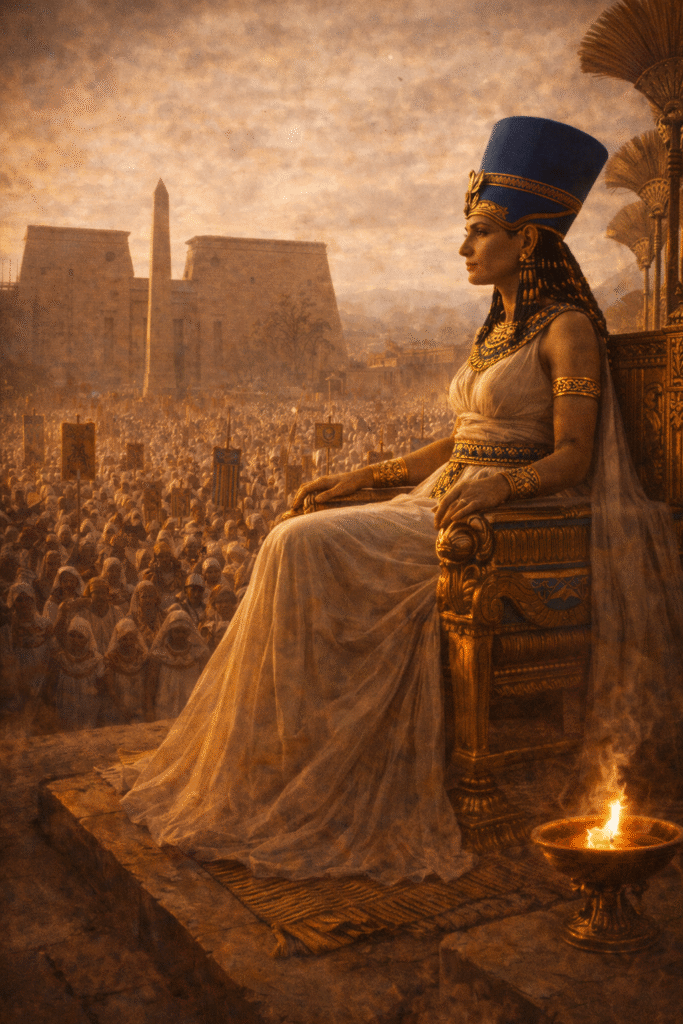
They placed the Blue Crown upon my head.
Not the nemes headdress of everyday rule,
but the war-and-ceremony crown
meant for moments of great display.
I looked at my reflection
in a polished copper mirror.
The woman who looked back
was both familiar and distant —
eyes lined with kohl,
mouth set in calm resolve,
cheeks touched with the slightest color.
A queen.
A symbol.
A body wearing a kingdom.
Outside, trumpets sounded —
long, clear notes
cutting through the last veil of night.
The city was waking.
The Festival of the Valley
was one of Egypt’s greatest days of connection:
living and dead,
east and west,
temple and tomb,
god and people.
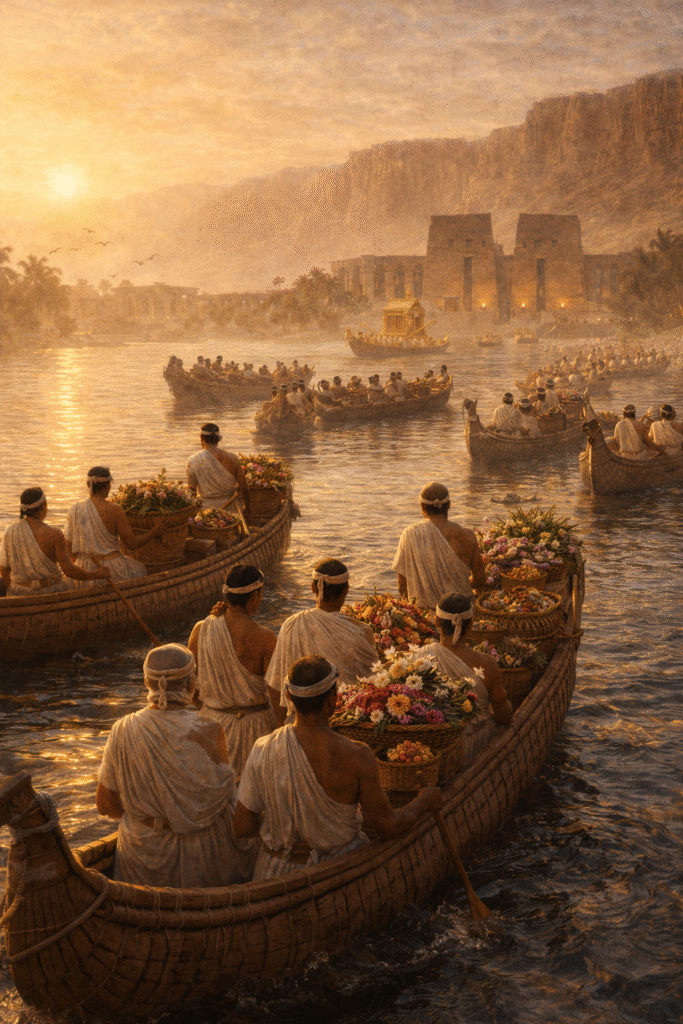
It was a day when the barques of Amun and his divine family
would cross the Nile
to visit the western temples and necropolis.
A day when families rowed across the water
to feast at the tombs of their ancestors.
A day when the entire city
remembered that life and death
were not enemies
but neighbors.
And on this particular year,
the priests had added
a more pointed emphasis:
A public, overwhelming
affirmation of my rule.
Not merely in temple courts,
but before the full gaze of Waset.
Part II — The Procession of a City
From the palace,
I rode to Karnak in a ceremonial chariot,
wheels humming softly over packed earth.
The streets were lined already.
People pressed close,
held back only loosely
by temple attendants and guards.
They had dressed themselves in their best linen,
freshly washed,
smelling of natron and river.
Women wore collars of glazed faience,
their colors catching the morning light.
Men had rubbed fragrant oil into their beards.
Children clung to parents’ hands
or sat upon broad shoulders,
eyes wide.
As I passed,
they raised their hands in blessing.
“Life to you, great queen!”
“May you live, be prosperous, be strong!”
“May Amun protect you!”
“May your reign endure like the sky!”
A girl not yet ten
held up a small clay figure
she had molded herself —
a crude, earnest likeness of a woman in a crown.
“Look, Mama,” she whispered,
not realizing I heard her.
“I made the Pharaoh.”
Her mother smiled,
pulling her a little closer to the curb.
“She sees you,” the mother said.
“Smile. Let her see you are grateful.”
So the child smiled up at me
with a seriousness
that made my heart ache.
This was the first face
that anchored me that day.
Not the priests.
Not the nobles.
Not the generals.
A little girl
who believed that she, too,
might shape the world with her hands.
Part III — The Festival Throne
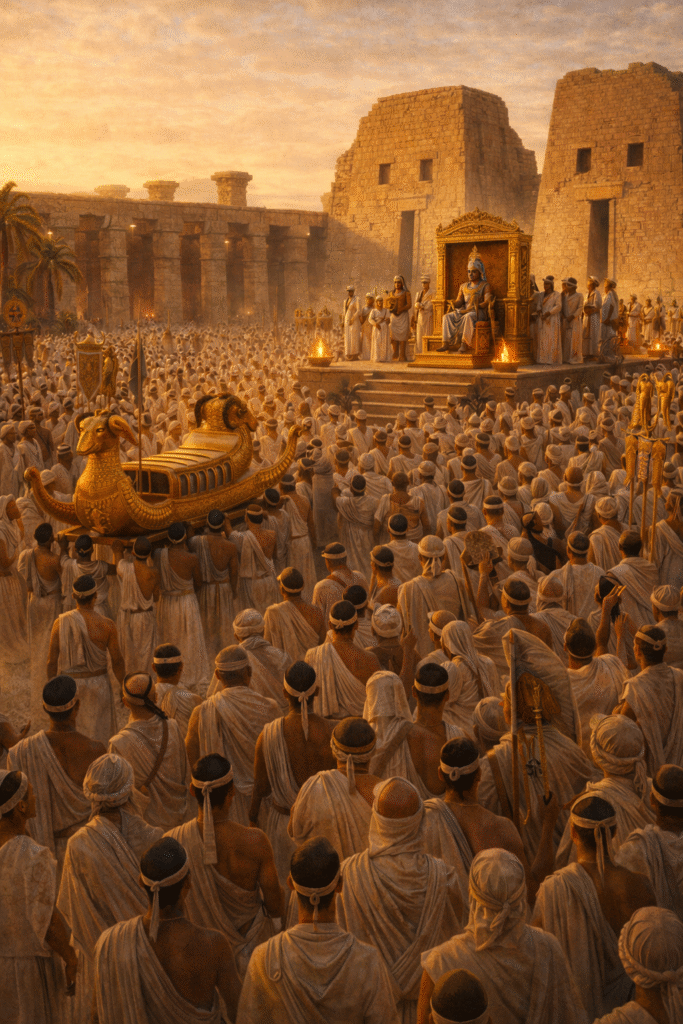
The great court at Karnak
had been remade for the festival.
Banners snapped in the rising breeze,
dyed cloth of crimson and blue and gold
fluttering from poles.
Fresh mats covered the ground
in designated areas for high officials,
foreign dignitaries,
leaders of the army and priesthood.
At the far end of the court,
just before the towering first pylon,
the throne platform waited.
It was not my usual throne.
This one had been constructed for visibility —
raised high upon a series of stone steps,
so that even those standing near the outer gates
could see the figure seated upon it.
Gold leaf glinted from the edges,
but the structure itself was solid,
sturdy,
unornamented where it met the force of weight.
Appearances may be delicate.
Thrones cannot be.
Behind it,
the pylons rose like mountains,
their faces carved with scenes of power:
kings smiting enemies,
gods bestowing crowns,
rituals of eternal triumph.
Priests moved about like pale birds
in white linen,
making final preparations.
Musicians tuned their harps and flutes.
Drummers tested their skins.
And all around,
the city poured in
through every gate.
By the time I stepped into the court,
it was a living sea of human presence.
The high priest of Amun met me at the entrance.
“Your Majesty,” he said,
bowing deep,
“today all eyes will witness
what the god has already declared.”
He meant it as reassurance.
To me,
it sounded like inevitability.
Still, I climbed the steps.
Each one
echoed in my chest.
When I reached the top,
I turned slowly
to face the court.
It was as if the world itself
had drawn a single breath and held it.
Then I sat.
The Blue Crown felt heavier.
Not physically.
Symbolically.
To sit upon a throne
in private
is to feel the burden of decision.
To sit upon a throne
before all Egypt
is to feel the weight
of their expectations.
The drums began.
Part IV — The gods Walk and the People Answer
The barques processed first.
From the inner courts
came the barque of Amun,
carried on the shoulders of his priests —
gold gleaming,
plumes rising,
veils hiding the statue’s sacred face.
Behind him,
Mut and Khonsu followed,
their shrines swaying gently in rhythm
with the steps of those beneath.
The crowd surged forward and back,
like the intake and release of a single enormous lung.
As they passed my elevated throne,
the priests paused
just long enough
for the barques to tilt in my direction.
A ritual bow.
A god acknowledging king.
King acknowledging a god.
The high priest’s voice
rose above the music:
“Behold Maatkare,
Beloved of Amun,
who upholds the Two Lands
as the sky upholds the stars!”
The crowd roared,
a sound like a desert storm.
In that moment,
I felt something rare:
A unity so complete
it bordered on dangerous.
Because a people who can love you
with that much intensity
can also turn
with that much force
if the tides shift.
But today,
they did not turn.
Today,
they rose like a wave
and carried my name upon it.
Part V — Faces in the Sea
From the high platform,
the mass of people blurred
into a moving tapestry.
But I have always believed
that a ruler must learn
to see individuals
within crowds.
So I let my gaze soften
and sharpen
again and again
until faces pulled into focus.
A farmer
from a village north of Waset,
calloused hands clenching
a small bundle of dried flowers.
He held them to his chest,
then lifted them toward me,
lips moving in a prayer
I would never hear
but could guess.
A foreign envoy
from a land far to the south,
eyes watchful,
measuring the strength of Egypt
not only in its temples,
but in the devotion of its people.
An elderly woman
leaning on a staff,
her face lined like dried riverbeds.
She watched me without smiling,
but there was no bitterness in her gaze.
Only a seasoned assessment,
as if she had seen many rulers
and weighed each of us
in her own silent balance.
A group of tomb workers
from the West Bank,
still bearing faint traces of ochre and chalk
on their forearms,
knees dusty from stone and sand.
They had traveled early
to stand in the heat
and see the one
whose eternity they carved.
I met their eyes,
one by one.
For each face,
the festival was different.
For some,
it was chance to ask the gods
for rain in the right places.
For others,
a moment to feel that their ruler
knew they existed.
For a few,
it was a test:
Is she truly as strong
as the hymns claim?
A queen cannot answer each question aloud.
But she can answer
with posture,
with presence,
with the steadiness of her gaze.
So I sat upright
and let my eyes say:
I see you.
I hear you.
I carry you with me.
Part VI — The Crack Behind the Column
Amid the roar and ritual,
smaller currents moved.
As the barques turned toward the river gate,
and the people surged to reposition themselves
to watch the crossing,
I let my gaze drift toward a shaded corner
near one of the great columns.
There,
beneath carved images of past kings smiting enemies,
two men stood a fraction too close.
One wore the linen of a mid-ranking priest.
The other,
a noble with land on the western side of the river.
Their heads were inclined toward each other,
lips moving quickly.
I could not hear their words.
But I recognized the posture.
I had seen it in courts
since I was a girl:
The quiet cluster of those
who believe themselves
the true interpreters of fate.
The priest glanced toward the barque.
The noble’s eyes flicked up toward me
just once,
then away,
as if contact might burn.
They were not the only ones.
Near the section reserved for military officers,
I saw a commander
whose loyalty had always been outwardly impeccable
standing just a little behind the others,
watching me with a look
that was not defiance
but not devotion either.
Assessment.
Calculation.
They bowed when appropriate.
They did not misstep.
But the current beneath their gestures
was not the same as the people’s.
The crowd’s love
was straightforward.
These men’s allegiance
was conditional.
It is a dangerous thing,
to sit above a sea of devotion
and see,
just at the edges,
the first ripples of doubt.
Part VII — A Modern Traveler in the Festival Court
Now, traveler —
let me bring you into this scene.
If you stand today
in the great court of Karnak,
especially in the late afternoon
when the crowds thin
and the sun slides lower
behind the pylons,
you can almost feel
the echo of that festival day.
The stone flags of the courtyard
still warm from the sun.
The shadow of columns
stretching long and dark.
The open space before the pylon
where a throne platform
could easily rise again
if enough hands laid stone.
Stand near the center,
turn slowly.
Imagine the empty air
filled with linen-clad bodies,
with incense smoke,
with musicians’ tones.
Hear drums.
Hear shouts.
Hear prayers shouted
over children’s laughter.
Then imagine a throne
high above you
with a woman seated upon it —
composed,
still,
imbued with all the symbolism
your world has been trained to place
in a male body.
Feel the intensity of that.
Feel the boldness.
Feel the fragility.
Because power,
even at its most grand,
is never untouchable.
It is always resting
on living, breathing,
deciding humans.
If you can feel this court around you
even as you read…
if you can hear the murmur of the crowd,
see the banners move,
sense the ripple between devotion and doubt…
then you already stand
partway inside this festival.
When you walk Karnak with us,
we’ll bring you to the spaces
where thrones once rose.
We’ll let you feel
the difference between empty stone
and a day when all Egypt watched.
When you’re ready
to see temples as living stages,
not just ruins—
we’ll meet you in the court.
Part VIII — Shared Glory
After the barques had left the court
for the Nile crossing,
and the priests had finished their first cycle of hymns,
it was time for offerings.
Delegations from across Egypt
approached the throne.
A delegation from the Delta
presented jars of honey,
fish dried in intricate plaits,
and woven mats dyed with marsh reeds.
Nomarchs from the south
brought gold rings,
blocks of ebony,
and panther skins
that shimmered as they moved.
A group of soldiers
laid down shields
taken from enemies in the north,
signs that my reign
was not merely peaceful but protected.
Each group bowed.
Each swore fealty.
Each proclaimed my name
in connection with “life,”
“stability,”
and “health.”
It was theater,
yes.
But theater with teeth.
The entire court watched
not only me,
but each other.
“Who stands closest?”
“Who bows most deeply?”
“Who presents the most valuable goods?”
“Who avoids the queen’s direct gaze?”
I distributed my own gifts in return—
collars of honor,
rings,
fine garments,
promises.
Reward is a language.
I spoke it fluently.
And for a time,
it worked.
On that day,
there were no open refusals.
No withheld tributes.
No public challenges.
The Festival Throne
held.
Part IX — A Queen Alone After the Roar
When the official ceremonies ended,
and the barques had begun their journey across the Nile
toward the west,
I stepped down from the platform.
Protocol dictated
that I return to the palace
for rest and private thanksgiving.
Instead,
I asked to be led
to a smaller courtyard
outside the main flow of processions.
The sun had tilted westward.
The city was pouring toward the river,
drawn by the promise of feasting near tombs,
by the sacred chance
to picnic among the dead.
The court emptied,
its noise trailing off
like receding tide.
In the smaller courtyard,
under a lone sycamore,
I sat on a simple wooden chair.
No gold.
No elevation.
Just wood on stone.
Just a woman
who had worn a mountain of expectations all day
finally placing it down.
My chief steward approached
to ask if I wished for food.
“Not yet,” I said.
I wanted silence first.
To hear the echo of the day
within myself.
From beyond the wall,
I could still hear faint music
from the boats.
Children’s laughter carried on the wind.
A donkey brayed,
indifferent to the sacredness of any of it.
I closed my eyes.
For a brief moment,
I let go of the posture
the throne demanded.
My shoulders relaxed.
My hands loosened.
I thought of the little girl
with the clay figure.
The worker with ochre on his forearms.
The woman with the riverbed face.
I thought of the men behind the column.
Of the subtle star misalignment
the skywatchers had spoken of.
Of the dream
where my path and Thutmose’s
had overlapped.
And I realized:
Today had not only been proof of my strength.
It had also been
a measure of how much I had to lose.
Glory is never pure.
It is always edged.
Part X — The Traveler’s Quiet Throne
You may never sit
upon a raised golden seat
in front of an entire people.
But you have known
something like this
in your own life.
The day all eyes were on you.
At a ceremony.
At a promise.
At a risk.
At a beginning.
Maybe it was a wedding.
A graduation.
A promotion.
A moment when others
saw you as strong,
ready,
certain—
even if inside,
you felt the tremor.
When you walk Egypt’s temples,
remember this:
The people carved in stone
were not marble beings without doubt.
We felt what you feel.
The difference
is that our moments
were etched into walls
for you to inherit.
When you stand in Karnak’s court,
when you touch the stone
warm from afternoon sun,
you can offer your own quiet reflection there.
What throne have you sat on?
What day were all eyes on you?
What did you carry then
that no one else saw?
The Festival Throne
did not belong only to me.
It belongs to anyone
who has stood
between the weight of expectation
and the privacy of their own questions.
Part XI — The Ancient Questioner’s Desk
A novice once asked a temple scribe,
“Why do rulers sit on high thrones in festivals?”
The scribe replied:
“So the people may see their face
and decide what they believe.”
Another asked,
“Does the god truly choose who sits there?”
He answered:
“The god chooses through time.
Ritual confirms what the years reveal.”
A traveler wondered,
“Did the people love Hatshepsut?”
The scribe wrote:
“The full granaries,
the completed temples,
the quiet borders
answer that better than ink.”
A final question came,
“Did she know her glory would one day be challenged?”
The scribe paused,
then wrote:
“She knew enough
to build in stone
what whispers could not erase.”
The Scroll closes here…
but the festival does not.
If you heard the roar of the crowd in your imagination,
if you felt the weight of the Blue Crown
just for a moment,
if you saw yourself reflected
in the tension between glory and doubt…
then you are ready
to step into these courts
not as a tourist,
but as a witness.
Come stand
where the Festival Throne once stood.
Walk through Karnak’s courtyards.
Cross the Nile as they did
on days of celebration and remembrance.
Let Egypt show you
not just its ruins,
but its living stages.
Journey with ENA.
The festival is waiting for you
to take your place among those who remember.