
Scroll VIII – Deir el-Medina: The Village of Those Who Carved Eternity
Years: c. 1481–1479 BCE — West Bank of Waset, The Workmen’s Village, Paths Toward the Valley of Kings
Translated and restored for the modern traveler.
Prologue — The Hands Behind the Gods
Kings like to pretend
that temples appear
because they dream them.
We sit in courts,
we lift a finger,
we speak a wish—
and stone rises,
color blooms,
gods appear on walls.
That is the story
we tell ourselves.
The truth is simpler,
and far more sacred:
Everything I built
was carried
in someone else’s hands first.
Every column
rested on aching shoulders.
Every relief
came from a chisel
held by skin and bone.
Every painted sky
was once pigment dust
in a worker’s breathing.
If you want to understand
how I truly ruled,
do not start in Karnak,
or on my terraces.
Start here:
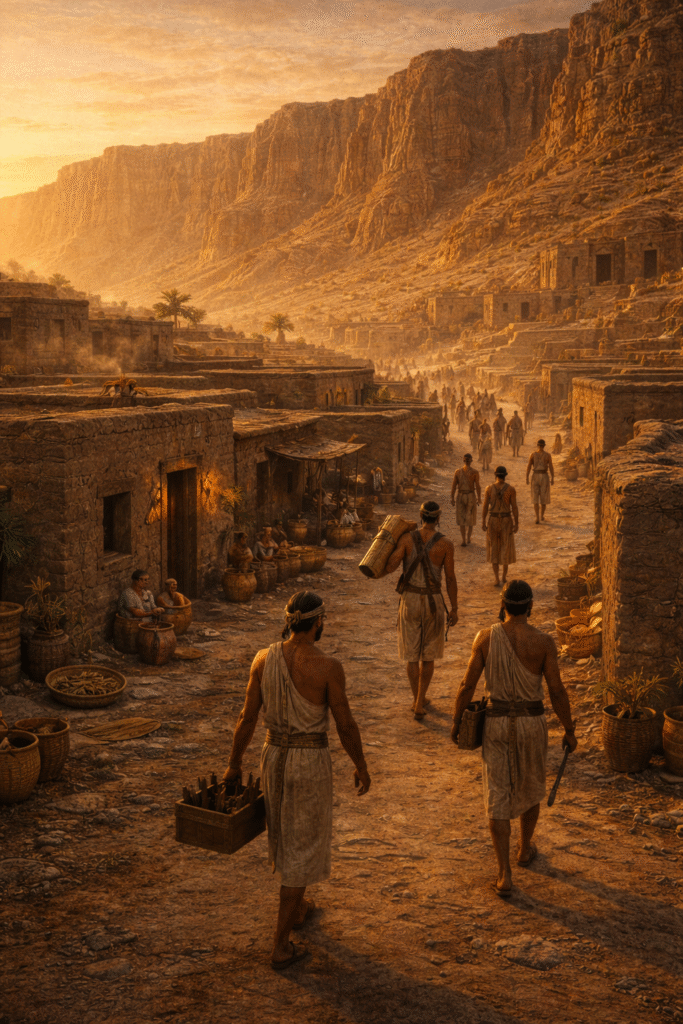
In a village of sun-baked walls
and narrow streets,
where the people
who carved eternity
lived in houses
almost small enough
to forget.
This is Deir el-Medina—
the village of those
who gave the gods
their faces.
PART I — Crossing to the Village at Dawn
We crossed the river
before the sun
had cleared the eastern horizon.
The Nile
was still that soft blue
it only carries at dawn,
when fishermen’s boats
move like dark brushstrokes
and the city behind you
has not fully woken.
We passed
from the living city of Waset
to the western bank—
the land of tombs,
of cliffs,
of silence.
But this time
our destination
was not a grand temple
or a royal tomb.
It was
a cluster of houses
built against the rock,
above the paths
leading to the Valley.
The village
was smaller
than I expected.
Rows of mudbrick houses,
each one tight against its neighbor,
a single lane running between them
like a spine.
No gilded gates.
No pylons.
No towering statues.
Just low doors,
narrow windows,
blue-painted lintels,
wooden shutters
hung slightly askew.
I stepped down
from the litter.
The foreman,
a compact man
with dust permanently
grained into his hands,
bowed.
“Majesty,” he said.
His voice carried
both reverence
and something else—
pride.
Not in me.
In the place
I had come to see.
“Welcome,” he added,
“to the village of your hands.”
PART II — The Houses of Those Who Built Tombs
We walked through the lane.
Children ran past,
bare feet kicking sand.
Women ground grain
on stone querns,
the sound rhythmic
as a heart.
A young apprentice
sat in a doorway,
practicing hieratic signs
on a broken potsherd.
Inside the houses,
I saw:
A low bed
pushed against a wall.
A chest storing clothes
and a few precious jars.
A clay niche
with a little painted stela—
not of gods alone,
but of forefathers
who had carved before them.
These were not
the sprawling homes
of nobles.
They were compact,
efficient,
filled with the quiet dignity
of people whose wealth
was not in land
but in skill.
“Your workers live well,”
I said to the foreman.
He bowed his head.
“We live… sufficiently, Majesty.”
“You do more than sufficient work,”
I answered.
“Your hands
shape the afterlife.”
He blinked,
as if no one
had ever said it so plainly.
“The tombs are for kings,”
he murmured.
“The tombs,” I said,
“are also for you.
When I walk through them,
I see your lines
more clearly
than my cartouches.”
He let out a breath
somewhere between a laugh
and a sigh.
“Then you see,” he said,
“what few above the river do.”
PART III — The Scribe of the Tomb
Every village
has its true center.
Here,
it was not a shrine
or a square.
It was a man
with a writing board
and a meticulous mind.
The Scribe of the Tomb
met us outside his small office,
scrolls stacked behind him.
“Majesty,” he said,
bowing low,
“your works
have many numbers.”
He meant:
Your building projects
are immense.
He meant:
We are stretched.
He meant:
We keep up
because we must,
but there is a cost.
“Show me,” I said.
He unrolled a papyrus.
Neat lines
recorded:
Which crew
had cut which corridor.
Which day
had been lost
to rockfall.
Which worker
had fallen ill.
Which family
had received extra rations
after a son’s injury.
This was not
a list of stone.
It was
a record of lives.
“Do you know each man?” I asked.
He nodded.
“By name,” he said.
“By habit.
By which tool
they reach for first.
By which wall
bears their best work.”
Only someone
who loved both craft
and people
could speak that way.
“These names,” I said,
tapping the scroll,
“are as important to me
as the names in my tomb.”
The scribe’s eyes
glossed for a moment.
Then his expression
steeled itself back
into professional calm.
“Then, Majesty,” he said,
“you will not forget them
when the stone
receives more orders
than hands can carve.”
I met his gaze.
“I will not,” I said.
Later,
I would remember
those words.
On nights
when they worked by oil lamps
to keep pace
with my ambitions.
On nights
when their sons
learned the craft
by copying my face
on scrap stone.
On nights
when I wondered
if I asked too much.
The Scribe of the Tomb
had given me
a kind of accountability
no noble
could have demanded.
PART IV — The Path Toward the Valley
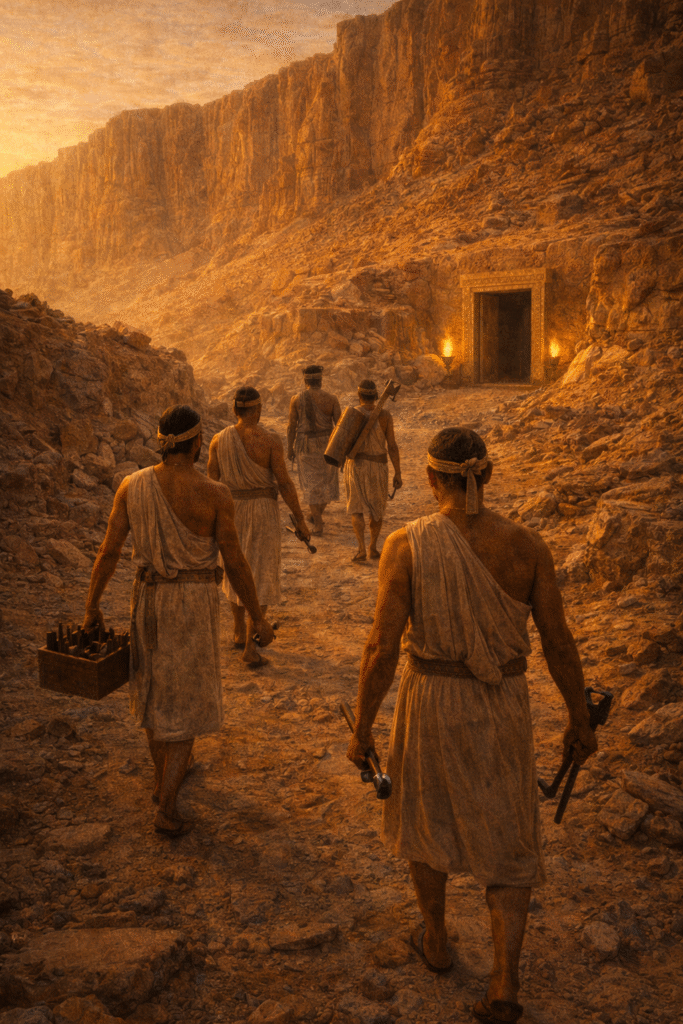
From the village,
a narrow path
climbs between hills
toward the hidden valleys
where tombs hollow the rock.
We walked that path
with a small group
of workmen.
They carried tools
wrapped in cloth—
chisels,
wooden mallets,
plumb lines,
red ochre for guidelines.
“Do you ever tire
of this walk?” I asked one.
He laughed.
“Majesty,
some men cross deserts
to raid cities.
I cross this path
to carve a corridor
only the dead will walk.”
He glanced back
at the village.
“I prefer my path.”
When we crested the hill,
the world opened:
Cliffs rising
on both sides,
raw and pale,
as if the earth
had split its own ribs open.
Marked entrances
to tomb corridors
dotted the rock.
From some,
the ring of metal
on stone echoed.
From others,
silence—for now.
“This is where
we carve eternity,”
said the foreman.
He gestured
toward a newly cut doorway.
“The one
preparing for your line.”
Not for me alone.
For the dynasty.
For the kings
who would sleep here—
including one day
the boy who watched me rule.
The air tasted
of dust and time.
“What you carve here,”
I said quietly,
“outlives all of us.”
The workers nodded.
“That is why we argue so much,”
one said.
“About what?”
“About getting it right.”
PART V — Inside the Unfinished Tomb
They led me
into a corridor
still in its raw stage.
Rough walls.
Ceiling marked
with red lines
in charcoal grids.
Outlines of figures
sketched with quick strokes—
gods,
offerings,
pharaohs,
stars.
It was like
standing inside
a thought
half-formed.
A worker
stood on a low scaffold,
carving the curve
of a vulture’s wing.
He did not stop
when he saw me.
His hand
did not shake.
Only when he finished
the line
did he step down
and bow.
“I did not wish
to ruin the arc,”
he said.
“Good,” I answered.
This was what
I had wanted to see—
not the finished glory
of polished walls,
but the living process.
The way red lines
became shallow grooves,
grooves became depth,
depth became image,
image became myth.
“Do you know,”
I asked him,
“who will be buried here?”
He nodded.
“A king.”
“Which one?”
He smiled faintly.
“Does it matter, Majesty?
Our work
must be worthy of a king
whether or not
we know his face.”
I studied his features.
He was young—
perhaps only a little older
than Thutmose.
“Do you ever think,”
I asked,
“that when people
look at these walls
centuries from now,
they will say
‘this is the tomb
of such-and-such king’
and never ask
who carved it?”
He shrugged.
“That is how it is.”
“But how do you feel?” I pressed.
He considered.
“Honestly?” he said.
“The gods know my lines.
The stone knows my hands.
That is enough.”
He hesitated.
“But if you remember us too,”
he added,
“that is more than enough.”
In that unfinished tomb,
with dust in my hair
and chalk on my fingers,
I made another quiet promise:
I would not forget
the ones
who gave my reign
its body.
PART VI — The Village at Evening
We returned to the village
as the sun dropped
toward the horizon.
Smoke rose
from cooking fires.
Someone played a flute
in a half-collapsed doorway.
Women laughed softly
over shared bowls of stew.
The day’s tools
were laid to rest
in niches and baskets.
Dusty linen
hung on pegs.
A girl
skipped past us,
singing a snatch
of a work song:
“Stone and story,
dust and glory…”
She stopped mid-step
when she saw me,
staring with wide eyes.
“Majesty,” she whispered.
I knelt
to her height.
“Do you know
what your father does?”
I asked.
“He hurts his hands,”
she blurted.
“Why?”
“So that kings
do not hurt theirs.”
I swallowed.
“What would you like
to do one day?” I asked.
“Paint the ceilings,”
she said promptly.
“Why the ceilings?”
She grinned.
“Because that is where
the stars are.”
Of course.
The future
always reaches upward.
PART VII — The Quiet Vow of the Workmen
As we prepared to leave,
the foreman
asked permission to speak.
“Majesty,” he said,
“you have walked our street.
You have stood in our dust.
You have seen us
as more than shadows
behind walls.”
“Yes,” I said.
“And for that,”
he continued,
“we owe you more
than our usual work.”
He glanced
at the men behind him.
They stepped forward—
not in procession,
not in choreographed display,
just a few paces closer,
as if drawn by a single thought.
“Say what you mean,”
I invited.
The foreman inhaled.
“If the day comes,”
he said slowly,
“when others
try to carve you out—”
My chest tightened.
He continued.
“—know that somewhere
in the foundations,
in the under-sketches,
in the layers of plaster
no priest inspects,
your truth will be there.”
He met my eyes.
“We carve what we are ordered.
But we can also carve
what we remember.”
I felt the weight
of his words settle
like stone.
“You think
they will try to erase me?”
I asked softly.
He hesitated.
“I know how courts work,”
he said.
“And I know
what it means
when a woman
moves stone like you do.”
There was no flattery
in his voice.
Only realism.
“And you?” I asked.
“What will you do then?”
He smiled crookedly.
“We will do
what we always do, Majesty.”
“Carve.”
Stand Where the Carvers Lived
If you have ever stood
in a cool, painted tomb
and wondered
who made the lines—
if you’ve walked
beneath perfect ceilings
and felt the presence
of the hands
that never signed their work—
if you’ve ever loved
the workers
behind the wonders
more than the names
on the plaques—
then this Scroll
is your invitation.
Come with ENA
into Deir el-Medina.
Stand in the narrow streets
where artisans
raised children
between shifts of eternity.
Step into their houses.
See their sketches,
their jokes on ostraca,
their little household shrines.
See the world
that made the world
you came to see.
Journey with ENA.
Eternity is carved
by ordinary hands.
PART VIII — The Night I Understood Who Would Save Me
On the way back
across the river,
the sky turned violet.
The city of Waset
glowed ahead,
torches and lamps
pricking the dark.
My officials
discussed supplies.
They calculated costs.
They plotted schedules
for future tombs.
Their voices
were a distant hum.
My mind
was in the village.
I saw again
the calloused fingers
holding chisels.
The girl who wanted
to paint stars.
The scribe
with his careful lists.
The foreman
making a promise
that history
would one day
depend on.
I realized something
with a sharpness
that almost hurt:
If the court
ever turned on me,
if the priests
ever tried
to rewrite me,
if a future king
felt threatened
by my memory—
it would not be
the nobles
who protected me.
Not the generals.
Not the bureaucrats.
It would be
the people
who carved and painted,
who could hide truths
in under-layers,
in faint lines
beneath newer scenes,
in corners
no one thought to scrub.
The village
of those
who carved eternity
would become,
one day,
the village
that carved me back
into it.
I did not say this aloud.
But I felt
a strange peace
knowing it.
Stone, I thought,
would remember me.
Because the hands
that fed stone
had just sworn it so.
Ancient Questioner’s Desk — The Workmen’s Edition
A student asked:
“Did she truly visit
the workers’ village?”
The elder replied:
“Those who build much
must someday see
who is building.”
Another asked:
“Did the workers love her?”
The scribe wrote:
“They loved their craft.
They respected
that she did too.”
A traveler wondered:
“Who kept her story alive
when the chisels turned?”
The historian answered:
“The same hands
that once cut her name in stone.”
A final question came:
“Can ordinary people
save a queen’s memory?”
The old master smiled.
“Who else ever has?”
Walk the Village of Eternity
This Scroll ends here—
not in a hall of gold,
not before towering pylons,
but in a narrow street
between small houses
on the west bank.
If you want to feel
the heartbeat
behind the monuments,
if you want to see
where the carvers slept
after shaping constellations
on tomb ceilings,
come walk
Deir el-Medina with us.
Run your fingers
along the walls
of homes
where eternity’s architects
once argued,
laughed,
and washed dust
from their hands.
Journey with ENA.
Behind every god in stone,
there is a village.
Historical Context
Deir el-Medina was a real and highly organized community of artisans responsible for constructing royal tombs. Archaeological evidence reveals details of their daily lives, labor systems, and religious practices.
The individual encounters and narrative focus in this scroll are reconstructed to reflect the social reality of the village, rather than to document specific recorded interactions.