
Scroll VII – A Night at the House of Skywatchers
Years: c. 1482–1481 BCE — Luxor Temple Observatory, Roof Chambers of the Priests of Heaven, and the Night the Stars Tilted
Translated and restored for the modern traveler.
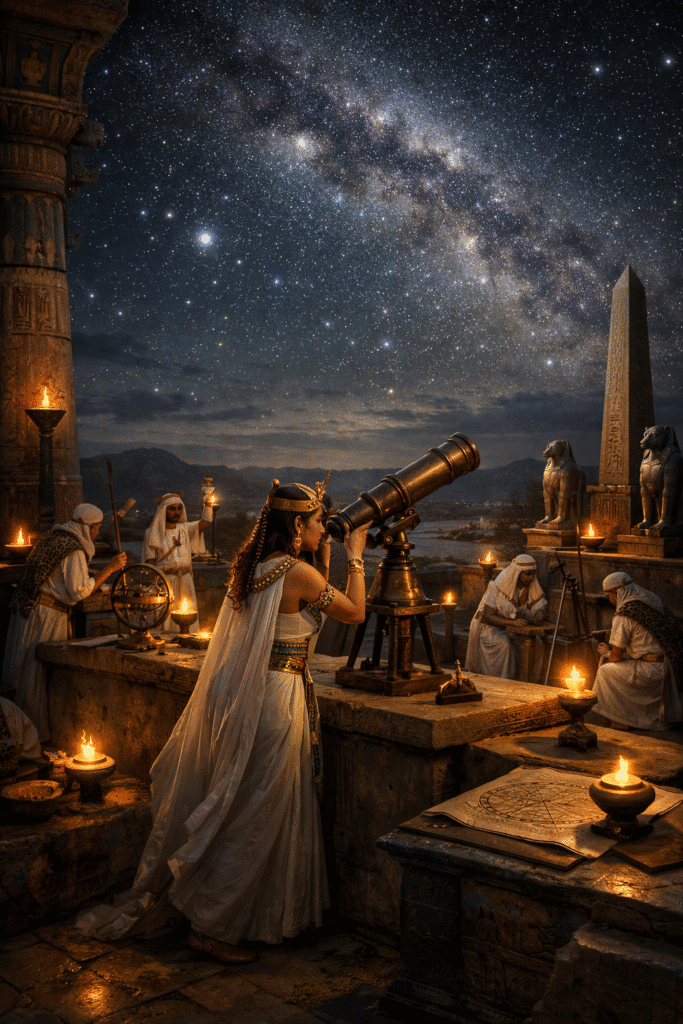
Prologue — The Stars Knew Me Before the Crowns Did
My destiny was not first spoken
in the halls of the palace
or the courts of Karnak,
nor in the whispers
of ambitious men.
It was spoken
in silence.
In the deep,
patient hum
of the sky.
Before I wore the crowns,
before priests nodded
in Amun’s dark chambers,
before my name rose
on temple walls—
there was a night
where starlight
and prophecy
and mathematics
drew a circle
around me.
I did not know then
that the sky
was the first archive
of my life.
But the skywatchers did.
This is the night
they invited me
to see what they saw.
And the night
I realized
that not all power
sits on thrones.
Some power
waits above you,
quiet
and watching.
PART I — The Summons From the Sky House
It began with a papyrus
sent quietly
to my chambers at dusk.
A small seal of wax.
A symbol of a star
and a reed.
The High Astronomer
of Luxor Temple
requested my presence.
Not publicly.
Not ceremonially.
Privately.
This meant two things:
- They had seen something.
- They did not want
the priests of Amun
to know yet.
When I arrived at Luxor,
the temple was mostly dark.
Only the skywatchers
remained awake—
their white robes
softened by lamplight.
The High Astronomer,
a lean man named Menkheper,
greeted me.
“Princess,” he said.
“Tonight, the sky
is restless.”
“The sky does not rest,”
I replied.
He smiled faintly.
“Then perhaps
it is you
who is restless.”
He led me up
the narrow stairway
to the roof chambers—
an observatory,
if you wish to call it that—
though we Egyptians
used no telescopes.
We used the eye.
The horizon.
Memory.
The predictable geometry
of divine order.
“Tonight,” Menkheper whispered,
“the gods speak
in the turning of the heavens.”
I raised an eyebrow.
“The gods always speak.”
“Yes,” he agreed.
“But rarely
so clearly.”
PART II — The Sky House and Its Instruments
The rooftop of Luxor Temple
was alive with quiet movement.
Not frantic.
Not chaotic.
Precise.
Serene.
Skywatchers
knelt on reed mats,
tracking star risings.
Others inscribed lines
onto angled boards.
Assistant astronomers
marked time
by the rising of the Decans—
the star groups
that told the hour
long before water clocks.
Oil lamps flickered
on low stands.
Copper instruments glinted:
- sighting rods
- measuring cords
- palm-rib calipers
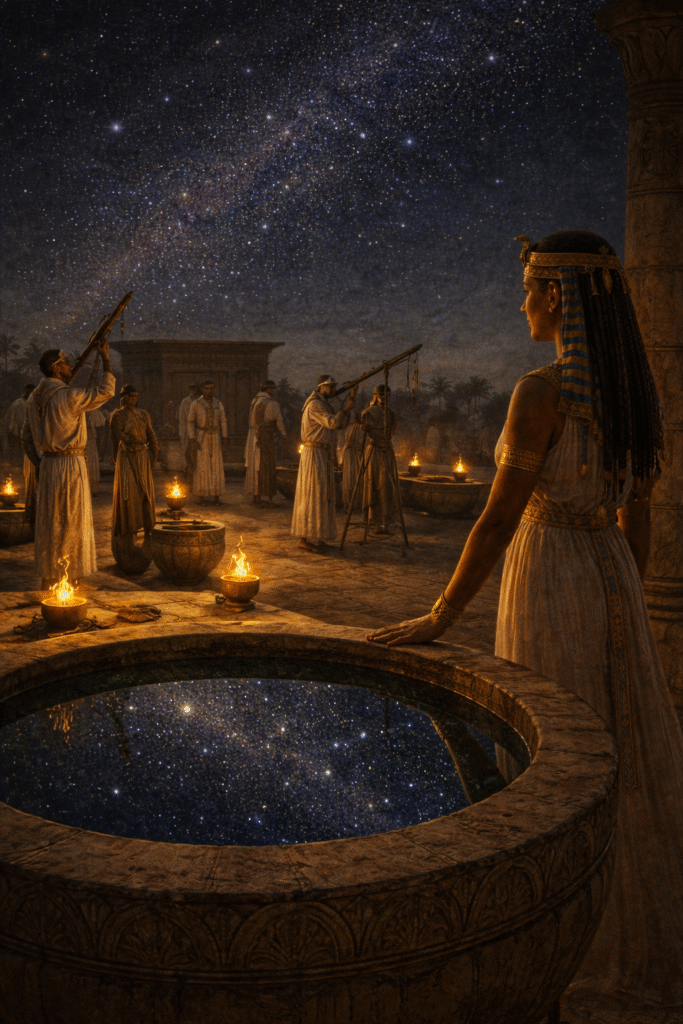
- star-mirroring bowls
filled with still water
One bowl caught my eye—
a reflection
of the sky above
laid out
like a glass copy.
Menkheper followed my gaze.
“That bowl,” he said,
“is for the stars
that cannot be looked at
directly.”
I leaned over it.
“The imperishable ones,”
I whispered.
“The undying stars.”
He nodded.
“They are the ones
kings rise to join
after death.”
He studied my face
as if waiting
for me to understand
some hidden meaning.
I ignored it.
And yet—
a chill crept
into my spine.
PART III — The Reading of the Night
The skywatchers moved
with choreographed grace.
One called out
the rising of Sopdet
(Sirius),
her light sharp as a blade.
Another read
the angle of Sah
(Orion),
whose belt
aligned with the horizon.
A third whispered:
“Note the shift
of Mesekhtyiu—
the Plough.”
Menkheper stood beside me.
“You know these stars
better than most princes,”
he said.
“I read the sky
because no one
forbade me,”
I answered.
A quiet laugh.
“Some rulers,” he murmured,
“interpret celestial signs
through priests.”
“And some rulers,” I replied,
“read the sky themselves.”
He bowed his head slightly.
“We called you
because the sky
is making a pattern.”
“What pattern?”
He gestured
toward a low writing board
where several skywatchers
were marking star paths.
A series of lines—
sharp, clean, deliberate—
intersected
in the shape
of a cartouche.
My throat tightened.
“That…
is coincidence,”
I said.
“Coincidence,”
Menkheper replied,
“is simply a message
we do not yet understand.”
He traced the pattern.
“These angles,” he whispered,
“have appeared only twice
in my lifetime.”
“When?”
“Once
the night your father
became king.”
“And the second?”
“Tonight.”
A pulse
throbbed in my temple.
“But I am not king,”
I said.
“Not yet,”
he murmured.
The word hung
between us.
Not prophecy—
but possibility.
And possibility
is more dangerous
than prophecy
because it does not
promise safety.
It promises choice.
PART IV — The Challenge They Set Before Me
The skywatchers
were not priests.
They were mathematicians.
Scientists.
Readers of time.
They did not flatter.
They tested.
Menkheper handed me
a sighting rod.
“If you wish to see
what we see,”
he said,
“mark the rising
of the Red Star.”
He meant
Montu’s Star—
the one associated
with kingship
and war.
I steadied the rod.
Positioned it.
Waited.
The horizon
shifted its color.
There.
A flicker.
A pulse.
A star rising
like a coal
sparking into flame.
I marked the angle.
Perfectly.
A murmur
ran through the skywatchers.
“She sees,”
one whispered.
“She sees clearly,”
said another.
Menkheper’s voice
was quiet.
“There are princes
who have tried
for years
to sight that star
without trembling.”
I lowered the rod.
“My hand is steady,”
I said.
“Your destiny,”
he answered,
“may be steadier still.”
PART V — The Star That Should Not Have Moved
Then—
as the night deepened—
something changed.
A skywatcher
shouted softly:
“Look—
Sah bends!”
The constellation
tilted slightly.
Not enough
to alarm the untrained eye.
But enough
to trouble
those who lived
by celestial consistency.
Menkheper’s face
tightened.
“That movement,”
he whispered,
“marks transition.”
“Of what?”
“Of power.”
My breath
caught.
He added:
“I have seen that shift
only once before.”
I swallowed.
“When?”
I asked.
“The night
your father died.”
Silence.
Huge.
Thick.
Electric.
I looked at Sah—
Orion—
the great hunter
of the sky.
He was tilting
toward the horizon
as if bowing.
No—
as if acknowledging.
Acknowledging what?
Or who?
Menkheper spoke again,
his voice very low.
“Princess…
the sky listens
before the court does.”
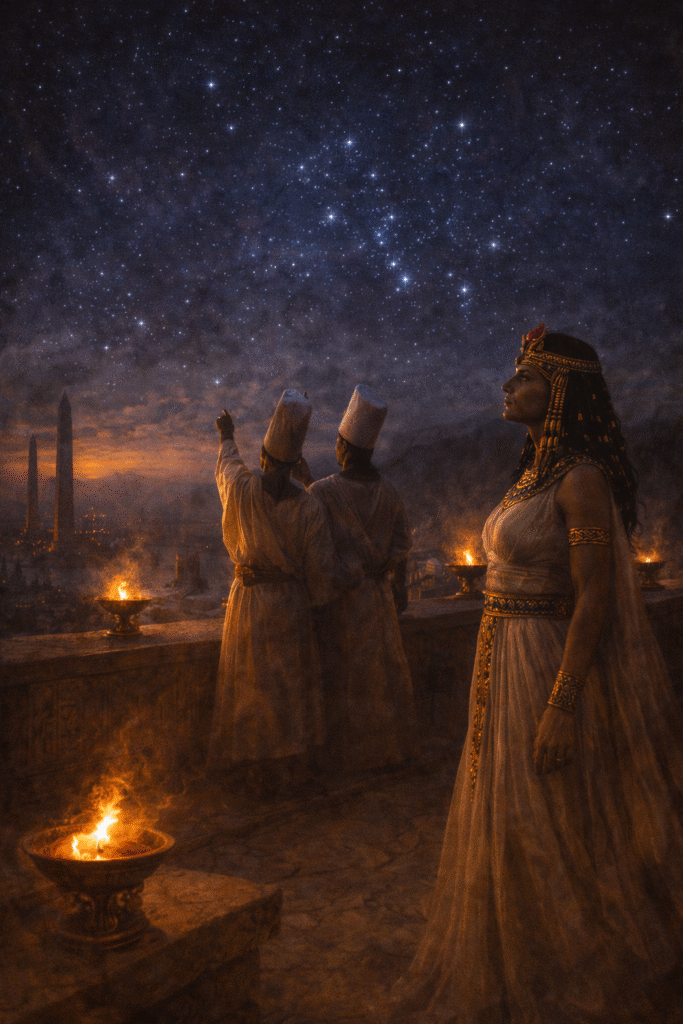
I stared at the stars.
They stared back.
PART VI — The Quiet Question They Never Asked Allowed
When the sky settled,
the skywatchers
gathered around me.
Not like courtiers.
Not like nobles.
Not like men
waiting for commands.
Like witnesses.
A young astronomer
barely older than I
asked:
“Princess…
do you feel something
when you look at the heavens?”
I hesitated.
Then nodded.
“Yes.”
“What do you feel?”
I searched for the word.
“Alignment,”
I whispered.
Menkheper inhaled sharply.
“Then,” he said,
“the sky sees you.”
He stepped closer.
“There are rulers,”
he said softly,
“who sit on thrones
without the heavens’ notice.”
“And there are those,”
he continued,
“around whom
the heavens reorder themselves.”
He looked into my eyes.
“You are the second.”
The rooftop
felt suddenly
too small.
The sky
too vast.
I felt seen
in a way
no court chamber
had ever made me feel.
Not by men.
Not by priests.
By something older.
Wider.
Beyond their reach.
PART VII — The Priest Who Interrupted the Stars
Our silence
was broken
by a sound—
footsteps.
The assistant high priest
of Amun
appeared on the roof,
face tight with disapproval.
He had not been invited.
“Princess,”
he said sharply,
“your place
is not among astronomers
at this hour.”
He looked at Menkheper.
“And yours
is not to fill her head
with illusions.”
Menkheper bowed
with mock courtesy.
“Forgive me,”
he said,
“if knowledge
is an illusion.”
The priest bristled.
“The heavens,”
he snapped,
“are the domain
of the gods.”
“And of those,”
Menkheper replied,
“who measure
what the gods create.”
The priest turned to me.
“You should leave, Princess.”
He meant:
You should not know
what we cannot control.
I straightened.
“No,”
I said.
The wind
caught my braid.
“I stay.”
His jaw tightened.
“This is not wise.”
“Then wisdom,”
I murmured,
“has taken a new form tonight.”
He stared at me—
a long, assessing stare.
He bowed stiffly.
“As you wish.”
He left.
But not before
glancing at the sky—
and seeing
what we had seen.
He would carry
that image
straight back to Karnak.
Whispers
would begin.
Not yet loud.
Not yet dangerous.
But present.
And whispers
are the first winds
of storms.
PART VIII — The Star That Fell Into the Water
As the night waned,
Menkheper guided me
to a bowl
used for reflecting
the imperishable stars.
“Look,”
he whispered.
Sah—Orion—
glimmered faintly
on the water’s surface.
“It reflects
slightly deeper,”
he said.
“Unusual.”
“What does it mean?”
“That the sky
leans toward earth.”
He looked at me.
“Toward you.”
I exhaled.
The reflection trembled.
A wind rippled the water.
For a moment
it looked as if
a star
had fallen
into the bowl.
Menkheper murmured:
“Some rulers
leave their mark on earth.
A rare few—
heaven marks them first.”
I touched the rim
of the bowl.
Cold.
Smooth.
Alive.
“What should I do
with such a sign?”
I asked.
“Remember it,”
he said.
“Even if others
try to make you forget.”
His words
would return to me
years later—
when the chisels
began their work.
When the priests
turned silent.
When the records
grew thin.
When my name
started fading
from temple walls.
This night—
this reflection—
this strange alignment—
would become a thread
that tethered me
to something
the erasers
could not reach.
The sky remembers
what stone forgets.
PART IX — Dawn Over Luxor
When the stars dimmed
and the sky
turned from black
to ash-blue,
the skywatchers
extinguished their lamps.
Menkheper walked me
to the edge
of the roof.
“Princess,”
he said,
“tell me something.”
“What?”
“When you stand
in the court tomorrow…
will you stand differently?”
I considered.
“Yes,”
I whispered.
“Good,”
he said.
“Then tonight
was not wasted.”
He bowed to me—
not as a courtier
bows to a princess,
but as a scholar
bows to someone
who understands
the weight
of the unseen.
As I walked back
through Luxor’s quiet halls,
I felt
something deep inside me
click into alignment.
Not ambition.
Not arrogance.
Orientation.
A sense
that I was beginning
to stand
in the direction
my life
was meant
to rise.
Walk Beneath the Sky That Marked Her
If you’ve ever stood
beneath Luxor Temple
and felt the wind shift
as if carrying
something older—
if you’ve ever wondered
how ancient Egypt
read the sky
long before telescopes—
if you’ve ever felt
destiny brush against you
in a quiet hour—
then this Scroll
speaks your language.
Walk with ENA
through the temple
where astronomers
once whispered
to the heavens.
Climb the paths
where skywatchers
mapped time.
Stand on the roof
where she once stood
under a night
that changed her life.
Journey with ENA.
Sometimes the gods whisper
in the turning of the stars.
PART X — What This Night Means for the Story Ahead
This night
did not crown me.
It did something more subtle—
and more important.
It prepared me.
The skywatchers
did not say:
“You will rule.”
They said:
“The sky sees you.”
And once you have been seen
by something larger
than the world—
you cannot return
to being small.
When I stood in Karnak
for the oracle soon after,
when Amun’s barque tilted,
when priests whispered
of dual destinies—
I already carried
the memory
of this night.
The court thought
they were revealing
my path.
But the stars
had shown it to me first.
Ancient Questioner’s Desk — The Celestial Edition
A student asked:
“Did the sky truly move for her?”
The elder replied:
“The sky moves for all—
but only some
notice the shift.”
Another asked:
“Was this prophecy?”
The scribe wrote:
“No.
It was recognition.”
A traveler wondered:
“Did the priests fear
what she saw?”
The historian answered:
“They feared
that she saw too clearly.”
A final question came:
“Why did this night matter?”
The old master smiled.
“Because power
first touches us
in silence.”
Step Into the Star House
This Scroll ends here—
on a rooftop,
in starlight,
with wind brushing
against a destiny
not yet named.
If you want to see
where the heavens
once leaned toward a woman
long before the kingdom did,
come walk
beneath the stars
that still remember her.
Journey with ENA.
Some nights
reshape an entire life.