
Scroll VI – The Ship That Carried My Dreams: Sailing to Punt
Years: c. 1482–1480 BCE — The Nile Waters, Khmunu Shipyards, The Red Sea Port, and the Horizon Beyond Kemet
Translated and restored for the modern traveler.
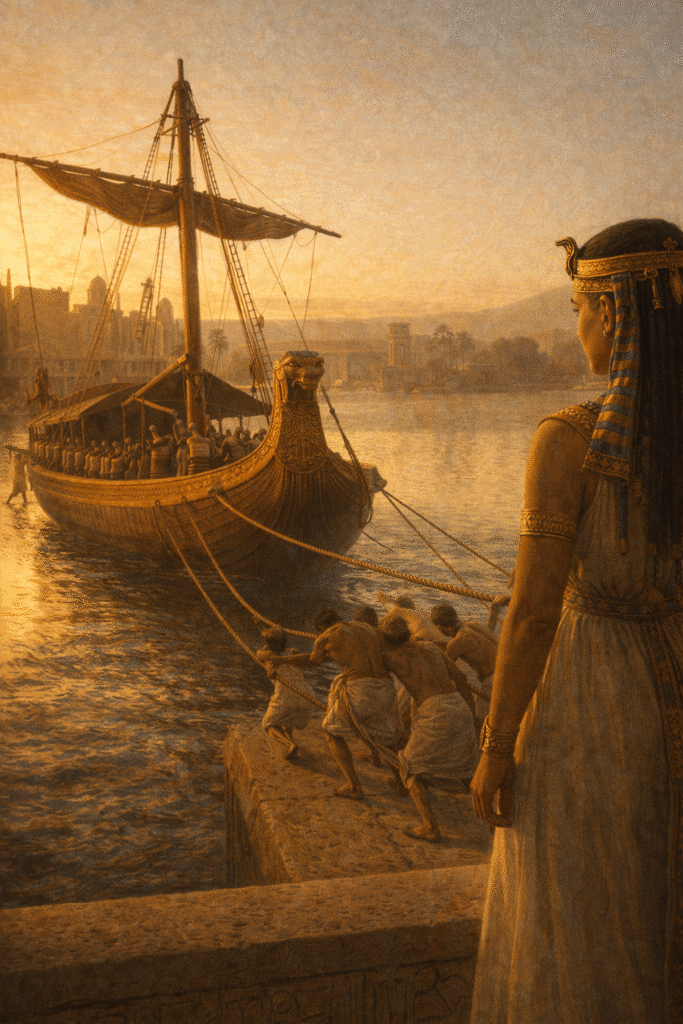
Prologue — Before I Ruled, I Reached
People think my reign began
when they placed the crowns upon me.
It did not.
It began
when I reached.
Reached beyond the river.
Beyond the court’s expectation.
Beyond the safe borders
that kept women in palaces
and kings in the center of maps.
Before I ruled Egypt,
I expanded it—
not with soldiers,
but with ships.
This Scroll
is not only about a voyage.
It is about the moment
I realized something dangerous:
I could move the world
even before the world
allowed me to rule it.
PART I — The Idea the Court Laughed At
The idea came to me
in a warm season
when the Nile
was low and fragrant.
Trade was sluggish.
Incense stores
were running thin.
The temples
complained softly
that their offerings
smelled less divine
than they wished.
One evening,
I stood with my mother
on the palace rooftop
watching boats drift lazily
toward the west bank.
“There was a time,” she said,
“when ships brought myrrh
from Punt
as easily
as wheat comes from the fields.”
“And why not again?”
I asked.
She smiled,
half amused,
half wistful.
“Because Punt,” she said,
“lives on the edge
of memory.”
Most thought Punt
existed in stories—
a place told by grandfathers,
half real, half myth.
But I had read
every scribal note
about the old voyages.
I had traced the routes
on palm-leaf maps
in the scribal hall.
I had questioned
old sailors
with more scars than teeth.
“Let us sail again,”
I said.
My mother looked at me
with something like pride—
and worry.
“Present it to the council,”
she whispered.
“And see
how small
their imaginations are.”
So I did.
The next morning
in the audience hall,
I proposed it.
A noble snorted.
A general raised an eyebrow.
Two scribes exchanged
smirking glances.
“Punt?” one muttered.
“Perhaps she seeks
the land of dreams next.”
The high priest
gave a thin smile.
“Princes reach
for ambitious things,”
he said,
“but the great river
doesn’t always flow
at their command.”
I held his gaze.
“The river does not need to,”
I said.
“We have the sea.”
A murmur.
Uncomfortable.
Intrigued.
Underestimated.
The idea was dismissed
with polite phrases
and quiet condescension.
But dismissing a woman
is not the same
as stopping her.
I realized then:
if a project stirred me deeply,
I would have to carry it myself.
And so I did.
PART II — The Shipyards of Khmunu
If the court
would not help me build,
I would go to those who loved building.
Khmunu—
the great shipyard city
near the river’s bend.
When I arrived unannounced,
the overseer nearly fainted.
“Princess,”
he stuttered,
“we were not told—”
“I did not come
to be told,”
I said.
“I came to see.”
The shipwrights
paused their hammering
and bowed.
The smell
was intoxicating:
cedar
heated by the sun,
pitch bubbling
in clay pots,
river air
thick with sawdust.
I walked through aisles
of half-built hulls.
Ribs of ships
curved upward
like the skeletons
of great beasts.
“Tell me,” I asked a builder,
“how far these ships can travel
if their hulls
are made double-thick.”
He blinked at me—
not with confusion,
but with delight.
“Farther than the nobles think,”
he said.
“And if we strengthen the mast
with Syrian timber?”
“Farther still.”
“And if we alter the sail shape?”
He grinned.
“Depends on the wind,”
he said.
“But Princess—
we could reach anywhere
the gods allow.”
I felt heat rise in my chest.
“Good,” I whispered.
“Because the gods
and I
have a destination.”
We began sketching designs
right there
in the dust.
The court had laughed.
The shipwrights
did not.
The shipwrights
understood ambition.
And more importantly—
they loved challenges.
PART III — The Boy on the Dock
Thutmose heard
I had left the palace
and raced after me
with two guards trailing behind.
He arrived breathless
at the shipyard.
“Aunt!”
he called out.
“You didn’t tell me!”
“I didn’t think
you’d want to come,”
I teased.
He frowned
in that serious way
children use
when they think
they are adults.
“I want to see everything.”
So I led him
along the docks.
He walked beside me,
eyes enormous
at the sight of towering hulls
and workers shouting
across scaffolds.
“What is this for?”
he asked.
“A journey.”
“To where?”
“A place called Punt.”
“Is it real?”
I crouched beside him.
“If it is not,” I said,
“we will be the ones
to make it real again.”
His eyes widened.
“And you can do that?”
I smiled.
“We can.”
He stared at the ship
for a long moment.
“Will the priests like it?”
“No.”
“Will the generals like it?”
“Not particularly.”
He grinned.
“Then it must be important.”
He was right.
Already
he knew
how to read a court.
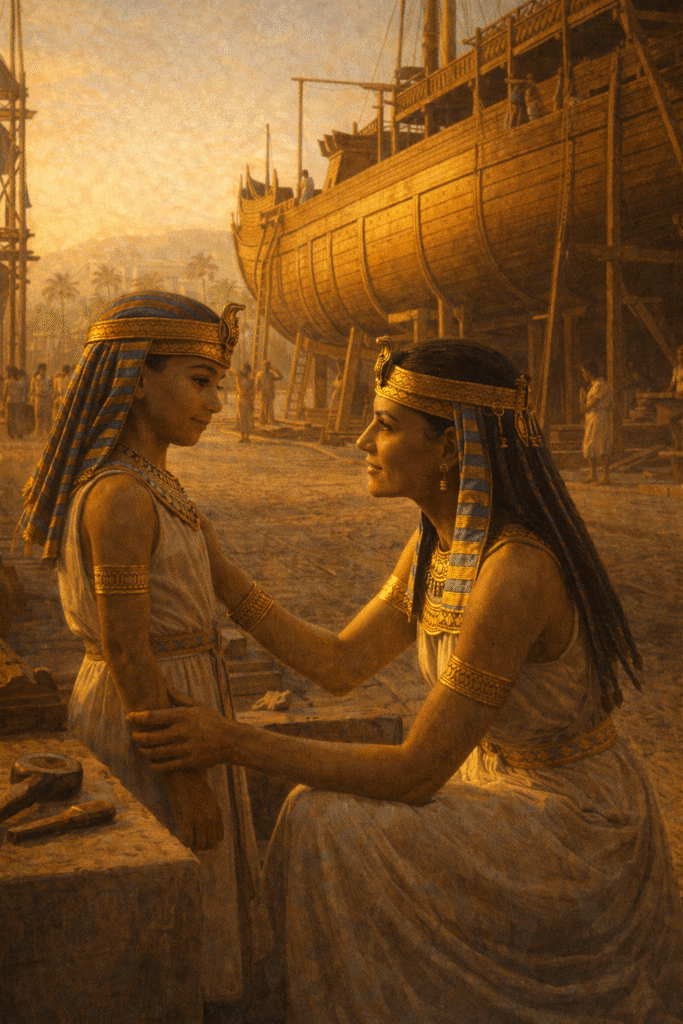
PART IV — The Day the Ships First Touched Water
When the ships
were completed,
the entire city
gathered to watch
the first one launched.
I stood with the overseer
on the dry dock platform.
Workers raised ropes.
Singers began hymns
to Ptah the Maker.
Water bearers
poured jugs
onto the carved runners
beneath the hull.
“Princess,”
said the overseer,
“give the word.”
My heart beat
like a drum.
“Let her enter the water,”
I said.
With a roar of rope,
the ship lurched forward.
Wood groaned.
Men shouted.
The massive hull
slid down the greased planks—
slow
then faster
then faster—
SPLASH.
The water erupted
in silver spray.
The ship rocked.
Settled.
Straightened.
Alive.
The crowd cheered—
but I felt something
deeper than triumph.
I felt expansion.
The sense
that the world
was larger
than the minds
that tried to limit me.
That possibility
was not a distant shore—
but something
you could build
with your own hands.
The first ship floated.
Then the second.
Then the third.
Five in total.
Five carriers
of ambition.
Five vessels
for a destiny
the court had not approved.
And yet—
they floated.
And I floated with them.
PART V — The Court Realizes Too Late What I Built
When the court
finally saw the ships,
their expressions
shifted.
Not fear.
Not outrage.
Awareness.
The generals squinted,
calculating distances.
The nobles muttered,
calculating trade routes.
The priests frowned,
calculating theological implications.
The king—
my brother-husband—
looked at me
with confusion
tinged with admiration,
as if trying to understand
what version of me
he had married.
“You planned this,”
he said quietly.
“Yes.”
“Without us?”
“Yes.”
“And you built it?”
“Yes.”
He exhaled.
“Hatshepsut…
this is large.”
“I know.”
“Larger than anything
we have attempted
in decades.”
“I know.”
He stared at the ships again.
“Then why,” he whispered,
“did no one see you doing it?”
I met his eyes.
“Because they were looking
in the wrong rooms.”
He shook his head—
not in disapproval—
in awe.
The high priest approached next.
“Princess,” he said,
voice guarded,
“the god Amun
is pleased with devotion—
but he has not commanded
this journey.”
“Then he may witness it,”
I replied.
He hesitated.
“You intend to sail?”
I looked at the ships—
proud, towering, impossible.
“I intend,” I said,
“to lead.”
For the first time,
the priest’s eyes flickered
with something new:
Respect.
And unease.
PART VI — The Sea Route and the Silent Hours
The journey
to the Red Sea port
was long.
We moved ships
piecemeal,
disassembled
and hauled
across the eastern desert
to be rebuilt
at the shoreline.
Caravans of oxen
pulled beams.
Workers carried rope
in coiled bundles.
Guards escorted
the entire procession.
The desert
was a world of silence.
By day
the sun hammered
the earth white.
By night
the stars burned
like unanswered questions.
As we walked,
I spoke with sailors
who had traveled
farther than nobles
ever would.
“How do you know
when to adjust the sail?”
I asked one.
“When the wind
changes mood,”
he answered.
“And how do you read that?”
“By listening,” he said.
Not with ears.
With skin.
With memory.
With instinct.
A general once told me
that soldiers
win empires.
He was wrong.
Sailors do.
—
At the Red Sea port,
the air tasted like salt
and foreign winds.
The workers
reassembled the ships
on the sand
as if resurrecting giants.
I walked between them
at dawn
while the tide whispered
in the shallows.
This was the moment
I realized
that leadership
was not throne-bound.
Leadership
was movement.
Direction.
Choosing a horizon
even when the court
wanted you to stay still.
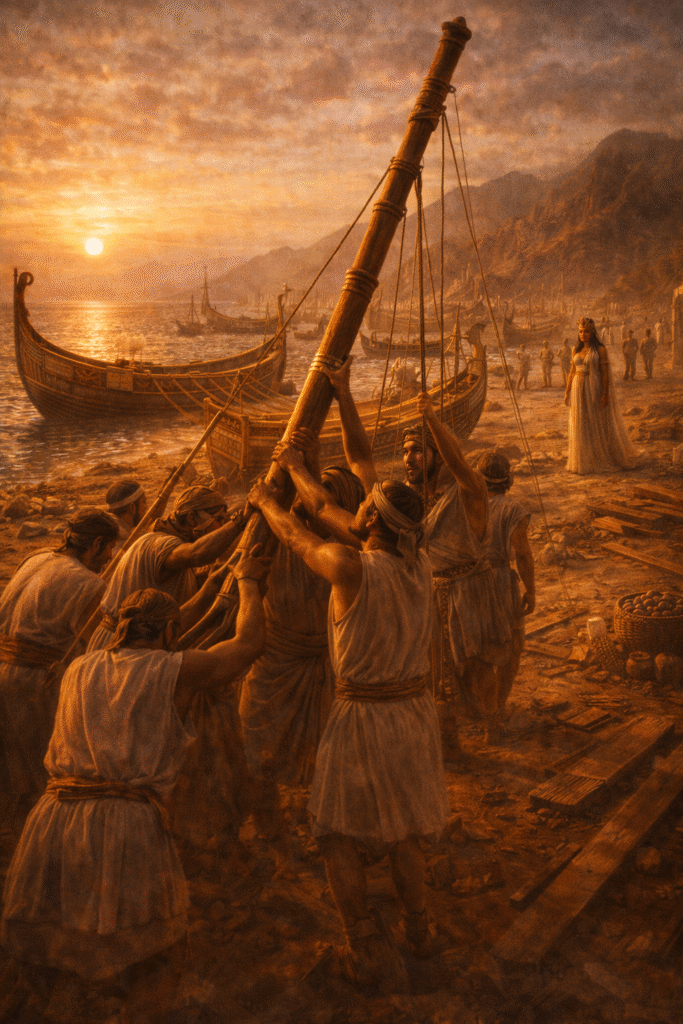
PART VII — The First Night at Sea
We set sail
under a sky
the color of burnt copper.
The sea
was nothing like the Nile.
The Nile
is a mother—
steady, predictable,
generous.
The sea
is a stranger—
beautiful,
dangerous,
never promising
to keep you alive.
The deck swayed
beneath my feet
as if testing me.
A sailor laughed.
“Princess,”
he said,
“the sea greets you.”
“Is this greeting friendly?”
“It depends
on whether you fear it.”
I smiled.
“I fear nothing
that answers to the wind.”
He grinned.
“You will do well.”
As night fell,
we sailed under stars
the priests
never taught me to name.
I stood at the bow
watching waves
turn black and silver.
I felt—
not fear,
not triumph—
certainty.
This journey
was more than trade.
It was proof.
Proof
that I could envision
a world larger
than the palace walls.
Proof
that Egypt could stretch
to the ends of memory.
Proof
that my hands
could shape things
that would outlast me.
I did not yet know
the priests
would later try
to erase this triumph.
But even if they did—
the sea itself
had witnessed it.
And the sea
forgets nothing.
PART VIII — The Land of Punt
I will not tell you
every detail
of the arrival.
Some things
must be felt
by standing
in the wind yourself.
But know this:
Punt
was real.
Real
in the warm smell
of myrrh groves.
Real
in the laughter
of its people.
Real
in the generosity
of its rulers.
Real
in the way
their queen embraced me
as if she had known
I was coming.
Real
in the trade
that flowed
freely
and joyfully
between us.
We stayed for months.
We learned
their medicines,
their ways,
their tides.
I recorded everything:
- the shape of their houses
- the spices they ground
- the trees they offered
- the stories they told
- the way they welcomed
a woman in authority
as if it were
the most natural
thing in the world
When we departed,
our ships
were heavy with gifts.
But my heart
was heavier
with something else:
A sense
that my destiny
was not confined
to what Egypt
expected of me.
If I could open the world
beyond the sea—
then perhaps
I could open the world
within Egypt too.
PART IX — The Return That Changed Everything
When we returned,
the court gasped.
The ships
arrived laden
with:
- myrrh trees
roots wrapped in baskets - ebony
- gold
- exotic animals
- fragrant resins
- rare pigments
- new knowledge
- new alliances
The people
crowded the docks.
Children climbed
onto their fathers’ shoulders.
Women lifted their hands
in blessing.
Even the priests
could not deny
the divine scent
that filled the air.
The high priest
approached me
with a strange expression.
“Princess,”
he said quietly,
“Amun smiles.”
Yes.
Amun smiled.
But so did
the court factions
who suddenly realized
what I had become.
Not just a princess.
Not just a wife.
Not just a priest’s favorite.
But a leader
who had moved a nation
before the nation
allowed her to rule.
Whispers spread
like wind:
If she can do this
without a crown…
what could she do
with one?
I walked past them
with calm grace.
Inside,
I felt the world tilt.
The sea
had changed me.
And now
Egypt
would have to change too.
For Travelers Who Want to Touch a Legend
If you have ever stood
on the terrace of Deir el-Bahari
and wondered
why the Punt reliefs
are carved so deeply—
If you’ve ever been drawn
to the story
of the woman
who brought literal forests
home from across the sea—
If you’ve ever wanted
to feel the wind
that carried her dreams
between worlds—
then this voyage
is waiting for you.
Walk with ENA
to the reliefs
that survived erasure.
Stand before the ships
carved into stone
as if they are still moving.
Trace the lines
that the workers protected
with quiet rebellion.
Journey with ENA.
Some voyages
reshape entire kingdoms.
PART X — The Shadow the Journey Cast Forward
Only later
would I realize
how much Punt
changed everything.
It became:
- the proof
that I could command loyalty
outside the palace - the reason
the gods’ favor
was publicly tied
to my hands - the justification
for future crowning - the seed
of future resentment
from those
who feared my ambition - the anchor
of my legacy
literally carved
in stone
The journey to Punt
was the first step
toward my rise.
And later—
ironically—
one of the reasons
they tried to erase me.
For if a woman
could command such success
without the crowns—
men wondered
what she might accomplish
with them.
Their fear
would grow.
But so would my certainty.
And certainty
is harder to erase
than any relief.
Ancient Questioner’s Desk — The Voyage Edition
A student asked:
“Did she go to Punt
for wealth
or glory?”
The elder replied:
“For neither.
She went for possibility.”
Another asked:
“Was Punt real?”
The historian wrote:
“Yes.
Real enough
to change the shape of Egypt.”
A traveler wondered:
“Why did they later
chip her story away?”
The scribe answered:
“Because the success
of this voyage
was too undeniable
to quietly ignore.”
A final question came:
“Did this journey
make her Pharaoh?”
The old master smiled.
“It made her inevitable.”
Returning Home With Her
This Scroll ends here—
with sails unfolding,
cargo heavy,
the Nile welcoming
a fleet few believed
could ever return.
If you want to see
the reliefs
that defied centuries
of erasure,
if you want to feel
the moment
Egypt realized
the greatness
already beating
inside her,
then come walk
the terraces
where the journey
still lives in stone.
Journey with ENA.
Some ships
carry more than cargo.
Some carry destiny.
Historical Context
Hatshepsut’s expedition to Punt is one of the best-documented events of her reign, recorded in detailed reliefs at Deir el-Bahari showing ships, goods, foreign rulers, and exotic landscapes.
While the voyage itself is historically attested, the personal observations, conversations, and narrative pacing in this scroll are literary interpretations intended to bring the monumental record into lived experience.