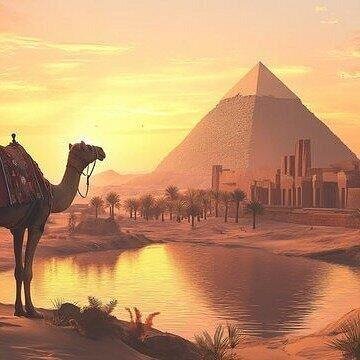
Scroll V – The Festival of a Thousand Lamps
Luxor & Thebes — Year 3 of My Reign
Translated and restored for the modern traveler.
*[Suggested Visual: Tutankhamun at dusk on a barge on the Nile, thousands of floating lamps glowing across the water, crowds lining the banks, drums echoing.]
AI Prompt: “Young Tutankhamun age 10 on ceremonial Nile barge at dusk during festival, thousands of floating oil lamps on water, crowds celebrating on riverbank, cinematic realism.”]*
Prologue — A Kingdom That Dances Is a Kingdom That Still Believes
For years
Egypt did not celebrate.
Not during my father’s revolution.
Not during the famine.
Not during the collapse of temples.
Not during the silence of the gods.
Joy
had become a memory.
But when the temples reopened
and Amun’s barque moved again,
the people asked for something
they had not felt
in a very long time:
Hope.
And hope, in Egypt,
is lit with lamps.
This scroll
is the day
Egypt burned with light again.
PART I — The Command That Surprised Me
Ay stood before me
in the audience chamber.
“Majesty,” he said,
“the people desire a festival.”
“A festival?”
I repeated.
I thought of temples
still under repair.
Officials still tense.
The kingdom still fragile.
“Yes,” Ay said firmly.
“A thousand lamps on the Nile.
Music.
Offerings.
Laughter.”
Horemheb stepped forward.
“It will show the world
that Egypt is stable again.”
I looked up from my throne.
“But are we stable?”
Ay’s smile was faint.
“If they believe it…
then we are.”
And that was my first lesson
in statecraft:
Sometimes a nation
must celebrate
before it is healed,
to remember
what healing feels like.
PART II — Preparing the Nile
As the day approached,
the palace overflowed with activity.
Artisans carved new lanterns
from alabaster.
Priests soaked wicks
in perfumed oils.
Scribes recorded lists
of offerings.
Boat captains polished
their ceremonial barges.
Women wove garlands
of lotus and papyrus.
Ankhesenamun dragged me
to the balcony one morning.
“Look!” she laughed.
Below us,
children chased each other
through the courtyard,
each holding a tiny clay lamp.
“Do you hear it?” she asked.
“Hear what?”
“Laughter, Tut.
Do you remember the last time
you heard that in this palace?”
I didn’t.
She squeezed my hand.
“Then Egypt is already healing.”
PART III — The First Lamp Lit
At sunset
the Nile turned gold.
Crowds gathered
along both banks—
families, soldiers, elders,
merchants, farmers, scribes,
children holding lamps
two hands too small.
A hush fell
as I stepped onto
the royal barge.
Its prow
was carved with the head of Amun.
Its deck
strewn with lotus petals
that crushed softly underfoot.
I lifted
a small oil lamp.
Simple.
Ungilded.
The lamp of a child
and a king.
Ankhesenamun stood beside me.
Ay and Horemheb behind me.
I turned toward the water.
A priest whispered:
“Majesty…
begin.”
I knelt
and lowered the lamp
onto the surface of the Nile.
For a moment
it floated dark.
Then—
light.
A single flame
blossomed on the water.
A cheer rose
from the crowd.
Small.
Tentative.
Growing.
Ay murmured:
“Now they will follow.”
And they did.
PART IV — A Thousand Lamps Become Ten Thousand
One by one,
lamps touched the Nile.
Then dozens.
Hundreds.
Thousands.
The river
became a ribbon of fire—
gold, orange, pink,
reflections dancing
like living spirits.
Drums began to beat.
Sistrums shook.
Women ululated.
Men called blessings
toward the barge.
Thebes
had not sounded like this
in years.
I felt
a tightness in my chest.
Not fear.
Emotion
so strong
it hurt.
Ankhesenamun leaned close.
“You did this,” she whispered.
“No,” I said.
“Egypt did.”
She smiled.
“Then Egypt needed you.”
PART V — The Night Dancers Arrive
As twilight deepened,
troupes of dancers
began to perform along the banks.
Their skin glistened with oil.
Gold anklets chimed
with each step.
Their silhouettes
moved like flames.
A group of young acrobats
leapt across platforms
built over the water,
their reflections
twisting beneath them
like living doubles.
Children threw lotus petals
into the river.
Musicians played
reed flutes
and lyres
in joyous, chaotic harmony.
People chanted my name:
“Tutankhamun!
Tutankhamun!”
But the name
did not feel heavy tonight.
It felt lifted
by the voices
of thousands.
For the first time
since my coronation—
being king
felt beautiful.
PART VI — The Warning Beneath the Celebration
While the music soared
and lamps floated like stars
upon the river,
Horemheb stepped beside me.
“Majesty,” he murmured,
“do not be deceived.”
I blinked.
“By what?”
He gestured
toward the joyful crowds.
“This.
Festivals
are also a test.”
I frowned.
“Of what?”
“Of loyalty,”
he said quietly.
“Of stability.
Of whether the people
believe in their king.”
I watched the crowds again.
The dancing.
The chanting.
The brightness.
It did not look like a test.
But then I realized—
Every cheer
was a vow.
Every lamp
was a prayer.
Every light
was a question:
Will you guide us
into a brighter future?
And every flame
asked for an answer.
PART VII — A Whisper from the Water
As the procession drew on,
I stood at the bow
of the barge.
A breeze
rose from the river.
Cool.
Steady.
Carrying the smell
of lotus and oil.
The lamps
drifted past
in a glowing procession
like the souls
of the blessed dead
crossing into the Field of Reeds.
I closed my eyes.
In the whisper of the breeze,
I heard something—not a voice,
but a feeling:
“If you lead,
they will follow.”
Was it Amun?
Was it the river?
Was it my own hope
reflected back at me?
I didn’t know.
But I felt
something shift inside me.
Purpose.
Courage.
A tiny ember
of destiny.
The lamps passed
one by one.
And each one
strengthened that ember.
PART VIII — The Gift from a Child
As the barge docked
near the palace steps,
the crowd parted.
A small girl—
no older than five—
stepped forward.
She clutched
a clay lamp
with trembling hands.
It was unlit.
Her mother pushed her gently.
The girl approached me
with wide eyes.
“Majesty,”
she whispered,
“my father says
I should give this to you.”
I knelt.
Pain sparked
through my joints—
but I knelt anyway.
“For me?”
I asked.
She nodded
and placed the lamp
into my hands.
Her mother cried softly.
“For your health,”
she said.
“For your long life.”
I lit the lamp
with my own flame
and returned it to the girl.
“For yours too,”
I said.
Her smile
broke something warm
open inside me.
I walked back
onto the barge—
not as a boy
carried by destiny,
but as a king
carried by a people.
PART IX — The Night That Changed Everything
Later,
in the quiet of the palace,
Ankhesenamun asked:
“Tut…
what did the festival mean to you?”
I looked out
at the last drifting lamps
far down the river.
“It meant,” I said slowly,
“that Egypt
is beginning
to believe again.”
She touched my hand.
“And you?”
I hesitated.
Then I answered:
“And I am beginning
to believe in myself.”
But there was another truth
beneath that—
one I did not yet know
how to speak:
**The festival
had awakened something
in the hearts of the people—
and also
in the hearts of those
who feared the power
of a beloved king.**
Light
attracts shadows.
And the brighter the kingdom glowed—
the more the shadows
would begin to move.
Epilogue — A Thousand Lamps Float Down the Nile Still
If you walk the Nile
on the right night,
the river still remembers.
It holds
the echo
of those lamps.
The whisper of music.
The scent of oil.
The warmth of hope.
The fragile courage
of a boy king.
And the promise
of a kingdom reborn.
Egypt does not forget
the night
her heart began beating again.
Neither do I.
FINAL CTA — Walk the Nile Where Egypt Reawakened
If you want to stand
where thousands of lamps
once floated like stars,
where Tutankhamun
tasted his first true moment
of being a king beloved—
walk the Nile with ENA.
Journey with ENA.
Even a child king
can relight a nation.
Even a single lamp
can guide a kingdom home.
Historical Context
Religious festivals were vital to reinforcing state religion and royal authority. After years of disruption, renewed public ritual signaled stability and continuity.
This scroll uses a single festival narrative to represent broader ceremonial restoration rather than a documented singular celebration.