
Scroll V – The Boy Who Watched Me Rule
Years: c. 1483–1479 BCE — The Nursery Overlooking the Court, The Audience Hall, The Garden of Sycamores, and the Roofs of Waset
Translated and restored for the modern traveler.
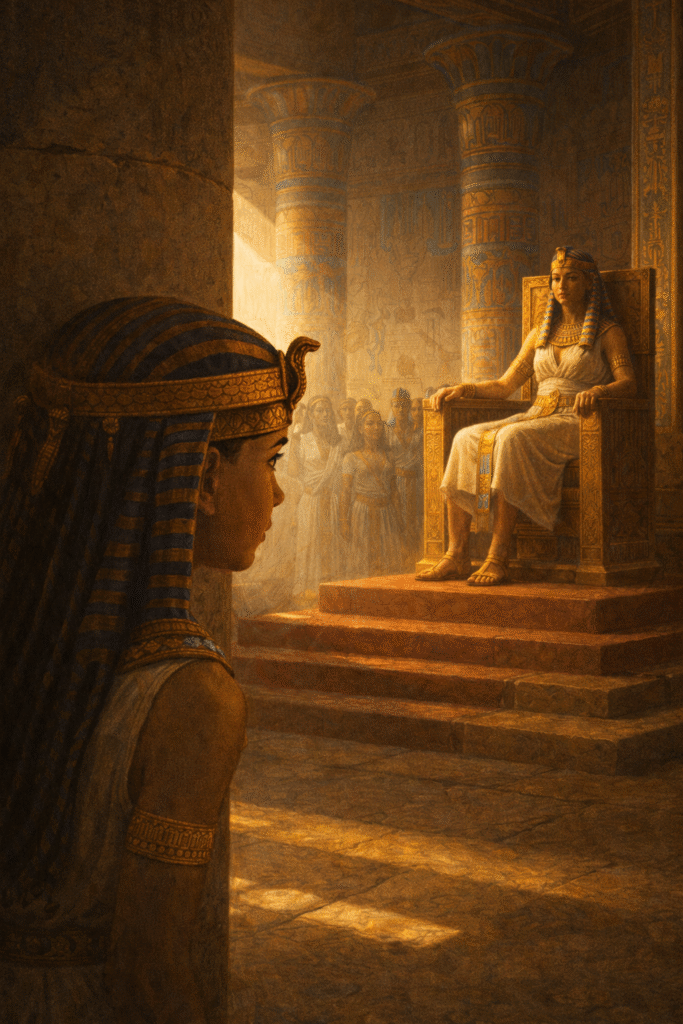
Prologue — The Eyes at the Edge of the Throne
Before he was Pharaoh,
before he wore the Blue Crown
and commanded armies,
he was a boy
with bare feet,
sharp eyes,
and too much history
resting quietly
on his small shoulders.
He watched me
long before he understood me.
From doorways,
from behind pillars,
from the nursery balcony
above the court.
He watched:
- how I sat
- how I spoke
- how I listened
- how I said no
to men twice my age
The court saw me as
King’s Great Wife,
King’s Daughter,
possible Regent,
possible problem.
He saw me as something simpler—
and more complicated:
The woman
who ruled
while he grew.
This Scroll
is not about conflict.
Not yet.
It is about affection,
formation,
and the quiet watching
that shapes both
mentor and heir.
Because before we stood
on opposite sides
of a changing kingdom,
we stood
on the same side
of a single throne.
PART I — The First Time He Climbed Onto My Lap in the Audience Hall
On most audience days,
children were supposed
to remain in the nursery.
Too many eyes.
Too many tensions.
Too many chances
for small hands
to reach
for dangerous things.
But one morning,
when I sat
in the secondary audience hall
receiving minor petitions,
a small figure
slipped from behind a column.
Bare feet.
Rumpled linen.
A braid hanging over one shoulder.
He stood at the bottom step
of the throne platform
and frowned.
“Your feet are not touching the ground,”
he announced.
A ripple of laughter
went through the hall.
I looked down at him.
“No, little hawk,”
I said.
“They are not.”
“You look uncomfortable,”
he said seriously.
“I am quite comfortable,”
I replied.
“You should sit differently,”
he declared.
“Like this.”
And to the horror
of half the nobles present,
he began to climb
onto the platform.
A guard moved instinctively.
I lifted a finger.
“Let him come.”
He scrambled up
and wedged himself
between the carved armrest
and my side.
He sat there,
legs swinging,
entirely at home.
The assembled petitioners
did not know
whether to bow deeper
or not look at all.
“Is this better?”
he asked.
“Yes,” I said.
“It is.”
The petitioners
began again.
From that day on,
when protocol allowed,
he would sometimes sit there—
half in my shadow,
half in my light—
watching everything.
A boy
at the edge of power,
learning
without anyone
formally teaching him.
PART II — The Nursery Above the Court
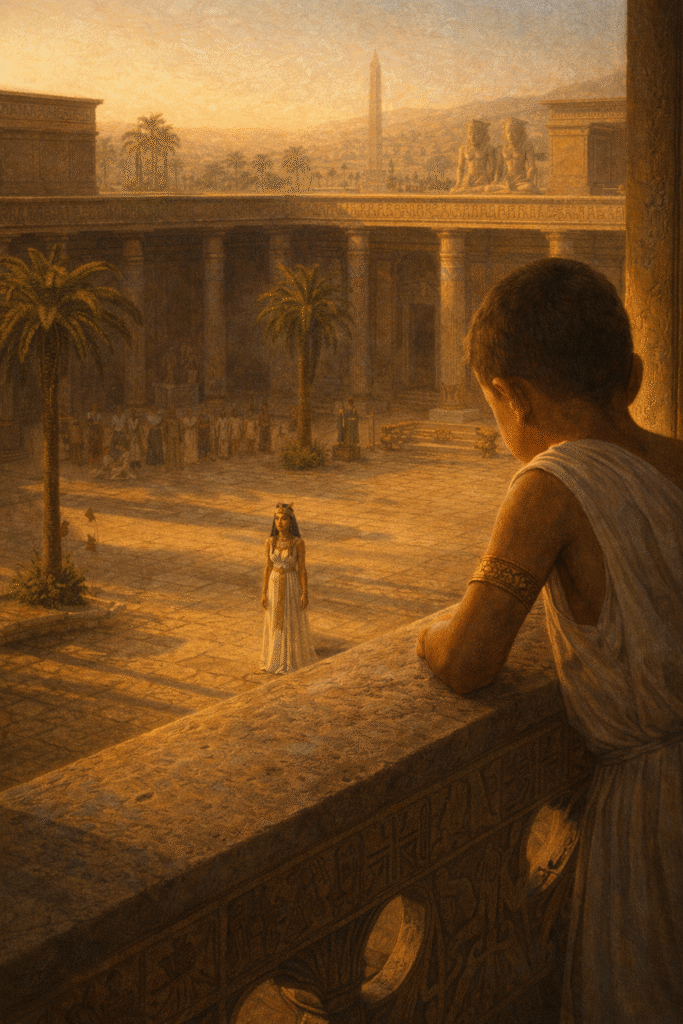
His nursery
overlooked a small courtyard
used for minor processions.
From its balcony,
one could see:
- envoys arriving
- scribes hurrying
- guards changing posts
- small offerings being carried
to secondary shrines
When I had time,
I visited him there.
He would press his face
against the carved stone rail
and point.
“Who is that?”
he’d ask.
“A governor from the north.”
“And him?”
“A captain who brought
bad news
last time he came.”
“And her?”
“A widow petitioning
for her land.”
He squinted.
“The soldiers look bigger
from up here,”
he said once.
“Do they?” I asked.
“Yes.
But you look bigger
down there
than you do up here.”
I smiled.
“How so?”
“You do not look like
my aunt,”
he said.
“You look like…
Egypt.”
Out of the mouths of children
come truths
no court poet
could refine.
I leaned on the balcony rail
beside him.
“Do you like watching?”
“Yes,”
he said simply.
“What do you see
when you watch?”
He thought.
“I see
who looks afraid
when they walk in,”
he answered,
“and who looks afraid
when they walk out.”
I blinked.
“Which frightens you more?” I asked.
“The ones
who are not afraid
either time,”
he said.
I made a note in my heart.
This boy
would grow
into a king
who understood fear
not as cowardice,
but as information.
PART III — The First Lesson in Saying “No”
One afternoon,
a noble petitioned
for more land.
His estates
already spread
like spilled ink
across the map.
He bowed low.
“Great Wife,”
he said,
“I humbly request
an extension of my fields
to support offerings
to the god.”
Half truth.
More fields
meant more income.
More income
meant more leverage.
“You already control
three villages’ worth,”
I said.
“Only by the king’s grace,”
he replied.
“And you wish
for a fourth?”
He lowered his eyes.
“Only
to serve better.”
Above,
on the nursery balcony,
a small face
pressed against the shade lattice.
Thutmose watched.
I knew
because his nurse
could not keep him
from such scenes.
I also knew
the noble could see him
out of the corner of his eye.
“Your request,”
I said calmly,
“would displace
thirty farming families.”
“They will find
employment under me,”
he said smoothly.
“Or they can keep
their own fields,”
I replied.
Silence.
He bowed again.
“As you say, Great Wife.”
I met his gaze.
“It is not only for the god
that Egyptians sow and reap,”
I said.
“It is also for themselves.
A hungry farmer
cannot pray sincerely.”
Scribes wrote quickly.
The hall murmured.
The noble stepped back.
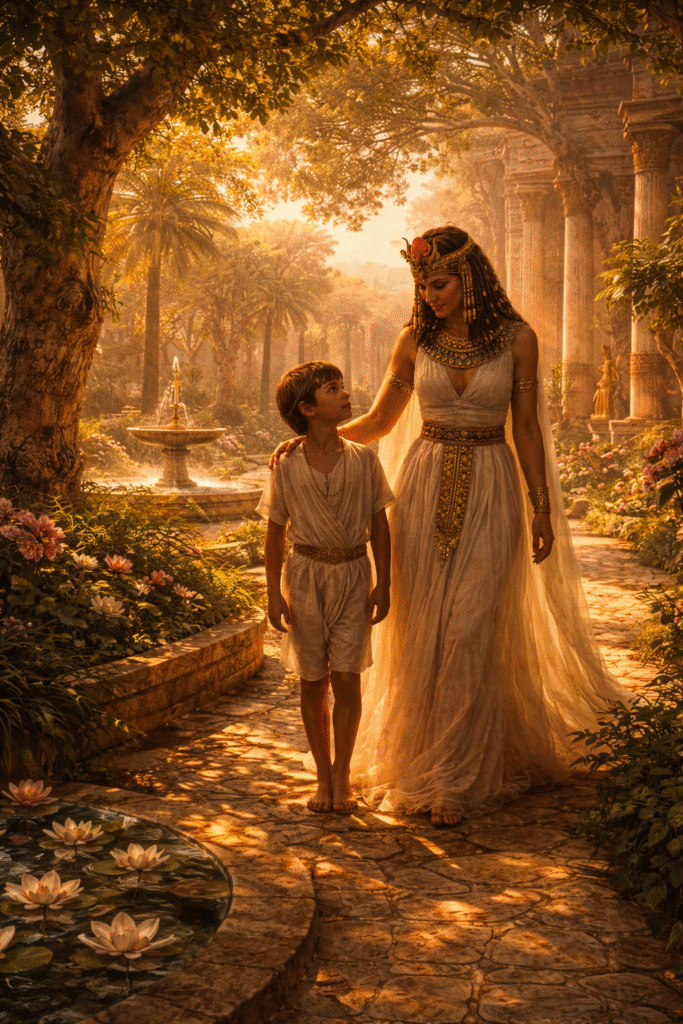
Later,
in the garden,
Thutmose tugged my sleeve.
“Why didn’t you give him
what he wanted?” he asked.
“You saw?” I said.
He nodded.
“I didn’t understand
all the words,”
he admitted.
“But I understood
that he wanted
too much.”
I smiled.
“Then you understood
the important part.”
He frowned thoughtfully.
“Did he like you after?”
“No,”
I said honestly.
“Does that matter?” he asked.
“Yes,” I said.
“And no.”
I knelt to his height.
“He does not have to like me,”
I said softly.
“But he does have to remember
that the land
belongs to Egypt
before it belongs to him.”
He nodded slowly.
“And to you?” he asked.
“For a time,” I answered.
“For a time…
it belongs to me
to protect.”
PART IV — The Garden of Questions
The sycamore garden
became our classroom.
Not for letters
and numbers—
those he learned
from scribes.
Here he learned
other things.
We walked the path
between the trees,
the shade dappled
and cool.
“Why do some men
smile when they bow,”
he asked,
“and others look angry
even when they say
‘May you live’?”
“Because,” I said,
“some learned
to split their faces
from their thoughts.”
He frowned.
“How?”
“By practice.”
“Is that good?”
“It is…
useful,”
I said.
“But dangerous
when they believe
their own masks.”
We passed the fountain.
“What is a regent?” he asked.
I smiled.
“A regent
is someone who holds the reed
until the hand it belongs to
is strong enough
to take it back.”
“Do you like being regent?”
I paused.
“I like
serving Egypt,”
I said.
“Is that the same thing?”
“On good days.”
“And on bad days?”
I looked at him.
“On bad days,” I said,
“it feels like
standing in a flood
trying to direct water
with my hands.”
He considered that.
“One day,” he murmured,
“I will have to stand
in that water.”
“Yes,”
I said quietly.
“And you
will not always agree
with how I held it.”
His eyes snapped up.
“How do you know?”
“Because no son
ever rules Egypt,”
I said,
“without changing
what came before him.”
He fell silent.
We walked in the shade,
each holding
the same future
from different directions.
PART V — The First Time He Saw Me Disagree with a Priest
Thutmose
was perhaps eight years old
when he first witnessed
an open tension
between me
and the priesthood.
We stood in a side courtyard
at Karnak.
The high priest
requested
additional resources
for a new small shrine.
“The god requires
another barque station
for the festival route,”
he said.
I had seen the treasury scrolls.
The kingdom
had just absorbed
the costs of construction
on a city gate.
“The god requires much
this year,”
I replied.
The priest smiled thinly.
“The god is generous,”
he answered.
“With what?” I asked.
He blinked.
“With his blessing.”
“Blessings
do not move stone,”
I said calmly.
“Men do.”
A few priests
shifted in discomfort.
“This shrine,”
the high priest insisted,
“will ensure
the god’s pleasure
and the stability
of your reign.”
I felt
Thutmose’s eyes
on my back.
I held the priest’s gaze.
“My reign’s stability,”
I said,
“depends as much
on granaries
not going empty
as on shrines
not being neglected.”
One of the junior priests
started to speak—
then thought better of it.
I continued:
“We will repair
the cracked altar
in the eastern court first.
Then,
if the stores remain strong
after flood,
we will revisit
your request.”
The high priest bowed.
“A wise compromise,”
he said.
We both knew
what this was:
A line drawn.
A reminder
that the throne
could think for itself.
That night
in the garden,
Thutmose asked:
“Are you afraid
when you say no
to the priests?”
“Yes,” I admitted.
“Why?”
“Because men
who believe
they speak for gods
do not like
to be contradicted.”
“Then why do you do it?”
“Because I, too,
was chosen with signs,”
I said,
“and the god
did not give me eyes
so I could keep them closed.”
He was quiet
for a long time.
“Will I have to say no
to them too one day?” he asked.
“Yes.”
“Will they like it?”
“No.”
He nodded slowly.
“Then I will practice
watching them now,”
he said.
And from then on,
whenever we entered Karnak,
he watched.
Quiet, sharp,
unblinking.
Learning.
PART VI — The Roof Lesson
One evening,
I took him
up to the palace roof.
From there,
Waset stretched out
in all directions.
The river glowed
in dying light.
Smoke spiraled
from cooking fires.
Temple pylons
cut into the sky.
“Look,” I said.
“What do you see?”
He squinted.
“The Nile,”
he said.
“The temples.
The houses.”
“Yes,” I said.
“But what else?”
He frowned.
“The boats are moving
with the current.”
“And?”
“The farmers
are walking home
from the fields.”
“And?”
“The light is still
on the obelisks
but not on the streets.”
I smiled.
“Good,” I said.
“Now—
remember this view.”
“Why?”
“Because most rulers,”
I said,
“spend their lives
in halls
where the ceilings
block the sky.”
He glanced at me.
“They forget,” I continued,
“that their decisions
reach places
they cannot see
from their thrones.”
I pointed
toward the farms.
“If you tax too high,”
I said,
“dusk becomes hunger
out there.”
I gestured
to the river.
“If you neglect the canals,
the Nile’s blessing
goes to waste.”
I pointed
to the temples.
“If you starve the temples,
the people fear
the gods are angry.”
Then I pointed
to the palace beneath us.
“If you fear the court
more than you fear
for these things…”
I let the silence finish.
He swallowed.
“I do not want to forget,”
he murmured.
“Then come back up here,”
I said,
“whenever you feel
the halls
making you small and blind.”
He reached for my hand.
“Will you be here?”
“Not always,”
I said gently.
“But the view
will remain.”
Bonding With the Human Story
If you’ve ever wanted
to see a future king
as a child—
If you’re fascinated
by how mentorship,
love,
and conflict
can grow
from the same soil—
If you want to feel
how a boy once learned
to rule
by watching a woman
who the world
would later try to erase—
then this Scroll
is your invitation.
Walk with us
through gardens, roofs,
and half-shadowed audience halls.
Stand where he stood.
Look where he looked.
Feel the story
before the history books
flattened it.
Journey with ENA.
Before kings wear crowns,
they watch.
PART VII — The Day He Called Me “Pharaoh” by Accident
It happened
years before
I officially took
the full titles.
I had just finished
a long session
with military envoys
from the southern fortresses.
My head ached.
My shoulders burned.
Thutmose ran up
as I left the hall.
“Ph—”
he started.
Then stopped.
We both froze.
He blinked.
“Pharaoh,”
he whispered,
as if tasting the word.
Then, quickly:
“I mean—
Aunt.
I mean—
Great Wife.”
I studied him.
“Why did you say that?”
I asked.
His cheeks flushed.
“Because,”
he said quietly,
“when you sit there,
you look like one.”
Silence
filled the corridor.
No priest
had yet dared
speak such a phrase.
No scribe
had written it.
But the boy
who would one day
be king
had already
seen it.
“Do you think,”
I asked carefully,
“that there can be
two Pharaohs?”
He tilted his head.
“I think,”
he said slowly,
“there can be
more Pharaoh
than the crowns
know what to do with.”
He tried to smile.
I did too.
But a part of me
heard something else:
A future
where that excess
would have to resolve itself.
Where his crown
and my legacy
would meet
at sharp edges.
We walked together
back to the garden.
The moment passed.
But the word remained.
PART VIII — The Tender Thread That Makes the Future Hurt
Here is the truth
I need you to understand,
traveler.
All the later scrolls—
the silence,
the unraveling,
the fall,
the erasure,
the eventual remembrance—
they are all sharpened
by this one fact:
We loved each other.
Not with romance.
Not with blind devotion.
With shared years.
Shared lessons.
Shared glances
across throne rooms
where both of us knew
we stood in something
too large
for either of us alone.
He was the boy
who watched me rule.
I was the woman
who prepared the world
he would inherit.
So when the time came
for history
to choose sides—
for the court
to tighten around him,
for the temples
to shift toward him,
for my name
to begin slipping
from inscriptions—
it was not only
political tragedy.
It was personal fracture.
This Scroll
exists to show you
the tenderness
beneath the tectonic shift.
So when you stand
in the halls
where our legacies diverged,
you will remember
that before any of that—
he sat beside me,
legs swinging,
watching me tell men
twice my age
that Egypt
was not theirs
to devour.
Ancient Questioner’s Desk — Bond Edition
A pupil asked:
“Did Thutmose love her?”
The elder replied:
“Yes.
In the restless way
of a boy
who grew up in her shadow
and light.”
Another asked:
“Did she love him?”
The scribe wrote:
“Yes.
In the fierce way
of a woman
who knew
he would inherit
what she shaped.”
A traveler wondered:
“Did that love
prevent the later pain?”
The historian answered:
“No.
It made it worse.
And more human.”
A final question came:
“Is it possible
to guide someone
who will one day
erase you?”
The old master smiled sadly.
“It is possible,” he said.
“And she did.”
The Heart Before the History
This Scroll ends here—
on rooftops at dusk,
in gardens of sycamore,
in nurseries
overlooking the court.
In the gaze
of a boy
who would one day
bear the crowns alone.
And in the presence
of a woman
who held them
until he was ready.
If you want to feel
the full ache
and beauty
of this Journal,
come walk the places
where they once walked together.
See the world
through his young eyes—
and hers.
Journey with ENA.
Before history chose sides,
they chose each other.