
Scroll IX – The Day the Oracle Warned Me
Year: 1463 BCE — Waset (Luxor), Karnak & the Western Sky
Translated and restored for the modern traveler.
Prologue — When Certainty Trembled
There is a moment in every reign when the ground beneath the throne shifts.
It does not always come with rebellion, invasion, or visible ruin.
Sometimes it arrives as a whisper.
A hesitation.
A question where once there was only certainty.
For many years, my rule flowed like the Nile in its strength —
steady, nourishing, unquestioned.
Temples rose.
Trade flourished.
Granaries swelled.
The people blessed my name.
I had been confirmed by oracles,
praised in hymns,
remembered in stone as the chosen of Amun.
And yet, one evening,
as the sun bled out beyond the desert hills
and the first stars pricked the darkening sky,
I felt something I had not felt in many years.
A subtle, insistent unease.
This is the Scroll of the night that unease took form.
Not through thunder,
not through miracles,
but through three quiet instruments:
The movement of a sacred barque.
The shape of a dream.
The position of a star.
And through them all,
one message, clear as chisel marks in stone:
Things will not remain as they are.
Part I — Rumors beneath the Hymns
Long before the oracle spoke,
the city had begun to murmur.
I heard it first in the pauses between reports:
A governor in the south writing less warmly than before.
A commander on the frontier asking more questions, fewer blessings.
A scribe letting his ink linger a moment too long
before writing my full titulary, as though measuring the weight of each name.
Thutmose — the boy I had once protected as Regent —
was no longer a child.
He had grown tall, hard-eyed,
broad-shouldered from training with bow and chariot.
He stood beside me at ceremonies,
his face composed,
his voice respectful.
But in the courts,
I could feel certain eyes turning toward him
with the restless attention that seeks the future
before the present is ready to yield.
It was not open disloyalty.
Egyptians are rarely foolish enough to show that.
It was something quieter.
A question taking shape in the minds of priests and generals:
How long will two hawks share one sky?
I knew this question.
I had carried it myself
on the night I chose my crown.
But now,
it was turned upon me.
Part II — Summoned to the god Who Chose Me
The priests of Amun requested my presence
on the evening of the Festival of the Valley.
This was not unusual.
The god and I had long been intertwined —
in ritual,
in symbolism,
in the stories carved upon my temple walls.
But there was something in the wording of their summons
that stirred my unease further:
“The God Amun-Re, Lord of Thrones,
wishes to confirm the path of the Two Lands.”
Confirm.
A simple word.
But I had learned to weigh such words carefully.
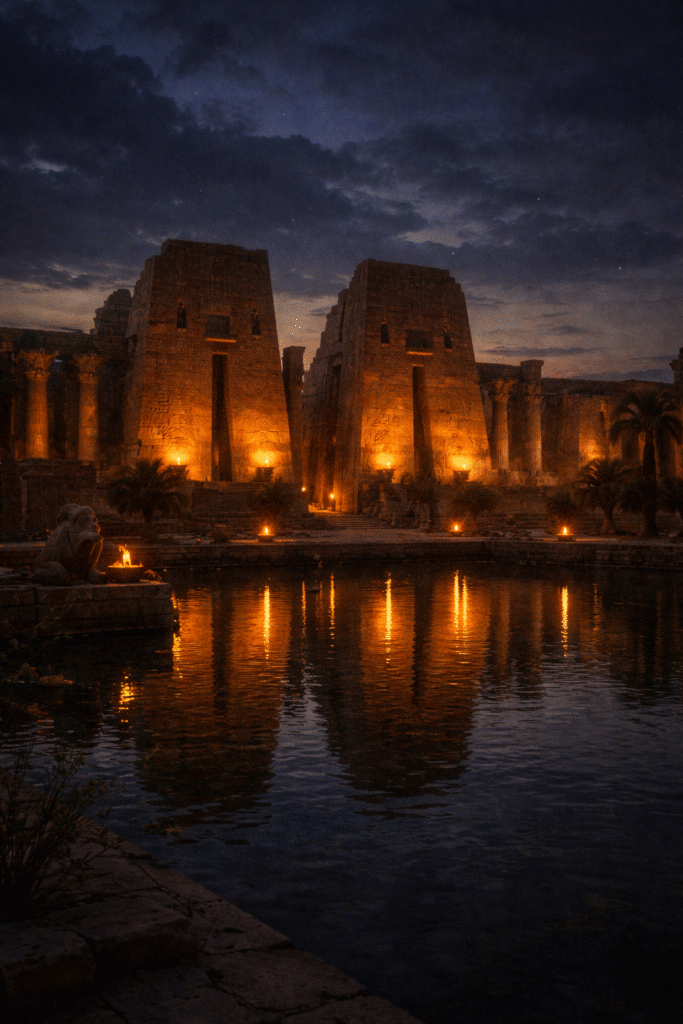
I entered Karnak at dusk.
Torches flared along the pylons.
The sacred lake lay black and still.
The air smelled of incense and river moisture,
stone cooling after the heat of day.
The great courtyard was quiet,
emptier than usual for a festival night.
Most of the people waited beyond the outer walls,
their songs and chatter a distant hum.
Inside, closer to the sanctuary,
the atmosphere shifted.
Fewer voices.
More shadow.
More watchful eyes.
The High Priest greeted me with formal words,
his expression unreadable.
“Your Majesty,” he said,
“tonight we shall ask Amun to bless the path forward.”
I had heard such phrases before —
but never with such weight.
Part III — The Barque That Hesitated
In the innermost court,
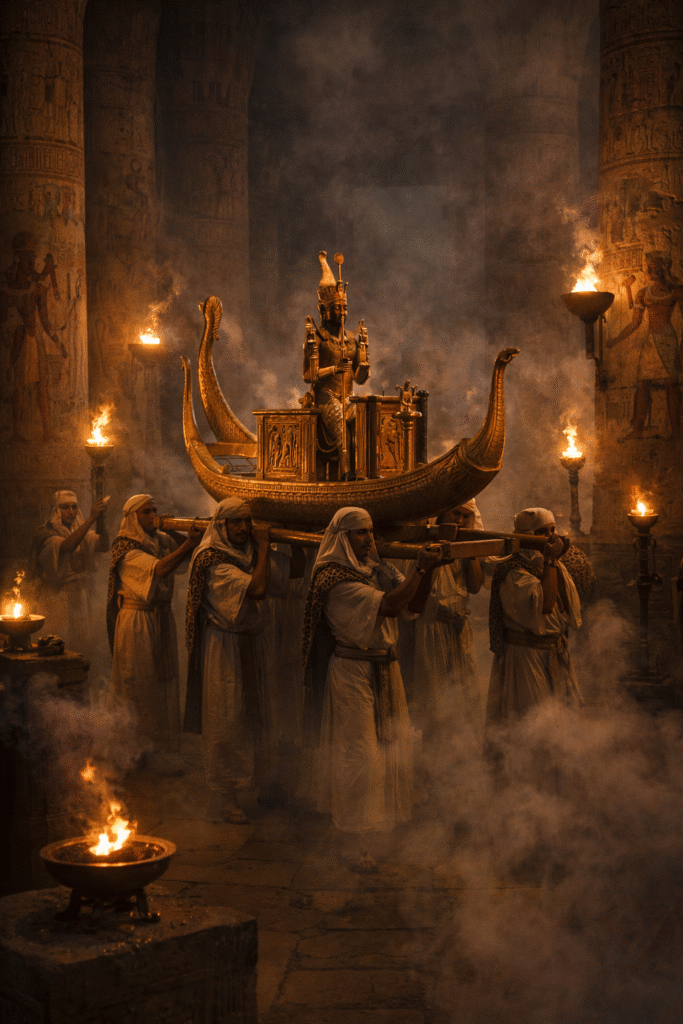
the shrine of Amun stood ready upon his sacred barque —
golden, veiled, crowned with plumes.
The ritual was familiar.
The priests would lift the barque onto their shoulders,
carry it in slow procession,
and ask yes-or-no questions
to which the god would respond
by the tilt and movement of the shrine.
It was a system of meaning
refined over centuries —
not magic,
but ritualized interpretation.
Tonight,
I was the one with questions.
As drumbeats thrummed softly in the background,
four priests bent beneath the poles and lifted.
The barque rose.
The high priest turned toward me.
“Daughter of Amun,” he said,
“do you seek the god’s confirmation
that your reign remains pleasing to him?”
The question was ceremonial,
but its edge was sharp.
“I do,” I replied.
He raised his voice,
addressing the veiled statue.
“Great Amun-Re, lord of Thrones,
does Maatkare Hatshepsut, Your chosen one,
still walk the path of Ma’at in your sight?”
The barque trembled.
Shifted.
Tilted forward in a clear affirmation.
Yes.
A murmur of relief passed through the assembled priests.
But the high priest was not finished.
He spoke again.
“Great Amun,
shall she continue to reign in this way
for many years to come?”
The barque lifted.
Moved forward half a step.
Then…
paused.
A subtle thing.
A hesitation.
Barely noticeable,
except that every man in that courtyard
had spent his life watching for such subtleties.
The shrine shivered.
Then settled.
No clear yes.
No clear no.
A silence heavier than any shout
descended upon us.
The high priest’s face tightened almost imperceptibly.
He swallowed,
then tried another path.
“Great Amun,
does your plan for the Two Lands
involve a changing of roles
between your servants upon the throne?”
This time,
the movement was unmistakable.
The barque tipped backward,
almost recoiling,
then swung sideways,
its bearers forced to adjust quickly.
An unambiguous rejection.
Not yet.
Not now.
Not like this.
Relief flared in me —
but did not quite settle.
Because woven into that sharp refusal
was another message,
heard not with ears
but with the thin, practiced intuition
of those who live their lives close to ritual:
Change is coming.
Just not in the way you imagine.
The god had not endorsed my permanence.
He had warned of shifts
beyond simple succession.
I stood very still.
For the first time since taking the Double Crown,
I felt the shape of a future
in which my story might not end
the way I had always imagined.
Part IV — The Sleep of Questioning
After the ceremony,
the high priest approached me privately.
“Your Majesty,” he said,
“the god’s answer was… complex.”
I nodded.
“So am I.”
He hesitated,
then suggested something rare:
“A night of dream-seeking
may bring clarity.”
Dream-incubation was an old practice.
A petitioner seeking guidance
would sleep within a sanctuary
after ritual purification,
hoping that the god would send a message
in image and symbol.
I had overseen such rites before.
I had never performed one myself.
But that night,
the unease had rooted too deeply within me to ignore.
“I will stay,” I said.
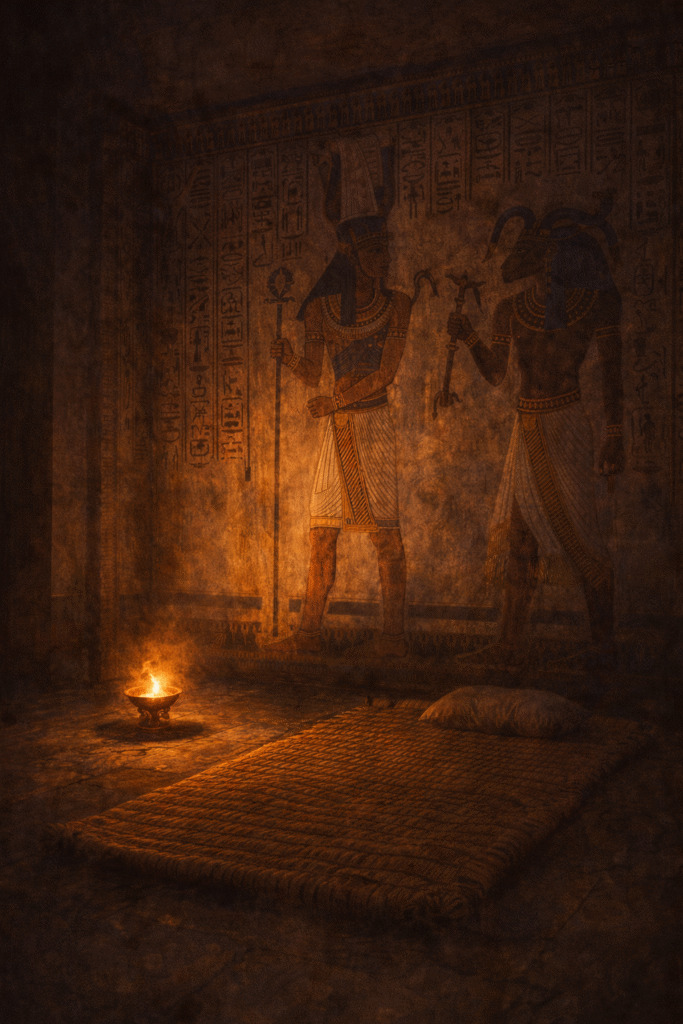
The priests led me
into a side-chapel near the sanctuary —
a small stone room, cool and dark,
its ceiling low,
its walls adorned with scenes of Amun’s embrace.
They burned kyphi incense
until the air grew thick and sweet.
They poured water from the Nile into a basin,
murmuring blessings as it fell.
One by one,
the lamps were dimmed
until only a single flame remained,
flickering before the god’s painted form.
“You will sleep here,”
the high priest said quietly.
“If there is a message,
the god will find you.”
They left me alone.
The stone beneath my linen mat was hard,
but I had known harsher beds in camp and desert.
I lay awake for a long time,
watching the final lamp gutter and die,
listening to the fading echo of footsteps
as the priests withdrew.
The silence that remained
was not empty.
It was full of breath.
My own.
The temple’s.
The god’s.
The city’s.
Eventually,
the thin river of my thoughts
slipped into the sea of sleep.
Part V — The Dream in the Corridor
In the dream,
I was neither queen nor child,
but something in between.
I stood in one of Karnak’s long colonnades,
its pillars rising around me
like the trunks of a stone forest.
Sunlight poured in from one side,
shadow from the other.
At the far end of the corridor,
two figures walked toward me.
One wore the crown.
One did not.
As they drew closer,
I recognized them both.
The crowned one was me,
radiant in full regalia,
step measured, gaze level.
The other was Thutmose —
younger than his current years,
older than the boy he had once been.
We approached each other
along the same axis.
The dream did not give us voices.
Only motion.
When we met in the middle,
something strange occurred.
We did not collide.
We did not displace each other.
We passed through.
For one breathless instant,
we shared the same space,
crown and bare head overlapping,
two paths interwoven.
Then we emerged on opposite sides—
each altered.
The crown on my head
had grown lighter.
So light it almost seemed transparent.
His bare brow,
for just a heartbeat,
held the faint outline of a diadem
not yet solid,
a suggestion more than an object.
I turned to look back.
So did he.
Between us,
the colonnade stretched
like the years of a reign.
The dream ended there.
No falling.
No blood.
No shouts.
No gods descending.
Only passage.
Overlap.
Change.
When I woke,
the stone was cold beneath my back.
The sanctuary air smelled of old smoke.
Dawn had not yet broken,
but the edges of the door
held the faintest hint of coming light.
I lay still,
heart steady,
mind racing.
The dream was clear
and yet ambiguous,
as dreams always are.
No doom.
No triumph.
Just a warning:
Your paths will cross more deeply than they have.
You will shape him.
He will shape what remains of you.
Part VI — The Sky That Refused Its Usual Script
As I left the sanctuary,
a novice priest hurried toward us,
his face pale despite the morning cool.
“High one,” he stammered to the high priest,
“the skywatchers request your presence.
Something… unusual happened last night.”
I felt the unease tighten again.
We crossed the temple courts
while the sun still hid below the horizon.
The sky above was bruised indigo,
a few fading stars still visible.
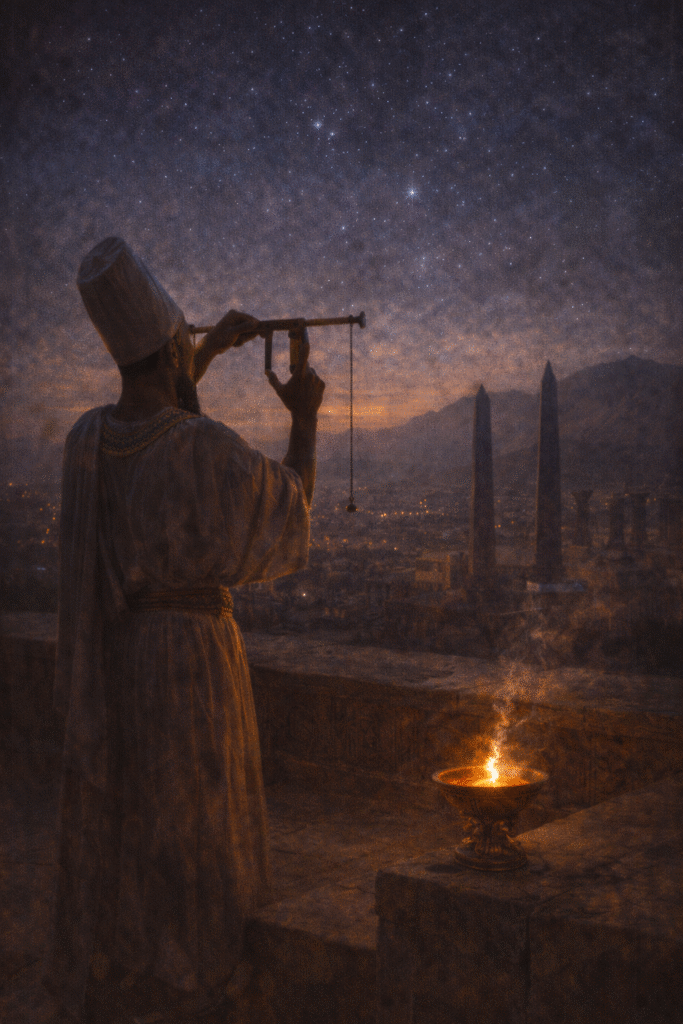
On the rooftop platform
near the Skywatchers’ posts,
two astronomer-priests stood together,
their tablets of star notes clutched to their chests.
They bowed to me hastily,
their eyes betraying a tension
they would never voice in a public court.
“Speak plainly,” I said.
The elder cleared his throat.
“Last night,
shortly before dawn,
when Sopdet should have risen
at her usual point above the horizon,
she appeared —
but subtly displaced.”
I frowned.
“You are certain?”
He nodded, slow and careful.
“We have observed her rising for many years,
Your Majesty.
There are nights when haze
or desert dust
make her seem dimmer.
There are slight variations
as the seasons turn.
But this…”
He hesitated, searching for a word
that would not make him sound like a fearful novice.
“…this felt like a misstep
in a dance we have watched all our lives.”
He caught himself.
“The star was there.
The world did not end.
But the alignment
was less precise than we expected.”
The high priest glanced at me.
Astronomers are not given to wild anxieties.
For them to voice such concern
meant the disturbance, however small,
had unsettled minds trained in patience and detail.
To the rational part of me,
it was simple:
Our instruments are imperfect.
The air is not always clear.
The world is not a perfect mechanism.
To the part of me steeped in Egyptian thought,
another layer unfolded:
Sometimes the fabric of Ma’at
ripples.
Not tears.
Not collapses.
Ripples.
Little disturbances in order
that hint at bigger ones to come.
I looked from the astronomers
to the high priest,
then up at the bruised sky
where stars were giving way to dawn.
Barque.
Dream.
Star.
Three quiet warnings,
none catastrophic,
all pointing in the same direction:
Change.
Realignment.
A future where the balance of power
would not remain as it was.
Part VII — What the Oracle Truly Said
It would be simple, traveler,
to tell this story as if the oracle
had declared some thunderous sentence:
“You will be betrayed.”
“You will be erased.”
“You will fall.”
That is the language of later storytellers,
not of my time.
Our oracles spoke in patterns,
in repetitions,
in echoes.
The barque hesitated.
The dream overlapped two figures.
The star strayed.
Taken alone,
each event might be dismissed.
Together,
they formed a constellation of meaning.
I am not a woman given to panic.
I did not wake that morning
and cry out that doom had arrived.
I did something quieter.
I looked inward.
Have I ruled with too firm a hand?
Have I left enough space for the boy
to become the man he was born to be?
Have I carved my image too deeply into stone
for those who come after to accept?
I looked outward.
Who among the court
watched Thutmose with hungry eyes?
Which priests would prefer
a male body on the throne
even if the mind within it were less prepared?
Which generals whispered about campaigns
they wished to lead
under a king eager for conquest?
The oracle did not tell me
that I would be destroyed.
It told me that forces were gathering
which would reshape
how my story was told.
And that I must decide:
Would I cling to power
as if stone could hold the tide?
Or would I trust
that what I had built —
in temples,
in trade,
in people’s lives —
would outlive the changing of faces
on the throne?
That is the true warning
the oracle delivered.
Not: “You will be undone.”
But:
“You are not the end of the story.
Prepare your heart.”
Part VIII — The Traveler at the Oracle’s Footstep
Now, traveler,
come stand where this unfolded.
If you enter Karnak near sunset
and walk toward the inner courts,
you will find places
where crowds thin
and shadows lengthen.
Imagine:
The priests carrying the barque of Amun.
Their shoulders straining under its weight.
The hush as it moves,
the way hundreds of eyes follow every shift.
Picture the barque pausing
just a heartbeat longer than it should.
Feel how that hesitation
can tighten a chest
more than any shouted curse.
Then, if your guide brings you
to a small chapel or shaded corner,
close your eyes.
Imagine lying there on cool stone,
the air heavy with incense,
your own thoughts loud in the darkness.
Imagine the drumbeat receding,
the temple’s breath slowing,
your mind slipping into the strange clarity
between waking and sleep.
Then lift your eyes to the sky.
Look to where Sirius
still rises above the eastern horizon
in certain seasons.
The same star.
The same earth.
Different rulers.
Different you.
The warnings we receive today
may not come from barques or dreams,
but the feeling is the same:
Something is shifting.
Listen.
Quiet, Psychological, Conversion-Warm
If any part of you
has ever felt the ground move
under what you thought was certain…
if you have known that subtle unease
that does not break your life
but bends its path…
then you understand
this Scroll.
And when you walk through Karnak with us,
we will show you
the spaces where decisions like this
were felt
rather than announced.
If you’re ready to explore
not just monuments,
but turning points—
we’ll walk that path with you.
Part IX — What I Did with the Warning
I did not abdicate.
I did not collapse.
I did not tighten my grip
until my knuckles whitened
against destiny.
I did what rulers of Ma’at
are meant to do.
I adjusted.
I began to give Thutmose more visible space —
more public roles,
more ceremonial presence,
more room to grow into the shape
the world expected of him.
I continued my great building works,
but with an added urgency —
a quiet understanding
that time is never infinite.
I strengthened alliances
that would endure
beyond a single reign.
I walked my temple at Deir el-Bahari
with a softer gaze,
aware that even stone
can be carved over.
And slowly,
I made peace with a truth
few rulers accept willingly:
We are chapters,
not the entire story.
Does that mean the warning
failed to prevent what later happened —
the attempts to erase my name,
the chisels cutting my image from walls?
No.
The oracle never promised
to shield me from the vanity of those who followed.
It warned me
so that when the time came,
I would not be surprised
that even a reign as strong as mine
would face the smallness of human resentment.
And yet,
here you are, traveler,
reading my words,
walking my terraces,
tracing the lines of my obelisks with your eyes.
Erasures fail.
Truth returns.
The oracle warned me
not that I would vanish,
but that I would be tested.
I was.
I endured.
Part X — The Ancient Questioner’s Desk
A student once asked the temple scribe,
“Do oracles always speak clearly?”
The scribe replied:
“No. They speak in mirrors.
The wise do not seek certainty from them,
only guidance.”
Another asked,
“Did the oracle of Amun betray Hatshepsut?”
He answered:
“No.
It told her the river of time would bend,
not dry.”
A traveler wondered,
“Can the sky truly give warning?”
The skywatcher wrote:
“The sky is order.
When order trembles,
the attentive feel it.”
A final question came:
“What is the purpose of a warning
if the end cannot be changed?”
The scribe smiled sadly:
“The purpose is not to save the body.
It is to prepare the heart.”
The Scroll ends here…
but the question it raises
does not.
If you have ever felt
a quiet warning in your own life—
in a conversation,
a dream,
a coincidence,
a moment of stillness—
then you walk closer to Hatshepsut
than you might think.
Come stand in the places
where she sought guidance.
Walk through Karnak’s shadowed courts.
Feel the cool stone of side chapels.
Look up at the same stars that watched her reign.
Let Egypt show you
not only its triumphs,
but its turning points.
Journey with ENA.
Some answers are only found
where history and heart
whisper together.
Historical Context
Oracles were a recognized mechanism for political communication in New Kingdom Egypt, often used to justify decisions or signal divine approval or concern. References to divine warnings appear in royal inscriptions, though rarely with narrative detail.
This scroll uses a reconstructed oracle episode to explore the political tensions and uncertainties surrounding succession and authority during Hatshepsut’s reign.