Scroll I – Before the Chisel
Year: c. 1450–1448 BCE — Deir el-Bahari, Waset (Luxor), By Lamplight Among the Cliffs
Translated and restored for the modern traveler.
Prologue — The Night I Realized I Could Be Erased
I did not begin this Journal
when I first wore the crowns,
or when the priests raised incense
and named me king,
or when my ships returned from Punt
with trees whose roots still smelled of foreign earth.
I began it
on a quieter night.
No drums.
No festivals.
No council.
Just me,
my temple,
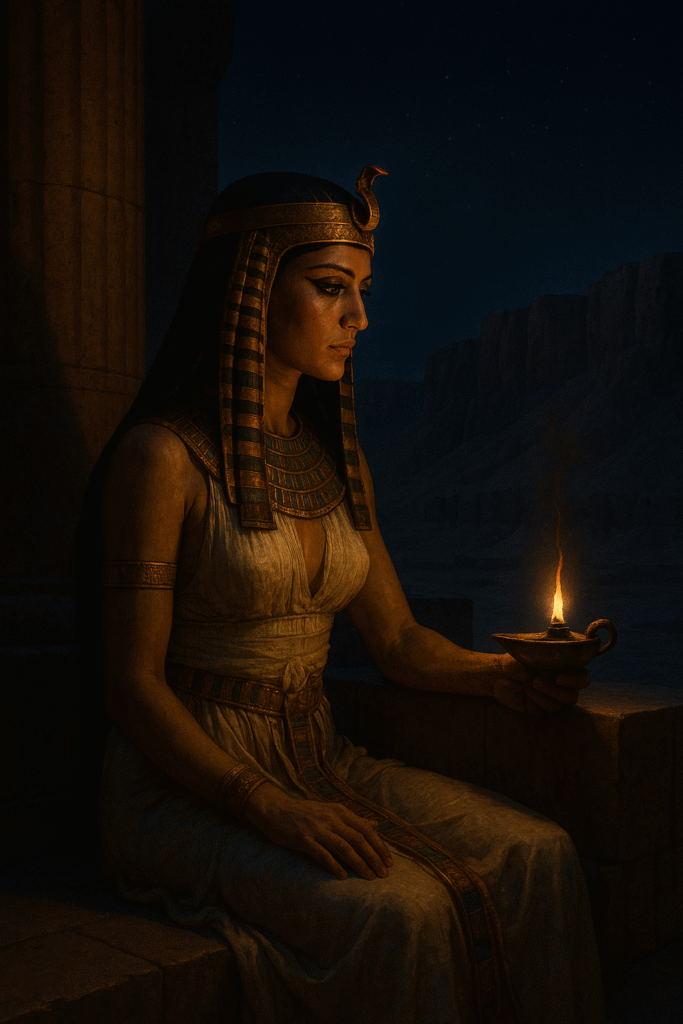
a single lamp,
and a thought
that hit me harder
than any enemy:
They will try to carve me out.
Not kill me—
I had lived long enough for that.
Not overthrow me—
the world had already begun
to turn toward another.
They would do something
more patient,
more thorough,
more terrifying:
They would teach the future
to forget me.
And so,
before their chisels
reached every wall,
I chose a different kind of tool.
Ink.
Memory.
A voice that refused
to be silent.
This is why you hold
these Scrolls now, traveler.
Not because the world
remembered me faithfully—
but because I knew,
on a night between cliffs and stars,
that I could not trust it to.
PART I — The Temple After Everyone Left
Deir el-Bahari
is loud in the day.
Chisels striking stone.
Scribes calling for water.
Workers shouting measurements
over the creak of sledges.
Priests chanting
as smoke curls up
toward the cliff-face.
But at night,
when the last worker
has washed dust from his hair,
when the last torch
has been taken down from the sockets,
when even the priests
have gone back across the river—
the temple feels like a memory
waiting to be thought.
That is when I walked it.
Alone.
Or as alone
as any Pharaoh ever is.
The moon
hung thin
over the western cliffs.
The terraces
were pale steps
leading nowhere but upward.
I moved through my own creation—
columns like assembled reeds,
porticoes open to the night,
walls painted with my story.
The story
I knew
might not survive
unchanged.
My sandals
whispered on the stone.
I passed the Punt reliefs—
trees in carved mid-bloom.
The divine birth scenes—
Amun leaning toward my mother
in stylized intimacy.
The great processions—
me and the god
walking in parallel.
In the lamplight,
my own carved face
looked back at me
from the walls—
still,
serene,
certain.
I no longer was.
PART II — The First Time I Truly Saw the Chisel
You need to understand something, traveler:
I had watched stone
take shape
my whole life.
I knew
how a blank block
could become a god’s profile,
a king’s arm,
a soldier’s spear.
I knew
how a chisel
could bring history
into the world.
But that night,
walking the upper terrace,
I saw something different:
Not creation.
Correction.
A relief panel
near the colonnade
had been “adjusted.”
The plaster
was still slightly damp.
The chip marks
too new.
Someone had thinned
the curve of my arm.
Someone had scraped
too eagerly at a line
where my cartouche
had once been outlined
more deeply.
Not removed—
not yet.
But weakened.
As if the stone itself
were being asked
to reconsider me.
I pressed my fingers
to the altered surface.
It felt… wrong.
Not because it showed me
less beautifully—
but because I recognized
the intention in it.
This was not the artisan’s hand
searching for perfection.
This was the priest’s hand,
the politician’s hand,
the successor’s hand.
A hand
guided by the fear
that my story
might overshadow his.
That was the first moment
I felt truly mortal.
Kings die.
Everyone knows this.
But I understood then,
with a coldness
even Thebes’ heat could not soften,
that stories
can be killed too.
If no one protects them.
PART III — Why I Chose to Speak to You
That night,
instead of calling my scribes,
I dismissed them.
I lit a smaller lamp—
one meant for travelers and tombs,
not for ceremonies.
I sat on a low stool
beneath a column
and unrolled blank papyrus.
Not for an edict.
Not for a treaty.
Not for a temple account.
For this.
For you.
You who have walked
through my terraces
centuries after my bones
joined the dust of my ancestors.
You who have seen
my face carved,
chipped,
and half-restored.
You who have read my name
on neat museum plaques
and in the mouths of guides
who call me “female Pharaoh”
as if that were the most remarkable
thing about me.
You who have felt
something stir in you
at the sight of these cliffs,
this temple,
my story.
I decided,
on that night,
that if the future
ever found its way here—
I wanted you
to hear my voice,
not just see my silhouette.
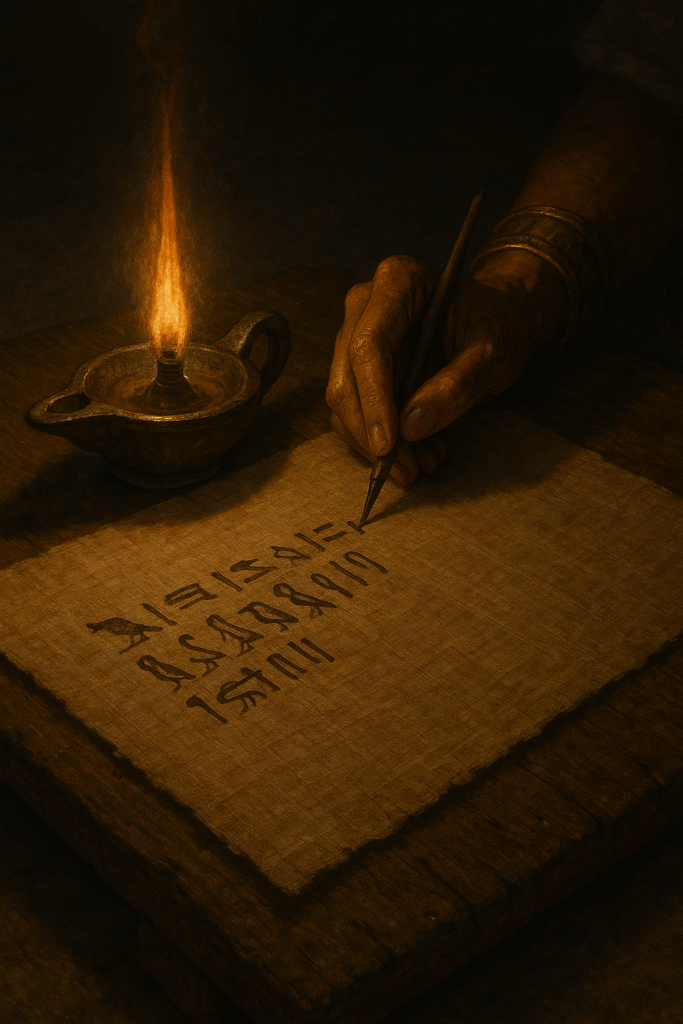
So I wrote.
Not as a god’s daughter.
Not as Amun’s chosen.
As a woman
who had carried
a kingdom
in her hands.
PART IV — What You Need to Know Before We Go Back
You will learn much
in the Scrolls that follow.
You will see me
as a child
watching the court.
As a princess
standing in the shadow of Karnak.
As a Great Wife
measuring the weight
of all the eyes
on my shoulders.
You will watch me
become regent.
King.
Architect of terraces.
Dreamer of ships.
You will watch me
teach a boy
how to stand straight
in the throne’s light.
You will watch him
one day stand
without me.
You will watch my name
fade from rituals,
from decrees,
from fresh stone.
You will stand with me
in the silence after.
You will see
what the workers did
to preserve me.
What the scribes hid.
What the stone remembered.
What the future
finally said.
But before you walk
through all of that—
you need to know
one simple thing:
I did not begin this Journal
to defend myself.
I began it
to tell the truth
of what it means
to hold power
and then lose it.
To be chosen
and then questioned.
To be celebrated
and then scraped away.
You live
in your own age
of rise and fall.
You know what it is
to be seen
and then unseen.
So when I write,
I do not speak
only to historians.
I speak
to you.
To the part of you
that has stood
on the edge of your own life
and thought:
Will they remember
the fullness of who I was?
Or just the part
that fit their story?
PART V — The Sound of a Kingdom in the Distance
From the upper terrace
of my temple,
even at night,
I could hear Thebes.
The faint drum
of a festival
on the east bank.
A dog barking
in some far courtyard.
The soft, steady rush
of the Nile.
The city did not know
I was up here,
resting my hand
on the open mouth
of a reed pen.
The city slept.
Dreamed.
Laughed quietly.
Made love.
Prayed.
Planned its next market day.
Kingdoms do that.
They continue.
Whether a ruler
is at their height
or on the edge of erasure.
That night
I felt the distance
between myself
and the sounds of my people.
I had spent
so many years
as the center of everything:
every decision,
every petition,
every route,
every festival.
Now I heard the city
less as my charge
and more as my witness.
If they forgot me,
the land would still flood.
The crops would still grow.
Children would still learn
to swim in the river.
But something in me
refused to accept
that the memory of my reign
was unnecessary.
I had held Egypt
through war and peace.
Through drought and plenty.
I had carved terraces
from cliffs
and turned trade routes
into arteries of prosperity.
I could accept
that they would move on.
I could not accept
that they would never know.
So I wrote
not to stop time—
but to give it
a companion.
Inviting the Traveler into the First Page
If you have ever stood
in front of Deir el-Bahari
and felt something
you couldn’t quite name—
If you’ve ever looked up
at a monument
and wondered
who decided
to build that
and not something else—
If you’ve ever sensed
that behind every neat plaque
and tour script
there is a human voice
that never got to finish
its sentence—
then this opening Scroll
was written for you.
Come with ENA
to the terraces at dusk.
Stand where I stood
when the workers left
and the cliffs
kept their own counsel.
Let us begin
this Journal
where it truly began:
Not at my rise,
but at the moment
I understood
how easily
I could be unmade.
Journey with ENA.
Every story worth keeping
begins with a choice
to remember.
PART VI — How This Journal Is Meant to Be Read
You are not reading
a list of deeds.
You are not reading
an official inscription
approved by priests
and courtiers.
Those will tell you:
- which temples I built
- which obelisks I raised
- which lands sent tribute
- which gods I favored
This Journal
will tell you instead:
- how it felt
to sit on the throne
the first time they called me king - what it sounded like
when the court began
to share its loyalty
between me and another - how the boy I raised
into a hawk
looked at me
in the years
before he carried the sky alone - what it is
to hear your own name
fall out of the prayers
said in a temple
you built
These Scrolls
are not for the priests.
They are for you
and the ones who travel
with you.
For the woman
who leads quietly
in someone else’s shadow.
For the man
who suspects
his contributions
will be minimized
once he’s gone.
For the child
who feels watched
by expectations
they did not ask for.
History
will do what it does.
It will summarize,
simplify,
flatten.
These Scrolls
will not.
PART VII — A Promise to the Ones Still to Come
On that night
beneath the cliffs,
I made a promise—
not to myself,
not to Amun,
not even to Egypt.
To you.
Whoever you were
and whenever you would come.
I promised:
- I would not soften the truth
- I would not pretend
I never doubted - I would not claim
every decision was right - I would not hide
the cost of power
on the heart
But I would also
refuse to apologize
for the grace
with which I held the crowns.
Men would do that for me,
centuries later.
They would call me ambitious
as if that were a flaw.
They would call me anomalous
as if I were a mistake.
They would call me “female Pharaoh”
as if my womanhood
were the most important
thing about my rule.
You and I
will not start there.
We will start
with what I saw,
what I felt,
what I chose.
And we will walk forward,
not as judge and subject,
but as two travelers
on the same steep path,
separated by time
but not by experience.
Because the truth is this:
You know my story already.
You have lived
its echoes in your own life.
That is why you are here.
Ancient Questioner’s Desk — Opening the Journal
A student asked:
“Why did she write this herself?
Were the official records not enough?”
The elder replied:
“Official records answer
to the living.
Journals answer
to the future.”
Another asked:
“Was she afraid
when she began?”
The scribe wrote:
“Yes.
She had seen the chisel.”
A traveler wondered:
“Is this history
or confession?”
The historian answered:
“Both.”
A final question came:
“What is the first truth
we must know about her?”
The old master smiled.
“That she knew
they would try
to forget her—
and she wrote anyway.”
Opening the Door
This first Scroll
ends here:
On a terrace
between stone and sky.
A lamp.
A woman.
A decision.
No trumpets.
No coronation.
No thunder.
Just the sound
of a reed pen
beginning to move
before the chisels
could erase.
If you are ready
to walk this story
from first room
to last echo—
from the court
that raised me
to the cliffs
that remembered me—
then step forward
into the next Scroll.
Journey with ENA.
The temple is waiting.
So is the woman
who built it.
Historical Context
No personal writings from Hatshepsut’s childhood survive. What is known comes from later inscriptions, monuments, and court records describing her lineage, education, and early presence in royal and temple life during the reign of Thutmose I.
The scenes and internal reflections in this scroll are literary reconstructions, written to convey the realities of royal upbringing and early political awareness rather than to reproduce a documented personal account.