
Scroll XVI – The Boy Becomes the Hawk
Year: 1449 BCE — Borders of Kharu and the Southern Palace at Waset
Translated and restored for the modern traveler.
Prologue — When a Shadow Grew Wings
There is a difference
between a boy with a crown
and a man with a standard.
A boy wears power.
A man carries it.
For years,
Thutmose had been both:
The child I held
when his father’s death
made him king in title
but not yet in deed.
The young prince
I guided through gardens,
councils,
and ceremonies.
The co-ruler
who stood beside me in festivals,
his name growing louder
on the tongues of our priests.
But he had not yet become
what the generals whispered he would be:
A hawk.
Not the falcon carved on temple walls,
frozen in perfect poise—
but a living hawk,
eyes narrowed against the sun,
wings outstretched,
talons ready to answer
what the horizon demands.
This Scroll tells
how he became that.
It is not the story
of my fall.
It is the story
of his flight.
And yes—
the beat of his wings
cast a longer shadow
over my light.
But I would be lying
if I said
I did not feel
a fierce, unexpected pride
as I watched him rise.
PART I — Rumors from the North
It began, as such things often do,
with rumors.
Not in the form of shouting envoys,
wild-eyed and breathless—
but in small, hard messages
carried by disciplined couriers.
A border town in Kharu
slow to send its agreed tribute.
A client prince
writing with less deference
than before.
A caravan ambushed
near a key trade road—
the attackers organized,
not merely bandits
but men who had trained together.
Nothing catastrophic.
Nothing like the full rebellions
my grandfather once crushed
with chariots and fear.
But enough.
Enough to hint
that Egypt’s reach northward
was being tested.
At first,
I responded as I always had:
Letters.
Reminder delegations.
Adjustments to garrison rotations.
Then came a message
from a commander
stationed near the troubled region.
“Majesty,”
he wrote,
“the princes of Kharu
watch the court closely.
They hear whispers
that the young king
has not yet led an army.
They interpret this
as hesitation.”
They interpreted my restraint
as weakness.
That was their first mistake.
PART II — The Council of Iron and Linen
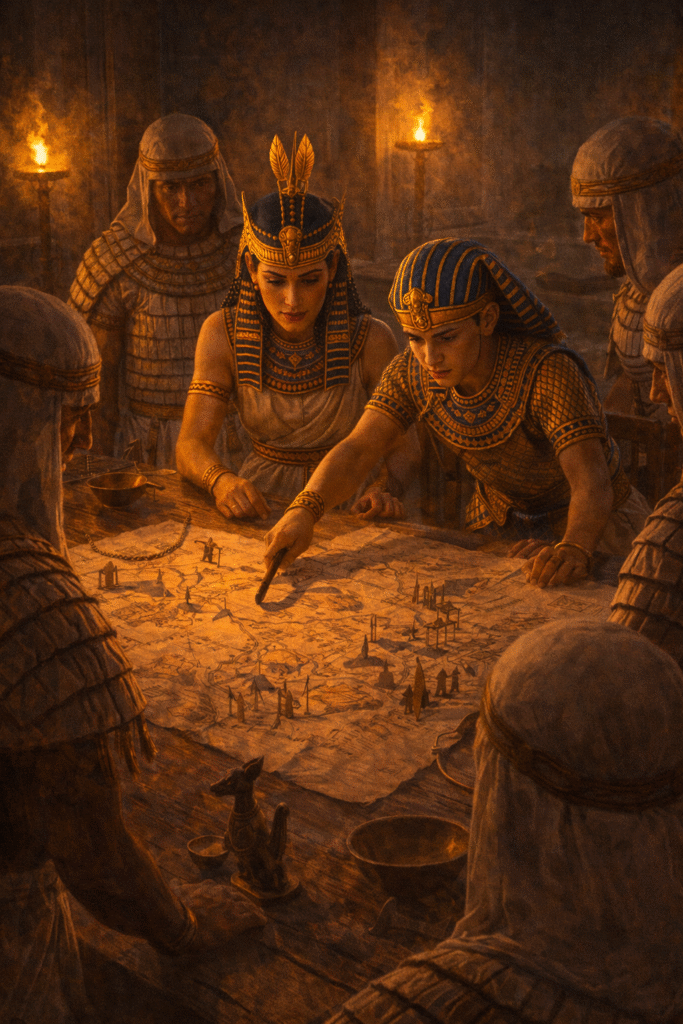
We met in the war council chamber—
a long room
with papyrus columns
and a central table
where maps were spread
like the skin of a beast
awaiting inspection.
Thutmose stood opposite me,
hands behind his back,
shoulders squared.
Around us,
generals in leather
and linen harnesses,
scribes with sharpened reeds,
priests of Montu,
lord of war.
The commander from the north
presented his report.
Transgressions.
Delays.
Soft refusals.
When he finished,
the room waited.
“It is a test,”
one general murmured.
“They think Egypt’s claws
have grown dull.”
“They think the throne
is divided,”
said another,
less cautious.
I let the words hang.
Then I spoke.
“Egypt is not divided,”
I said.
“It breathes with two lungs.”
Thutmose’s eyes flickered,
just for a moment.
I placed my palm flat
on the map.
“Kharu must remember
we are one body.”
A general cleared his throat.
“Majesty,” he said carefully,
“The army is ready
to answer any order you give.
But…”
He hesitated.
Then made himself continue.
“It might be wise
for the young king
to lead this campaign.”
The room stilled.
All eyes shifted—
not to me,
but to Thutmose.
He did not speak quickly.
That,
at least,
he had learned from me.
“I will go,”
he said at last,
voice steady.
“If you command it.”
Not:
“I demand it.”
Not:
“It is my right.”
“If you command it.”
I studied him.
He had trained for years—
chariot,
bow,
sword,
tactics.
He knew how to hold men’s loyalty.
He knew the smell of sweat and leather
in the practice grounds.
He knew the weight of armor.
But he did not yet know
how it feels
to hear the sound of a charge
beneath his feet.
“Why should you lead?”
I asked him.
The generals tensed.
Thutmose did not flinch.
“Because they doubt us,”
he answered.
“And doubt must be answered
by the one whose shadow
they are measuring.”
“You think you are that shadow?”
I pressed.
He met my gaze.
“I think,” he said,
“that I am the hawk
they whisper about.”
Silence.
Then,
from somewhere behind me,
a voice older than all of us:
“The boy must learn to fly
before the wind decides for him.”
The high priest of Montu.
I turned back to Thutmose.
“Very well,”
I said.
“You will go.”
I saw relief—
and something like terror—
flash through him.
“You will command the army,”
I continued,
“but you will carry my seal
and my peace as well as my war.
Egypt does not conquer
for sport.”
“I know,” he answered.
“You think you do,”
I said gently.
“Now you will find out.”
PART III — Preparing the Hawk
The days before departure
were dense
with preparation.
Smiths hammered bronze
into gleaming spearheads.
Leatherworkers tightened girths
and reins.
Scribes tallied supplies
until their fingers cramped.
Priests offered sacrifice
to Montu and Amun,
burning cedar and myrrh
until the palace courtyards
were thick with fragrant smoke.
Thutmose threw himself
into readiness
with a fervor
that was almost painful to watch.
From before dawn
until after midday
he trained
with his personal guard.
Driving chariot wheels
over rough practice ground
until dust coated his skin.
Shooting arrows
at distant targets
until his arm ached
and the targets looked like
angry eyes
pierced and silenced.
Sparring with captains
who did not dare
let him win easily.
In the evenings,
he came to me.
Not as king,
not as rival,
but as student—
for the last time.
“What must I remember?”
he asked one night,
after a long day of drilling.
We stood on the palace rooftop,
watching the last light
fade over Waset.
“That you are not alone,”
I said.
He frowned.
“I know I have an army.”
“I do not mean them,”
I said.
“I mean Egypt.
When you ride,
you do not ride
as Thutmose the man.
You ride
as the shape of this land’s breath.
Every command you give
has weight
far beyond the dust
of the battlefield.”
He nodded slowly.
“What else?” he asked.
“That victory
is not the only measure,”
I answered.
He stared at me,
astonished.
“How can that be?”
“Because,” I said,
“victory without restraint
can break the very thing
you are trying to strengthen.
A hawk that kills
everything it sees
soon starves.”
He was silent.
Then he said:
“Do you think I will win?”
“Yes,” I said.
His eyes widened.
“You did not hesitate.”
“I have seen you,”
I replied.
“In lessons,
in councils,
in training yards,
in how men look at you
when you speak.
You will win.”
He exhaled.
“So what do you fear?”
he asked.
“That you may enjoy it too much.”
He did not smile.
He understood.
PART IV — Farewell in the Courtyard of Columns
The morning the army left
was as clear
as polished alabaster.
Trumpets called.
Standard-bearers lifted flags
emblazoned with falcons,
coiled cobras,
and the signs of gods.
Chariots lined the palace road,
horses tossing their heads,
metal harnesses chiming.
Soldiers stood in ranks—
leather armor,
kilts,
shaved heads,
eyes forward.
I walked out into the courtyard
wearing plain linen,
no diadem,
no heavy gold.
This was his day.
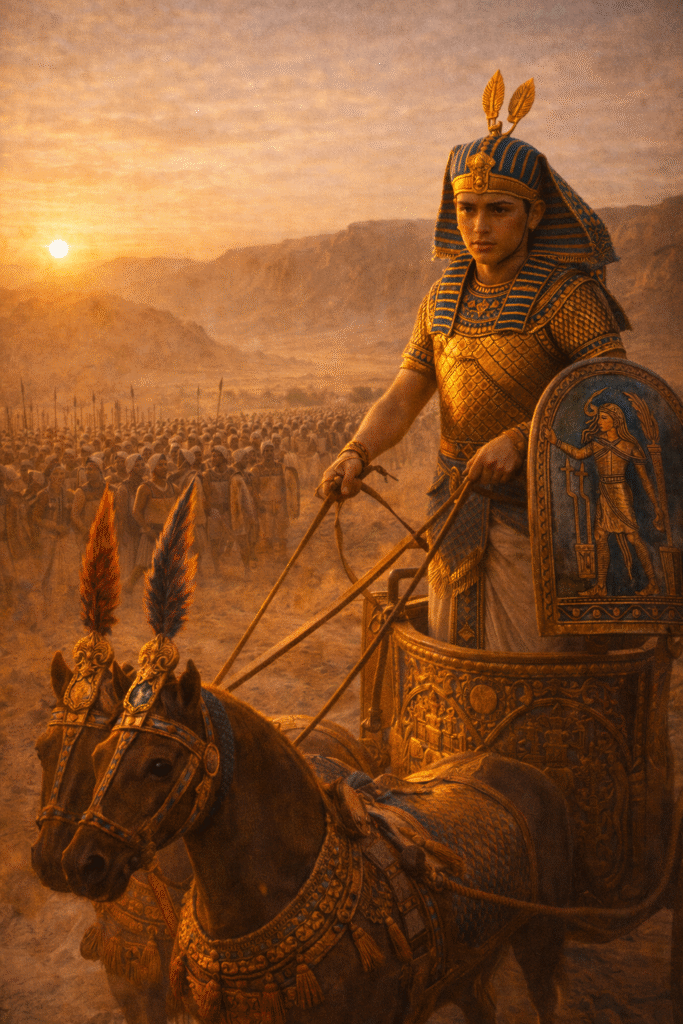
Thutmose waited
near the lead chariot,
armor gleaming,
Blue Crown secure on his head,
bow strapped to his chariot rail.
He bowed to me.
Not as a boy.
As a commander.
“Majesty,” he said.
I stepped close
and placed my hand
on his cheek.
For a heartbeat,
protocol dissolved.
“Thutmose,” I said,
not bothering with titles,
“remember what carries you.”
“Your blessing?” he asked.
“Egypt’s hope,” I answered.
He swallowed.
“I will not break it.”
“I know,” I said.
“That is why I send you.”
Behind us,
priests of Montu began to chant.
Horses stamped,
impatient.
The men
were restless to move.
I stepped back.
“Go, then,” I said,
voice firm.
“Show Kharu
that Egypt’s patience
is not weakness.”
He gave a short nod,
climbed into his chariot,
took the reins.
For just a moment,
our eyes met again.
There was fear there,
and excitement,
and something like gratitude.
The chariot rolled forward.
The army followed,
a river of disciplined motion
pouring out of the gate.
I watched
until they were dust
on the horizon.
The courtyard,
so full a moment before,
felt strangely large
and suddenly quiet.
That is the sound
a hawk makes
when it leaves the branch.
PART V — The Road to Kharu
I did not see the campaign.
I heard it
in reports.
But I can imagine it—
and so can you.
Dust rising
from hundreds of sandals.
The clatter of chariot wheels
over rocky ground.
The creak of leather.
The low murmur of soldiers’ talk
around campfires each night.
At way stations along the road,
local officials
brought offerings:
Bread,
beer,
dried fish,
figs.
They watched Thutmose carefully.
Some had once bowed only to me.
Now they measured
whether the boy
had become a man
who could hold Egypt’s sword.
Word traveled faster
than the army.
By the time he reached
the troubled region,
the princes of Kharu
had heard:
He came himself.
He looked like a king.
He rode like one.
They tested him anyway.
They arrayed their forces
on a hill
overlooking a narrow valley,
thinking to catch Egypt
in a trap.
According to the commander’s report,
Thutmose listened
to the scouts’ warnings,
then laughed once—
short, sharp.
“They think we will march
straight into their teeth,” he said.
He chose a different path.
Night march.
Flanking maneuver.
Chariots hidden
behind a low rise
until the signal was given.
At dawn,
as the princes of Kharu
looked down
upon what they thought
was our vulnerable line,
Egypt’s hawk
appeared at their side.
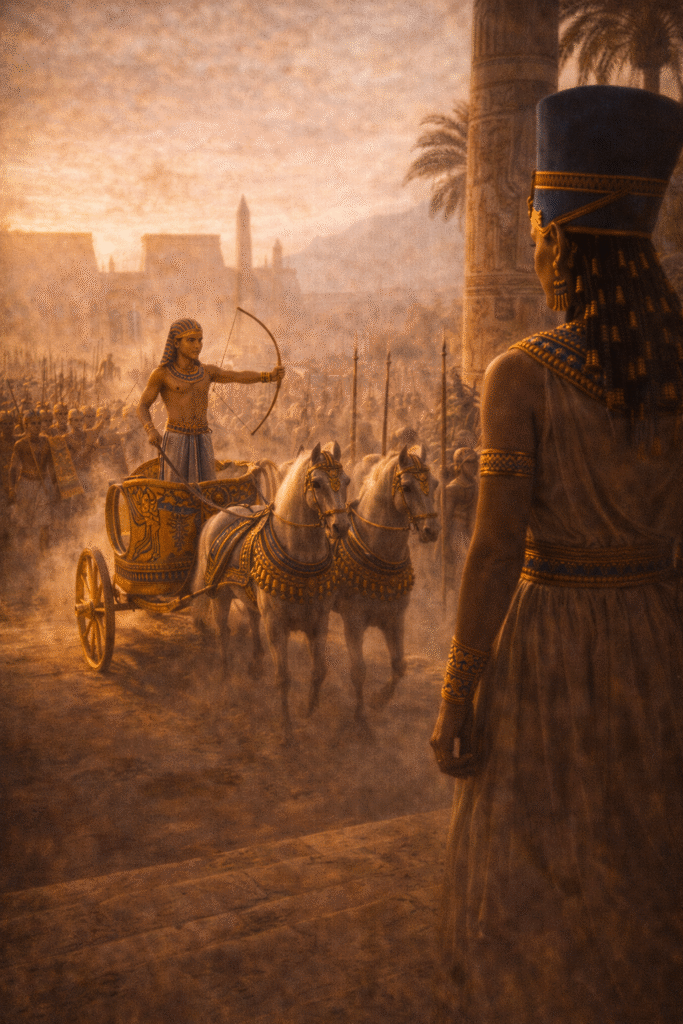
His chariot
flew down the slope
like a stone from a sling.
He did not hang back
behind his troops.
He led.
His arrows
found their marks.
His voice
cut through chaos.
His presence
stitched fear
into the hearts
of those who had thought
us weakened.
The battle
was not long.
He did not slaughter
for pleasure.
When their line broke,
he did not chase
the fleeing too far.
He had listened to me
more than he knew.
He did not need
their bodies.
He needed
their memory.
PART VI — The Letter with Blood on Its Edge
Weeks later,
a courier arrived at Waset.
His sandals
were worn.
His face
burned dark by sun.
He knelt before me,
holding out a scroll.
“From His Majesty Thutmose,”
he said,
“to His Majesty Hatshepsut.”
Our titles
balanced on his tongue
like twin weights.
The scroll’s edge
bore a faint streak—
not of ink,
but something rust-brown.
Blood.
I unrolled it.
The handwriting
was his:
“holy mother,
The princes of Kharu
have remembered themselves.
Their forces have scattered.
Their tribute will arrive
without further delay.
Our losses were not small,
but our discipline held.
The men obeyed.
The chariots flew true.
I have seen battle now.
It is not as glorious
as songs would have us believe.
But neither is it
beyond us.
You were right.
Victory is not the only measure.
Restraint
cuts deeper.
I return
not as the boy who left,
but I return.
May Amun and Montu
be pleased.
— Thutmose,
who flies at your command.”
I read the letter twice.
The first time
as Pharaoh.
The second time
as the woman
who had once held him
on her lap.
The edges of my throat
tightened.
I did not weep.
Queens
do not weep
over good news.
But I understood,
more fully than ever:
He would not be stopped.
Nor should he be.
If you’ve ever watched
someone you guided
step into danger
and return changed—
if you’ve felt
the fierce pride
and quiet ache
of seeing them become
what you always knew they would…
then you understand
this Scroll.
When you travel with us,
we can bring you
to the borderlands of story—
to the roads
Egypt’s armies once marched,
to the halls
where letters like this
were opened,
to the places
where hawks
first tested their wings.
When you’re ready
to feel the human heart
beneath the armor—
we’ll walk that path with you.
PART VII — The Return of the Hawk
The day the army returned,
Waset woke
as if to another festival.
People lined the quay.
Vendors called.
Children wove reeds
into makeshift laurel rings.
The air smelled
of river mud,
roasting fish,
and anticipation.
From my place
on the palace balcony,
I watched the first chariots
cross the eastern bridge.
He was easy to spot.
Even among hundreds
of soldiers,
the way he sat his chariot
marked him out.
Back straight.
Chin level.
Eyes scanning
not just the path ahead
but the people
on either side.
The crowd’s roar
when they recognized him
was like nothing
I had heard before.
It was not the deep,
steady cheer
they gave me—
the sound of long trust.
It was sharper.
Higher.
Laced with excitement.
They saw in him
what they always love
in a ruler:
Power
that moves.
He climbed the temple steps
to present thanks to Amun
before coming to the palace.
This, too,
he had learned.
Let victories
kneel first.
When he finally entered
the great hall,
flanked by captains,
I descended from the throne.
We met
at the center.
For a breath,
protocol waited.
“You are changed,”
I said quietly.
He considered.
“Yes,” he replied.
“I have seen
how thin the line is
between order and chaos.”
“And?”
“And I have no wish
to see Egypt
on the wrong side of it.”
I touched his shoulder.
“You led well,”
I said,
meaning every word.
He bowed his head.
“I led
because you let me,”
he answered.
And for just an instant,
we stood
as we once had:
Queen and boy.
Mother and son-in-duty.
Teacher and pupil.
Then the hall filled
with nobles,
priests,
generals.
Trumpets blared.
The moment dissolved.
But its truth remained.
PART VIII — The Court That Chose Its Hawk
In the days
that followed,
gifts flowed in.
From Kharu:
tribute delivered
on time.
From Nubia and Sinai:
envoys expressing
admiration
for Egypt’s “young, vigorous king.”
In the palace:
the shift
became visible.
Generals
spoke to him first
about troop movements.
Nobles
sought his ear
about border security.
When matters of war
appeared on scrolls,
scribes’ eyes
instinctively sought him.
I was not excluded.
Not yet.
But I was no longer
the unquestioned center
in that sphere.
The court
had seen him fly.
They would never
see him as a grounded prince again.
One afternoon,
I entered a strategy meeting late
—delayed by temple matters.
Before I could speak,
Thutmose was explaining
a proposed reorganization
of northern garrisons.
He spoke clearly,
decisively,
without hesitation.
The generals
nodded.
When I stepped into view,
they all rose.
“Majesty,” they said.
“Please,” I said calmly,
“continue.”
Thutmose paused.
“This concerns us both,”
he said.
The words were respectful.
The reality was clear.
His hawk-shadow
stretched across the map.
Mine
was longer over stone,
temple,
and trade.
Egypt,
for a time,
had two centers of gravity:
One in war.
One in peace.
It could not last forever.
But for that moment,
it worked.
And it worked
because neither of us
sought openly
to crush the other.
We let the balance hold
as long as it could.
PART IX — The Modern Traveler at the Edge of Two Reigns
When you stand
in temple reliefs
that show Thutmose
smashing enemies
beneath his sandals,
remember this Scroll.
He was not born
with dust of conquest
already on his feet.
He grew into it.
And when you see
my terraces,
my obelisks,
my trade routes—
remember:
We existed
together.
Not as caricatures.
Not as rivals
in a painted drama.
As two human beings
bound by fate,
duty,
affection,
tension.
When you walk Egypt with us,
we can place you:
At Karnak’s courts,
where victory offerings
once piled at Amun’s feet.
On palace thresholds,
where returning soldiers
laid their weapons.
Along the Nile,
where news of victory
raced faster than the boats.
History often chooses
one protagonist
at a time.
The truth rarely does.
PART X — The Ancient Questioner’s Desk
A student of history once asked:
“Was Thutmose jealous of Hatshepsut?”
The old scholar replied:
“At first,
he was her shadow.
Later,
he learned
to cast his own.”
Another asked:
“Did she try to stop him
from becoming a great warrior?”
He answered:
“No.
She sharpened him
and then let him fly.”
A traveler wondered:
“Was this campaign
the beginning of her end?”
The scribe wrote:
“It was the beginning
of his beginning.”
A final question came:
“Could both have ruled strongly,
side by side,
forever?”
The scribe smiled sadly:
“The sky is wide,
but even it
must choose
where the sun stands
at midday.”
The Scroll closes here—
with a hawk returned,
blood-dust on his sandals,
battle-smoke in his lungs,
and Egypt’s gaze
turning toward him
with new intensity.
If you felt the ache
and the pride,
if you saw both their hearts
in these choices,
if you’ve ever watched
someone you love
rise into their own power
even as it changed
your place in the story…
then you carry this chapter
of Hatshepsut’s life
inside you now.
Come walk the roads
Egypt’s armies once marched.
Stand in the courts
where victory was proclaimed.
Look up at the stars
that watched a boy
become a hawk.
Journey with ENA.
Some flights
can only be understood
from the ground
where they began.
Historical Context
After Hatshepsut’s death, Thutmose III emerged as sole ruler and later undertook actions that reduced or erased some of her public legacy. Scholars continue to debate the timing and motivations behind these actions.
This scroll interprets that transition narratively, using symbolism and interior perspective to represent a historically complex and unresolved period.