Abu Simbel Egypt: The Complete Travel Guide to Ramses II’s Greatest Monument
Few places in Egypt feel as powerful, remote, and unforgettable as Abu Simbel.
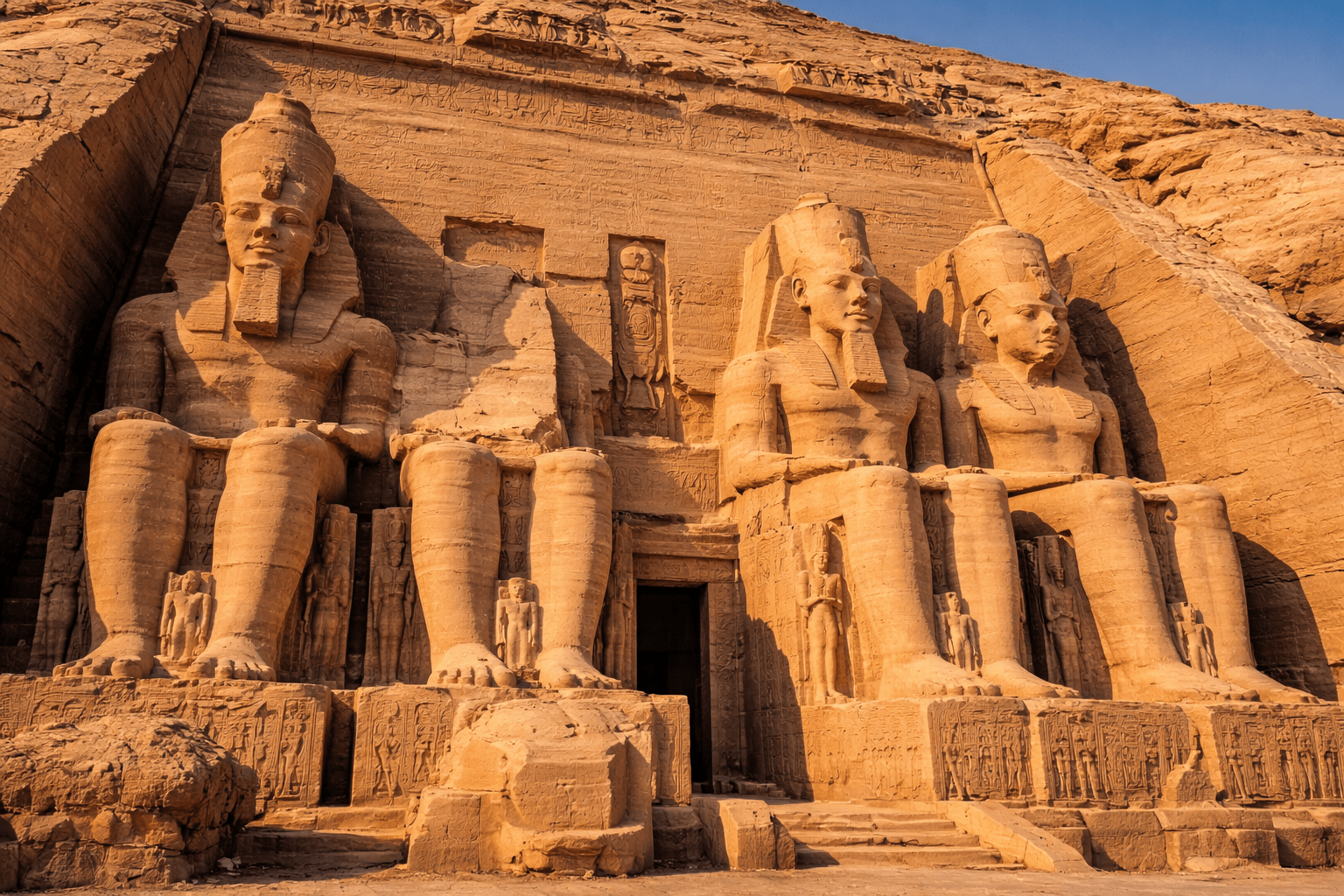
Located in the far south of the country near the border with Sudan, the temples of Abu Simbel stand on the western shore of Lake Nasser, surrounded by desert landscapes that feel almost untouched by time. Rising from the sandstone cliffs are four colossal statues of Pharaoh Ramses II, each more than 20 meters tall. For more than three thousand years they have gazed across the desert horizon, guarding one of the most extraordinary temple complexes of the ancient world.
The scale alone is breathtaking.
Unlike most Egyptian temples built from massive stone blocks, the temples of Abu Simbel were carved directly into the rock face of the mountain. Their façades are monumental statements of royal power, designed to impress travelers, merchants, and foreign emissaries arriving from Nubia to the south.
But what makes Abu Simbel truly remarkable is not only its ancient history.
In the 1960s, the construction of the Aswan High Dam threatened to submerge the temples beneath the rising waters of Lake Nasser. Rather than abandon the site, an international team of engineers and archaeologists undertook one of the most ambitious heritage preservation projects ever attempted.
The temples were carefully cut into massive blocks, lifted from their original cliff, and reconstructed on higher ground, preserving their orientation and architectural integrity. The entire process required years of work and cooperation between dozens of countries.
Today, Abu Simbel represents two extraordinary achievements at once:
- the monumental ambition of ancient Egypt under Ramses II
- and one of the greatest archaeological rescue efforts of the modern era
For travelers exploring Egypt, visiting Abu Simbel often becomes a highlight of the entire journey. The temples’ remote location, colossal scale, and dramatic desert setting create an experience that feels both ancient and timeless.
This guide explains everything you need to know before visiting Abu Simbel: the history of the temples, what makes them unique, how to travel there from Aswan, the famous Sun Festival, and how to include Abu Simbel in a well-planned Egypt itinerary.
Where Abu Simbel Is Located
Abu Simbel sits in one of the most remote and dramatic settings of any major monument in Egypt.
The temples are located in southern Egypt near the Sudanese border, approximately 280 kilometers (175 miles) south of Aswan. Today they stand beside the vast waters of Lake Nasser, one of the largest artificial lakes in the world, created after the construction of the Aswan High Dam in the 1960s.
This region forms part of Egypt’s Nubian frontier, an area that historically marked the southern boundary of the ancient Egyptian state. In antiquity, Nubia was both a valuable trade partner and a strategic region rich in natural resources, especially gold. Because of its position along the Nile corridor, the area around Abu Simbel served as an important gateway between Egypt and the lands farther south in Africa.
When Ramses II chose this location for his monumental temples, the choice was intentional. By carving massive statues into the cliff face overlooking the Nile, he created a visual statement that anyone traveling north along the river could not ignore. The temples were meant to signal the power of Egypt to traders, diplomats, and travelers entering the kingdom from Nubia.
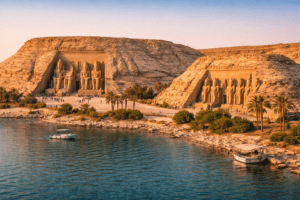
Today, the surrounding environment looks quite different from what ancient visitors would have seen. Instead of the flowing Nile River, the temples now overlook Lake Nasser, whose calm blue waters stretch across the desert horizon. The lake dramatically changes the visual setting, creating a striking contrast between sandstone cliffs, desert landscapes, and open water.
Despite its remote location, Abu Simbel is surprisingly accessible for modern travelers. Most visitors reach the site from Aswan, either by road or by short domestic flight. Because of the distance, many tours depart early in the morning so visitors can reach the temples in time to explore them before the desert heat intensifies.
The isolation of Abu Simbel is part of what makes the experience so memorable. Unlike many other Egyptian monuments located within busy cities or towns, the temples rise from a quiet desert landscape where the scale of the architecture feels even more powerful against the surrounding emptiness.
Standing in front of the colossal statues of Ramses II, with desert cliffs behind and Lake Nasser stretching into the distance, visitors quickly understand why Abu Simbel is considered one of the most extraordinary archaeological sites in Egypt.
Why Abu Simbel Was Built: The Power of Ramses II
To understand Abu Simbel, you have to understand the ruler who created it.
The temples were built during the reign of Pharaoh Ramses II, one of the most powerful and prolific rulers in ancient Egyptian history. Ramses II ruled for more than sixty years (1279–1213 BC) during the New Kingdom, a period when Egypt controlled vast territories stretching from Nubia in the south to parts of the Levant in the north.
Like many pharaohs, Ramses built extensively across Egypt. But Abu Simbel was not simply another temple. It was a political and symbolic statement carved directly into the desert frontier.
A Monument on Egypt’s Southern Border
In ancient times, the region south of Aswan marked the boundary between Egypt and the lands of Nubia, an area rich in gold, trade routes, and strategic influence. Nubia was both a valuable partner and, at times, a rival power.
By constructing an enormous temple complex at Abu Simbel, Ramses II sent a clear message to anyone traveling along the Nile from the south: Egypt was powerful, wealthy, and protected by a divine ruler.
The colossal statues at the entrance were meant to impress and intimidate at the same time. Each statue represents Ramses II seated on his throne, wearing the double crown of Upper and Lower Egypt. At more than 20 meters (65 feet) tall, they rank among the largest statues ever created in ancient Egypt.
For travelers approaching the temple in antiquity, the sight would have been overwhelming.
A Temple Dedicated to the Gods — and to Ramses Himself
Although the Great Temple of Abu Simbel was dedicated to major Egyptian deities — including Amun-Ra, Ra-Horakhty, and Ptah — it also honored Ramses II himself.
This was not unusual in ancient Egypt. Pharaohs were considered divine or semi-divine figures, acting as intermediaries between the gods and humanity. By placing statues of himself alongside the gods inside the temple, Ramses reinforced his claim to divine authority.
The temple’s interior walls are filled with relief carvings that celebrate Ramses’ achievements, including scenes of battles, rituals, and offerings to the gods.
One of the most famous scenes depicts the Battle of Kadesh, a major military campaign fought between Egypt and the Hittite Empire. Ramses portrayed the battle as a heroic victory, emphasizing his role as a powerful warrior king.
The Temple of Nefertari
Next to the Great Temple stands a second temple dedicated to Queen Nefertari, Ramses II’s beloved wife.
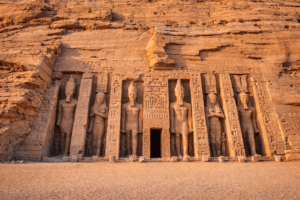
This temple is unique because it honors both the goddess Hathor and Nefertari herself. The façade features six statues — four of Ramses II and two of Nefertari — each standing nearly equal in size.
In most Egyptian monuments, queens appear much smaller than the king. At Abu Simbel, Nefertari’s statues stand almost as tall as Ramses himself, highlighting her importance and status.
The temple reflects both royal devotion and the cultural role of queens within the religious life of ancient Egypt.
Architecture as Power
Beyond its statues and carvings, Abu Simbel represents something deeper: the use of architecture to project power across geography.
By carving monumental temples directly into the cliffs at Egypt’s southern frontier, Ramses II turned the landscape itself into a political message.
Anyone traveling along the Nile toward Egypt would encounter these colossal figures rising from the desert — a reminder that they were entering the territory of one of the ancient world’s most powerful civilizations.
More than three thousand years later, the message still resonates. Abu Simbel remains one of the most dramatic examples of how ancient Egypt used monumental architecture to express authority, religion, and identity.
The Great Temple of Ramses II
The Great Temple of Ramses II
The Great Temple of Abu Simbel is one of the most impressive monuments ever created in ancient Egypt. Carved directly into a sandstone cliff during the reign of Pharaoh Ramses II in the 13th century BC, the temple was designed to demonstrate the king’s power, divine authority, and dominance over Egypt’s southern frontier.
Even today, more than three thousand years later, the scale of the structure remains breathtaking.
The Colossal Statues
The most recognizable feature of the temple is the row of four enormous seated statues of Ramses II that dominate the entrance. Each statue stands more than 20 meters (65 feet) tall, making them among the largest statues created during the New Kingdom.
The statues depict Ramses wearing the double crown of Upper and Lower Egypt, symbolizing his rule over the unified kingdom. Although the figures appear identical at first glance, each one contains subtle differences in facial expression and carving details.
At the feet of the statues are smaller figures representing members of the royal family, including Queen Nefertari, Ramses’ mother, and several of his children. Their much smaller scale reflects the traditional hierarchy of ancient Egyptian art, where the pharaoh was always shown as the dominant figure.
One of the statues was damaged by an ancient earthquake, causing its upper portion to collapse. The fallen fragments still lie near the base of the temple entrance, providing a reminder of the monument’s long history.
The Temple Entrance and Hypostyle Hall
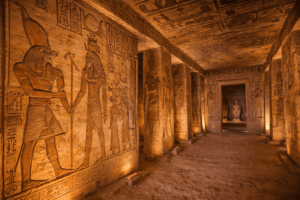
Visitors entering the temple pass through the massive doorway into a large hypostyle hall, supported by eight enormous pillars. These pillars are carved in the form of Osiride statues, representing Ramses II as the god Osiris, ruler of the afterlife.
The walls of this hall are covered with intricate relief carvings depicting religious rituals and military scenes from Ramses’ reign. One of the most famous carvings shows the pharaoh in battle during the Battle of Kadesh, one of the most celebrated military campaigns of his rule.
In the scene, Ramses is shown charging into battle in his chariot, defeating enemy forces almost single-handedly. While modern historians believe the battle was more of a stalemate than a victory, the carvings emphasize Ramses’ image as a heroic warrior king.
Inner Chambers and Sanctuaries
Beyond the hypostyle hall, the temple continues through a series of smaller chambers that become progressively darker and more sacred.
These inner rooms were used for religious ceremonies and offerings to the gods. Their walls are decorated with scenes showing Ramses II presenting gifts and prayers to major Egyptian deities.
At the very back of the temple lies the sanctuary, the most sacred space within the structure.
Here, four seated statues represent:
- Ra-Horakhty (a solar form of the god Ra)
- Amun-Ra, the chief god of Thebes
- Ptah, the creator god associated with Memphis
- Ramses II himself, shown as a deified ruler
The presence of Ramses among the gods reinforces the idea that the pharaoh was considered a divine figure who acted as a bridge between humanity and the gods.
The Solar Alignment
One of the most remarkable features of the Great Temple is its astronomical alignment.
Twice each year, sunlight travels through the entrance and along the temple’s central axis, illuminating the statues in the sanctuary at the back of the temple. The phenomenon occurs around February 22 and October 22, dates believed to correspond with important events in Ramses II’s life.
During this moment, the statues of Ra-Horakhty, Amun-Ra, and Ramses II are illuminated by sunlight, while the statue of Ptah, associated with darkness and the underworld, remains in shadow.
This precise solar alignment demonstrates the extraordinary architectural planning of the ancient Egyptian builders and adds to the temple’s symbolic power.
A Monument Designed to Impress
The Great Temple of Ramses II was never meant to be modest.
From the colossal statues at the entrance to the carefully aligned sanctuary deep inside the mountain, every part of the structure was designed to communicate a clear message: Ramses II was a ruler favored by the gods and powerful enough to shape the landscape itself.
Even today, standing before the towering statues at Abu Simbel, visitors experience the same sense of awe that ancient travelers must have felt when approaching the temple more than three thousand years ago.
Inside the Great Temple
Stepping inside the Great Temple of Abu Simbel feels like entering a carefully designed sacred space where architecture, religion, and royal propaganda merge into a single experience.
While the colossal statues outside announce the power of Ramses II to the world, the interior of the temple reveals the deeper purpose of the monument: to present the pharaoh as a ruler chosen by the gods and protected by divine forces.
The temple was carved directly into the rock of the cliff, creating a series of chambers that gradually lead visitors from the bright desert exterior into increasingly sacred and shadowed spaces.
The Hypostyle Hall
The first chamber inside the temple is a large hypostyle hall, supported by eight massive pillars carved into the shape of Ramses II as the god Osiris, ruler of the afterlife.
These figures, known as Osiride statues, show the pharaoh standing with crossed arms, holding the crook and flail — symbols of royal authority. The statues face forward in rigid poses, creating a powerful visual impression of the king’s eternal presence within the temple.
The walls surrounding the hall are covered with detailed relief carvings that illustrate important moments from Ramses II’s reign.
One of the most famous scenes depicts the Battle of Kadesh, a major conflict between Egypt and the Hittite Empire. In the reliefs, Ramses appears as a heroic warrior king charging into battle with his chariot, defeating enemies and restoring order. Although the historical outcome of the battle is debated, the temple carvings present it as a dramatic victory for Egypt.
Other wall scenes show the king making offerings to various gods, reinforcing the idea that Ramses ruled with divine approval.
The Second Hall
Beyond the hypostyle hall lies a smaller chamber sometimes called the second pillared hall. This space contains four pillars rather than eight and marks a transition deeper into the sacred areas of the temple.
The relief carvings here emphasize religious ceremonies rather than military power. Scenes show Ramses performing rituals and presenting offerings to the gods, demonstrating his role as the mediator between the divine world and the people of Egypt.
The change in decoration reflects the increasing sacredness of the inner temple.
Side Chambers
Several smaller rooms branch off from the main halls. These chambers likely served as storage areas for ritual equipment, sacred objects, and offerings used during temple ceremonies.
Although simpler than the main halls, they reveal how the temple functioned as a living religious space rather than simply a monument.
Priests would have moved through these rooms preparing offerings, incense, and ritual tools used during ceremonies dedicated to the gods honored in the temple.
The Sanctuary
At the deepest point inside the temple lies the sanctuary, the most sacred chamber of the entire complex.
Four seated statues are carved directly into the rock wall at the back of the room. These statues represent:
- Ra-Horakhty, a solar deity associated with the rising sun
- Amun-Ra, one of the most powerful gods in ancient Egypt
- Ptah, the creator god of Memphis
- Ramses II, depicted as a divine figure seated among the gods
The presence of Ramses among these deities illustrates how the king positioned himself within the divine order of the universe.
This chamber is also the focal point of the temple’s famous solar alignment. Twice each year, sunlight enters through the temple entrance and travels along the central axis of the structure to illuminate three of the statues in the sanctuary.
Only Ptah, associated with darkness and the underworld, remains in shadow.
A Journey From Light to Sacred Darkness
The layout of the temple reflects a common pattern in Egyptian temple architecture: moving from public spaces into increasingly sacred areas.
Visitors begin in the bright desert sunlight, enter the monumental hypostyle hall, and then gradually move into darker chambers that lead toward the sanctuary where the gods reside.
This progression creates a symbolic journey — from the everyday world into the divine realm.
Even today, walking through the interior of the Great Temple allows visitors to experience the temple in much the same way ancient priests and worshippers once did, following a path designed to emphasize the power of the gods and the divine status of Ramses II.
The Abu Simbel Solar Alignment
One of the most remarkable features of the Great Temple of Abu Simbel is its precise solar alignment, an architectural phenomenon that demonstrates the extraordinary astronomical knowledge of ancient Egyptian builders.
Twice each year, sunlight penetrates deep into the temple’s interior and illuminates the statues in the sanctuary at the very back of the temple — a chamber that normally remains in darkness.
This event occurs around February 22 and October 22.
On these mornings, the rising sun aligns perfectly with the temple’s entrance and central corridor. As the sunlight moves through the hypostyle hall and inner chambers, it eventually reaches the sanctuary, where it illuminates three of the four seated statues carved into the rock wall.
The statues represent:
- Ra-Horakhty, the sun god associated with the rising sun
- Amun-Ra, the chief god of Thebes
- Ramses II, shown as a deified ruler
- Ptah, the creator god linked with the underworld
During the solar alignment, the sunlight falls directly on the statues of Ra-Horakhty, Amun-Ra, and Ramses II, while the statue of Ptah remains in shadow.
This detail is not accidental. Ptah was associated with darkness and the underworld, so leaving his statue in shadow likely reflected symbolic religious meaning built into the temple’s design.
The Sun Festival
Today, this solar phenomenon is celebrated as the Abu Simbel Sun Festival, which attracts visitors from around the world. On the mornings when the alignment occurs, crowds gather before sunrise to witness the sunlight travel through the temple and illuminate the sanctuary.
The event has become both a cultural celebration and a demonstration of ancient Egyptian engineering.
Although the temples were relocated in the 1960s during the rescue operation that saved them from flooding, engineers managed to preserve the solar alignment almost perfectly. The phenomenon now occurs only about one day later than it did in antiquity, an incredibly precise result considering the scale of the relocation project.
A Masterpiece of Ancient Engineering
The solar alignment of Abu Simbel shows how ancient Egyptian architects combined astronomy, religion, and monumental design into a single structure.
The temple was not only a political statement about the power of Ramses II. It was also a carefully calibrated sacred space designed to connect the king with the cosmic order of the universe.
Even thousands of years later, the moment when sunlight reaches the sanctuary continues to remind visitors of the remarkable sophistication of ancient Egyptian architecture and the enduring power of the temple itself.
The Temple of Queen Nefertari
Next to the Great Temple of Ramses II stands a second monument that is equally remarkable, though often slightly overshadowed by the colossal statues beside it. This is the Temple of Queen Nefertari, one of the most beautiful and unusual temples in ancient Egypt.
While the larger temple celebrates Ramses II and the major gods of Egypt, this smaller temple was dedicated to Queen Nefertari, the king’s most beloved wife, and to the goddess Hathor, the deity associated with love, music, beauty, and motherhood.
The existence of this temple alone reveals something important about the relationship between Ramses II and Nefertari. In most Egyptian monuments, queens appear only as supporting figures, often shown much smaller than the pharaoh. At Abu Simbel, however, Nefertari receives a temple of her own carved into the same cliff as the king’s monument.
The Temple Façade
The façade of the Temple of Nefertari features six standing statues carved into the rock face.
- Four statues represent Ramses II
- Two statues represent Queen Nefertari
What makes the temple extraordinary is that the statues of Nefertari stand nearly the same height as those of Ramses, each measuring about 10 meters (33 feet) tall.
This is highly unusual in Egyptian art. Normally, queens appear much smaller than the king to emphasize royal hierarchy. Here, Nefertari stands almost equal in scale, a clear indication of her importance within the royal court.
Between the statues are smaller figures of royal children, reinforcing the temple’s connection to the royal family.
Dedication to the Goddess Hathor
The temple was formally dedicated to Hathor, one of the most widely worshiped goddesses in ancient Egypt.
Hathor was associated with music, joy, motherhood, and divine femininity. She was often depicted with cow horns and a solar disk, symbols of nurturing and protection.
By linking Nefertari with Hathor, the temple elevates the queen’s status to that of a divine figure connected with the goddess’s protective power.
Inside the Temple
The interior of the Temple of Nefertari is smaller than the Great Temple but richly decorated.
Visitors enter a hypostyle hall supported by six pillars, each decorated with images of Hathor. The walls are filled with colorful reliefs showing both Ramses II and Nefertari presenting offerings to the gods.
Unlike the military scenes in the Great Temple, the imagery here focuses on religious rituals, music, and divine worship.
One particularly striking feature is the prominence given to Nefertari in the reliefs. She appears participating in rituals alongside Ramses and the gods, reflecting her elevated status within the royal family.
The Sanctuary
At the back of the temple lies the sanctuary, where a statue of the goddess Hathor in the form of a sacred cow emerges from the rock wall.
This symbolic image represents the goddess offering protection and blessing to the temple and to those who worshiped there.
The sanctuary reinforces the temple’s spiritual purpose: honoring Hathor while celebrating the queen who was closely associated with her.
A Monument to Royal Devotion
The Temple of Queen Nefertari stands as one of the clearest examples of royal devotion in ancient Egyptian architecture.
While many pharaohs built monuments celebrating their own achievements, Ramses II created a temple that elevated his queen almost to divine status.
Together with the Great Temple beside it, the Temple of Nefertari forms one of the most extraordinary temple complexes in Egypt — a place where monumental power and personal devotion are carved into the very rock of the desert.
The Relocation of Abu Simbel
One of the most extraordinary chapters in the history of Abu Simbel did not occur in ancient Egypt, but in the 20th century. In the 1960s, the temples faced a threat that could have erased them from the landscape forever.
The construction of the Aswan High Dam was one of Egypt’s most ambitious modern development projects. The dam was designed to control the flooding of the Nile, generate hydroelectric power, and improve agricultural stability across the country. However, the dam also created a massive reservoir known as Lake Nasser, which would flood large sections of southern Egypt and northern Sudan.
Unfortunately, the rising waters of the new lake would have completely submerged the temples of Abu Simbel.
A Global Rescue Effort
Recognizing the historical importance of the site, Egypt appealed to the international community for help. In response, UNESCO launched a global campaign to save the monuments of Nubia, including Abu Simbel and several other ancient temples that were threatened by the new reservoir.
More than 50 countries contributed funding, engineering expertise, and archaeological support to what became one of the most ambitious preservation efforts in history.
The challenge was enormous. The temples were carved directly into the cliffside, and moving them required dismantling the entire structure without damaging the carvings, statues, or architectural alignment.
Cutting the Temples Into Blocks
Engineers ultimately decided that the only viable solution was to cut the temples into massive blocks and move them to higher ground.
Between 1964 and 1968, workers carefully cut the temples into more than one thousand large stone blocks, each weighing several tons. These blocks were then lifted and transported to a new location approximately 65 meters higher and about 200 meters farther from the river.
The blocks were then reassembled to recreate the temples exactly as they had originally appeared.
To preserve the appearance of the original cliff, engineers constructed an artificial dome-shaped structure inside the mountain, covering the rebuilt temples with rock and desert terrain that mimicked the natural landscape.
Preserving the Solar Alignment
One of the most remarkable aspects of the relocation was the effort to maintain the temple’s famous solar alignment.
The engineers carefully reconstructed the temple so that sunlight would still reach the sanctuary on the same dates each year. The alignment now occurs only about one day later than it did in antiquity, an astonishing level of precision considering the scale of the relocation.
A Monument Saved for the Future
The relocation of Abu Simbel is widely regarded as one of the greatest archaeological preservation achievements in modern history.
Without the international rescue effort, the temples would now lie beneath the waters of Lake Nasser. Instead, they remain one of Egypt’s most iconic sites, visited by travelers from around the world.
The story of Abu Simbel is therefore not only about ancient Egyptian ambition, but also about modern cooperation to protect humanity’s shared cultural heritage.
Today, when visitors stand before the colossal statues of Ramses II, they are witnessing not just an ancient monument — but also the remarkable success of a global effort to preserve the past.
What Visiting Abu Simbel Feels Like
Many famous monuments in Egypt sit inside cities or near busy towns. Abu Simbel is different.
The journey to reach it is part of the experience.
Whether you arrive by road or by plane from Aswan, the landscape gradually empties. Villages disappear. The Nile becomes distant. The desert stretches wider and quieter. Eventually the road leads toward the shoreline of Lake Nasser, where sandstone cliffs rise from the edge of the water.
And then the statues appear.
From a distance, the four colossal figures of Ramses II emerge from the rock face like guardians of the desert. Even after seeing photos, most visitors are surprised by the scale. Standing beneath them makes the human body feel small in comparison — exactly the effect the temple’s builders intended more than three thousand years ago.
The First Impression
Approaching the Great Temple is a powerful moment.
The statues dominate the cliff, their faces calm and symmetrical, gazing outward across the landscape. The silence of the surrounding desert makes the monument feel even more dramatic. Unlike many Egyptian sites surrounded by city noise or modern development, Abu Simbel still feels remote.
That isolation preserves something rare: the sense that the monument belongs to the landscape itself.
Moving From Sunlight Into Stone
After spending time outside, visitors step through the entrance into the temple interior. The bright desert light fades behind you as the air becomes cooler and darker.
Inside, the scale changes again.
Massive pillars carved into the shape of Ramses II as the god Osiris line the main hall. The walls are covered in reliefs that tell stories of the king’s victories, rituals, and offerings to the gods. As your eyes adjust to the light, the carvings reveal their depth and detail.
Walking deeper into the temple feels like following a ceremonial path, moving gradually from public space into sacred territory.
The Sanctuary
At the very back of the temple lies the sanctuary — the most sacred point in the complex. Four seated statues sit against the rock wall: Ra-Horakhty, Amun-Ra, Ptah, and Ramses II himself.
When you reach this chamber, the quiet becomes noticeable. The walls narrow, the space darkens, and the atmosphere shifts. It’s easy to imagine how this room once functioned as a sacred space where priests performed rituals and offerings.
If you visit during the famous solar alignment, sunlight travels all the way through the temple to illuminate three of these statues — a moment that still feels almost magical today.
The Surrounding Landscape
After exploring the interior, stepping back outside reveals another side of Abu Simbel’s beauty.
The temples sit beside Lake Nasser, whose deep blue water stretches across the desert horizon. The contrast between the calm lake, the sandstone cliffs, and the massive statues creates one of the most striking landscapes in Egypt.
Many visitors find that simply walking around the site — viewing the temples from different angles, watching the light change across the statues, and feeling the desert wind — becomes one of the most memorable parts of the visit.
Why Abu Simbel Stays With You
Some places impress with scale. Others impress with history.
Abu Simbel does both, but it also offers something harder to describe: presence.
It is remote. It is monumental. And it carries two stories at once — the ambition of ancient Egypt and the modern effort that saved the temples from disappearing beneath Lake Nasser.
For many travelers, standing in front of Abu Simbel becomes one of the moments when Egypt’s past suddenly feels real.
How to Visit Abu Simbel
Because of its remote location in southern Egypt, visiting Abu Simbel requires a bit more planning than most other archaeological sites in the country. However, the journey is straightforward once you understand the options.
Most travelers visit Abu Simbel as a day trip from Aswan, which serves as the main gateway to the temples.
Distance from Aswan
Abu Simbel is located about 280 kilometers (175 miles) south of Aswan.
Travel time is typically:
- 3–3.5 hours by road
- 35–45 minutes by plane
Because of the distance, most visitors leave very early in the morning to reach the temples before the midday heat.
Option 1: Private Road Trip from Aswan
The most common and flexible way to visit Abu Simbel is by private car with a driver or guide.
Advantages:
- Flexible departure time
- Comfortable travel
- Ability to spend more time at the site
- Stops for photos or breaks if needed
Most private tours depart around 4:00–5:00 AM, allowing visitors to arrive around sunrise when temperatures are cooler and crowds are smaller.
After exploring the temples, travelers typically return to Aswan by early afternoon.
Option 2: Group Tour
Another common option is a shared group tour.
These tours usually operate on fixed schedules and may travel in organized group tour for security and logistics. They are generally more affordable than private tours, but offer less flexibility.
Travelers still depart early in the morning and typically spend about 1.5 to 2 hours exploring the site.
Option 3: Flight from Aswan
For travelers who prefer to avoid the long drive, short flights operate between Aswan and Abu Simbel.
Flights usually depart in the morning and return shortly afterward.
Advantages include:
- Very short travel time
- Comfortable experience
- More energy for exploring the site
The main drawback is cost, as flights are usually more expensive than road travel.
Visiting Abu Simbel from a Nile Cruise
Many Nile cruise itineraries include Abu Simbel as an optional excursion from Aswan.
Cruise guests usually travel early in the morning by road or plane and return to the ship later the same day.
Because cruises often have tight schedules, it is important to confirm the excursion timing in advance.
How Long to Spend at the Site
Most visitors spend about 1.5–2 hours exploring Abu Simbel.
That is usually enough time to:
- Walk around the exterior of the temples
- Explore the interior chambers
- Visit the Temple of Nefertari
- Take photos from different viewpoints around Lake Nasser
However, travelers who want a slower pace or photography time may prefer closer to three hours.
The Best Time of Day to Visit
The most comfortable time to visit Abu Simbel is early morning.
Advantages of early visits include:
- Cooler temperatures
- Softer sunlight for photography
- Smaller crowds
- A calmer atmosphere around the temples
By late morning and early afternoon, temperatures in this desert region can become extremely hot.
An Experience Worth the Journey
Even though reaching Abu Simbel requires an early departure and a long drive, most travelers agree that the effort is worthwhile.
The combination of monumental architecture, desert landscapes, and the remote setting makes Abu Simbel feel completely different from the other sites in Egypt.
For many visitors, it becomes one of the most memorable experiences of their entire trip.
Is Abu Simbel Worth the Trip?
For many travelers, Abu Simbel becomes one of the most unforgettable experiences in Egypt.
The distance from Aswan and the early departure time often make visitors hesitate when planning their itinerary. But almost everyone who makes the journey comes away with the same conclusion: it was absolutely worth it.
The Scale Is Unlike Anything Else
Egypt has many large temples, but Abu Simbel feels different.
The colossal statues of Ramses II carved into the cliff are not just impressive — they are overwhelming in scale. Standing beneath them creates a sense of perspective that photographs cannot fully capture.
Unlike temples in cities such as Luxor, where modern life surrounds the monuments, Abu Simbel rises out of a quiet desert landscape beside Lake Nasser. That isolation makes the monument feel even more dramatic.
The Story Behind the Temple
Abu Simbel is not only an ancient site. It is also the setting for one of the greatest archaeological rescue operations in history.
Knowing that the entire temple complex was cut apart and relocated to save it from flooding adds a second layer of meaning to the visit. You are seeing both a masterpiece of ancient architecture and a triumph of modern preservation.
Few places in the world carry both stories at once.
The Emotional Impact
Many Egyptian monuments impress with history and craftsmanship, but Abu Simbel also delivers a strong emotional experience.
The journey across the desert, the sudden appearance of the statues, the silence of the surrounding landscape, and the monumental scale of the temples create a moment that often feels cinematic.
It is the kind of place where visitors pause, look around, and realize they are standing in front of something truly extraordinary.
Who Should Definitely Go
Abu Simbel is especially worth the trip if you:
- Love ancient history and monumental architecture
- Want to see one of Ramses II’s greatest achievements
- Enjoy dramatic desert landscapes
- Are already visiting Aswan or taking a Nile cruise
For travelers interested in ancient Egypt, Abu Simbel often ranks among the top highlights of the entire country.
When It Might Not Be Necessary
If your schedule is extremely tight and you are already seeing major sites in Cairo, Luxor, and Aswan, you can still have a very complete Egypt experience without visiting Abu Simbel.
However, if you have the time and energy for the early start, the temples offer something unique that few other places can match.
The Bottom Line
Abu Simbel requires effort to reach, but that effort is part of what makes the experience so memorable.
The remote setting, colossal architecture, and powerful history combine to create one of the most extraordinary archaeological sites in the world.
For many travelers, the moment they stand beneath the towering statues of Ramses II becomes one of the defining memories of their Egypt journey.
How Abu Simbel Fits Into an Egypt Itinerary
Abu Simbel is rarely the starting point of an Egypt trip. Instead, it works best as a powerful extension to an Upper Egypt itinerary, usually connected to Aswan or a Nile cruise.
Because of its remote location, most travelers visit Abu Simbel after they have already explored Egypt’s major historical centers.
A well-balanced Egypt itinerary often follows a natural progression through the country’s history and geography.
The Classic Egypt Route
Most trips follow a structure like this:
Cairo → Luxor → Aswan → Abu Simbel
Each destination builds on the last.
Cairo introduces travelers to Egypt’s most famous monuments — the Pyramids of Giza, the Egyptian Museum, and the layered history of the capital.
Luxor then immerses visitors in the height of ancient Egyptian civilization with temples and tombs such as Karnak Temple, Luxor Temple, and the Valley of the Kings.
Aswan shifts the pace. The atmosphere becomes calmer, the Nile widens, and sites such as Philae Temple and the Nubian villages provide a softer cultural experience.
Abu Simbel then serves as the dramatic finale — a remote, monumental site that captures the ambition and scale of the New Kingdom.
Visiting During a Nile Cruise
For many travelers, Abu Simbel fits naturally into a Nile cruise itinerary.
Most cruises operate between Luxor and Aswan, and many offer Abu Simbel as an optional excursion from Aswan.
This makes it easy to add the site without rearranging the entire travel plan.
A typical sequence might look like:
Day 1–2: Cairo
Day 3–4: Luxor
Day 5–7: Nile cruise to Aswan
Day 8: Abu Simbel excursion
This route allows travelers to experience Egypt’s most important ancient sites while keeping travel logistics manageable.
Why Abu Simbel Works Best at the End
Many travelers find that visiting Abu Simbel after Luxor and Aswan enhances the experience.
By that point in the trip, you already understand:
- the role of pharaohs like Ramses II
- the religious symbolism of Egyptian temples
- the architectural traditions of the New Kingdom
Seeing Abu Simbel after those experiences makes its scale and symbolism even more meaningful.
Instead of feeling like an isolated monument, it becomes the culmination of the story.
Combining Abu Simbel With Extra Time in Aswan
If your schedule allows, the best way to include Abu Simbel is by spending at least one extra night in Aswan.
This gives you enough time to enjoy:
- Philae Temple
- Nubian cultural experiences
- A felucca sail on the Nile
- A day trip to Abu Simbel
This pacing keeps the itinerary comfortable rather than rushed.
A Monument That Completes the Story
Abu Simbel is not essential for every traveler, but for those who make the journey it often becomes one of the most memorable parts of the trip.
Its remote setting, colossal architecture, and powerful historical story make it feel like the grand southern finale of ancient Egypt.
For travelers exploring Upper Egypt, adding Abu Simbel turns a great itinerary into an extraordinary one.
Best Time to Visit Abu Simbel
Because Abu Simbel sits deep in southern Egypt’s desert, timing your visit can significantly affect the experience. The monument itself is impressive year-round, but weather, light, and crowd levels can make a noticeable difference.
Best Months for Visiting
The most comfortable time to visit Abu Simbel is during Egypt’s cooler travel season, generally from October through April.
During these months:
- Daytime temperatures are more manageable for exploring the temples
- Early morning tours feel comfortable rather than exhausting
- Photography conditions are excellent with softer desert light
Winter months, especially December through February, often bring the most pleasant temperatures in southern Egypt. Mornings can feel cool at sunrise, but the desert warms quickly once the sun rises.
Visiting During Summer
From May through September, temperatures in southern Egypt rise dramatically. Daytime temperatures often exceed 40°C (104°F), especially in June, July, and August.
Visiting Abu Simbel during summer is still possible, but it requires planning.
Most tours depart from Aswan before sunrise, allowing visitors to explore the temples during the coolest hours of the day. By late morning, temperatures can become extremely hot, making early visits essential.
Visiting During the Abu Simbel Sun Festival
One of the most famous events at Abu Simbel is the Sun Festival, which takes place twice each year.
On approximately:
- February 22
- October 22
Sunlight enters the temple and travels all the way to the sanctuary at the back, illuminating statues of Ramses II, Amun-Ra, and Ra-Horakhty, while the statue of Ptah remains in shadow.
Thousands of visitors gather before sunrise on these dates to witness the phenomenon. While the event is extraordinary, it is also the busiest time to visit the temple.
Best Time of Day to Visit
Regardless of the season, the best time of day to visit Abu Simbel is early morning.
Early visits offer several advantages:
- Cooler desert temperatures
- Smaller crowds
- Soft morning light for photography
- A quieter atmosphere around the temples
By late morning and early afternoon, the desert sun becomes intense and the site becomes busier with tour groups.
Planning Your Visit Around Your Egypt Itinerary
Because Abu Simbel is usually visited from Aswan, the best strategy is to schedule the excursion after exploring Aswan’s main attractions, such as Philae Temple and a felucca sail on the Nile.
This allows Abu Simbel to serve as a powerful finale to the southern portion of your Egypt journey.
For many travelers, visiting Abu Simbel early in the morning — watching the sun rise over the desert before standing beneath the colossal statues of Ramses II — becomes one of the most memorable moments of the entire trip.
Abu Simbel vs Other Egyptian Temples
Egypt is filled with extraordinary temples, each representing different periods of the country’s long history. While many sites share architectural features and religious symbolism, Abu Simbel stands apart because of its scale, location, and purpose.
Understanding how Abu Simbel compares to other famous temples can help travelers decide where it fits within their itinerary.
Abu Simbel vs Luxor’s Temples
Luxor is home to some of the most impressive temple complexes in Egypt, particularly Karnak Temple and Luxor Temple.
Karnak is enormous and evolved over nearly two thousand years, with successive pharaohs expanding and modifying the complex. Walking through Karnak reveals a layered history of Egyptian religion and royal power.
Abu Simbel, by contrast, was built as a single unified project under Ramses II. Instead of a sprawling complex developed over centuries, it is a deliberate statement carved into a cliff. The monument feels more concentrated and dramatic because everything was designed at once.
Luxor impresses through scale and architectural complexity.
Abu Simbel impresses through monumental symbolism and setting.
Abu Simbel vs Philae Temple
Philae Temple, located near Aswan, is famous for its beauty and island setting. Visitors reach it by boat, and the temple’s elegant columns and relief carvings create one of the most picturesque scenes in Egypt.
Abu Simbel offers a very different experience.
Philae feels graceful and atmospheric, surrounded by water and palm trees. Abu Simbel feels powerful and monumental, rising directly from the desert cliff.
Both temples also share an important modern connection: each was relocated during the UNESCO Nubian rescue campaign to protect them from the rising waters of Lake Nasser.
Abu Simbel vs the Pyramids of Giza
The Pyramids of Giza are Egypt’s most famous monuments, representing the height of Old Kingdom architecture around 4,500 years ago.
Abu Simbel belongs to a much later period, the New Kingdom, when pharaohs built monumental temples rather than pyramids.
The pyramids demonstrate ancient Egypt’s mastery of engineering and funerary architecture. Abu Simbel represents a different idea: temples as political messages, designed to display the power and divine authority of the king.
Seeing both sites in one trip allows travelers to experience the evolution of Egyptian architecture across thousands of years.
Abu Simbel vs Edfu and Kom Ombo
Temples such as Edfu and Kom Ombo, often visited during Nile cruises, date from the Ptolemaic period, long after the reign of Ramses II.
These temples are extremely well preserved and provide clear examples of later Egyptian temple design. However, they were built using large stone blocks assembled into structures.
Abu Simbel is different because it was carved directly into a mountain, making the architecture feel more integrated with the surrounding landscape.
What Makes Abu Simbel Unique
What truly sets Abu Simbel apart from other Egyptian temples is the combination of several factors:
- Colossal statues carved into a cliff face
- A dramatic desert location beside Lake Nasser
- The temple’s solar alignment phenomenon
- The modern relocation project that saved the monument from flooding
Most Egyptian temples are impressive individually. Abu Simbel stands out because its architecture, history, and setting combine to create a monument that feels both ancient and extraordinary.
For many travelers, visiting Abu Simbel adds a final layer to the story of ancient Egypt — one that highlights the ambition of Ramses II and the remarkable efforts made to preserve this extraordinary site.
Practical Tips for Visiting Abu Simbel
Because Abu Simbel is located deep in Egypt’s southern desert, a little preparation can make the visit much more comfortable and enjoyable. The site itself is not difficult to explore, but the distance, climate, and early departure times mean it helps to arrive prepared.
Start Early
Most trips to Abu Simbel begin very early in the morning, often around 4:00–5:00 AM when traveling from Aswan.
While the early start may seem challenging, it actually improves the experience. Arriving early means:
- Cooler temperatures
- Softer morning light for photography
- Fewer crowds around the temples
By late morning the desert heat becomes intense, especially during warmer months.
Bring Sun Protection
Abu Simbel sits in an open desert landscape with very little natural shade.
Bring:
- Sunglasses
- Sunscreen
- A wide-brim hat or cap
- Lightweight breathable clothing
Even in winter, the southern Egyptian sun can be strong.
Wear Comfortable Walking Shoes
Exploring the site involves walking across stone paths and sandy ground. The temples themselves also have uneven surfaces in some areas.
Comfortable walking shoes make the visit much easier, especially if you plan to walk around the entire site for photographs.
Carry Water
Because of the desert climate, staying hydrated is important.
Most tours include short stops where drinks are available, but it is still wise to carry a small bottle of water, especially if visiting later in the morning.
Take Time to Walk Around the Temples
Many tour groups move quickly through the site, but one of the best parts of visiting Abu Simbel is walking around the temples from different angles.
From the front of the Great Temple you can appreciate the scale of the colossal statues. From the side viewpoints you can see how the temples were carved into the cliff and later reconstructed during the relocation project.
Looking toward Lake Nasser also reveals the dramatic contrast between desert rock and open water.
Visit Both Temples
Some travelers focus only on the Great Temple of Ramses II, but the Temple of Queen Nefertari is equally worth exploring.
Its façade statues and interior carvings provide a different perspective on the royal family and the goddess Hathor.
Visiting both temples gives a fuller understanding of the site.
Give Yourself Time to Absorb the Scale
Abu Simbel is one of those places where the emotional impact grows the longer you stand there.
Rather than rushing through the temples, spend a few minutes simply looking at the statues, the cliff face, and the surrounding desert landscape.
The quiet setting and monumental scale create a moment that many travelers remember as one of the highlights of their entire trip to Egypt.
Abu Simbel Egypt – Frequently Asked Questions
Abu Simbel Egypt – Frequently Asked Questions
Abu Simbel is located about 280 kilometers (175 miles) south of Aswan, close to Egypt’s border with Sudan. The drive usually takes around 3 to 3.5 hours each way across the Nubian desert.
Because of the distance, most travelers visit Abu Simbel as an early morning day trip from Aswan. Tours typically depart between 4:00 and 5:00 AM so visitors can arrive before the desert heat becomes intense.
Despite the early start, the journey is considered worthwhile by most travelers because Abu Simbel is one of the most dramatic monuments in Egypt.
Can you visit Abu Simbel on a day trip?
Yes. Most visitors see Abu Simbel as a day trip from Aswan.
There are three main ways to do it:
Private car tour
Most flexible option
Allows more time at the site
Comfortable for families or small groups
Group tour
Lower cost
Fixed schedule
Usually includes transportation and guide
Domestic flight
About 35–45 minutes each way
More expensive but saves travel time
Most tours allow 1.5–2 hours at the site, which is enough to explore both temples and take photos around Lake Nasser.
What is Abu Simbel famous for?
Abu Simbel is famous for two monumental temples built by Pharaoh Ramses II during the 13th century BC.
The most recognizable feature is the Great Temple façade, which includes four colossal statues of Ramses II, each over 20 meters (65 feet) tall.
The site is also famous for:
Its rock-cut architecture, carved directly into a sandstone cliff
The Temple of Queen Nefertari, dedicated to Ramses’ beloved wife
The solar alignment phenomenon, when sunlight illuminates the sanctuary twice each year
The 1960s relocation project, when the temples were moved to save them from flooding after the Aswan High Dam was built
Together these elements make Abu Simbel one of the most extraordinary monuments in Egypt.
Why was Abu Simbel built?
Abu Simbel was built by Pharaoh Ramses II to demonstrate Egypt’s power along its southern frontier.
During the New Kingdom period, this region marked the border between Egypt and Nubia, an area rich in trade routes and natural resources. By constructing a monumental temple complex here, Ramses sent a message to anyone entering Egypt from the south.
The temples also served a religious purpose. The Great Temple was dedicated to major Egyptian gods such as Amun-Ra, Ra-Horakhty, and Ptah, while the smaller temple honored Queen Nefertari and the goddess Hathor.
In many ways, Abu Simbel functioned as both a political statement and a sacred temple complex.
What is the Abu Simbel Sun Festival?
The Abu Simbel Sun Festival occurs twice each year when sunlight travels through the entrance of the Great Temple and illuminates the statues in the sanctuary.
This happens around February 22 and October 22.
During this event, sunlight reaches the statues of:
Ra-Horakhty
Amun-Ra
Ramses II
The statue of Ptah, associated with darkness and the underworld, remains in shadow.
Thousands of visitors gather at the temple before sunrise on these dates to watch the phenomenon, which demonstrates the advanced astronomical knowledge of ancient Egyptian architects.
How long should you spend at Abu Simbel?
Most visitors spend 1.5 to 2 hours exploring Abu Simbel.
This allows enough time to:
Walk around the Great Temple façade
Explore the Temple of Queen Nefertari
Visit the interior chambers and sanctuary
Take photographs from viewpoints overlooking Lake Nasser
Travelers who enjoy photography or want a slower pace may prefer closer to three hours at the site.
What is the best time to visit Abu Simbel?
The best time to visit Abu Simbel is early in the morning.
Early visits offer several advantages:
Cooler temperatures
Better lighting for photography
Smaller crowds
A more peaceful atmosphere
Because Abu Simbel sits deep in the desert, temperatures can become extremely hot by midday, especially during summer.
The most comfortable months for visiting are generally October through April.
Can you visit Abu Simbel without a guide?
Yes, it is possible to visit Abu Simbel independently, especially if you arrive by private driver or flight from Aswan.
However, many travelers choose to visit with a guide because the temples contain complex historical scenes and symbolism that can be difficult to interpret without explanation.
A guide can help visitors understand:
The relief carvings depicting Ramses II’s battles
The religious meaning of the temple layout
The story behind the relocation of the temples
The astronomical significance of the solar alignment
For travelers interested in ancient Egyptian history, guided visits often make the experience more meaningful.
Is Abu Simbel worth visiting?
For many travelers, Abu Simbel becomes one of the highlights of an Egypt trip.
Its remote setting, colossal statues, and dramatic desert landscape create a powerful experience that feels very different from other archaeological sites in the country.
While the early departure from Aswan can be challenging, visitors often say that standing beneath the towering statues of Ramses II makes the journey worthwhile.
For travelers exploring Aswan or taking a Nile cruise, Abu Simbel is often considered one of the most unforgettable places in Egypt.
Final Thoughts: Why Abu Simbel Belongs on Your Egypt Itinerary
Abu Simbel is more than a temple complex. It is a statement carved into the desert.
The colossal statues of Ramses II, the dramatic cliffside setting, and the story of the temple’s relocation combine to create one of the most extraordinary monuments in Egypt. Few places illustrate both the ambition of ancient Egyptian civilization and the determination of the modern world to preserve it.
What makes Abu Simbel unforgettable is the combination of scale and isolation. Unlike temples surrounded by modern cities, Abu Simbel still feels connected to the desert landscape that shaped its original purpose. Standing beneath the towering statues, looking out across Lake Nasser, visitors experience a monument that feels both ancient and timeless.
For many travelers, the journey to Abu Simbel becomes one of the defining moments of an Egypt trip — a place where the history, architecture, and atmosphere come together in a way that is difficult to replicate anywhere else in the country.
If your itinerary includes Aswan or a Nile cruise through Upper Egypt, adding Abu Simbel is one of the most powerful ways to complete the story of ancient Egypt.
Ready to Experience Abu Simbel?
Explore our curated Abu Simbel Egypt tours designed to make visiting this extraordinary monument seamless and memorable. Whether you’re traveling from Aswan, extending a Nile cruise, or building a full Upper Egypt itinerary, our guided experiences help you see the temples with the context and pacing they deserve.