Scroll XXIX – The Fall of the Lion
Alexandria — Spring & Summer, 30 BCE
Translated and restored for the modern traveler.
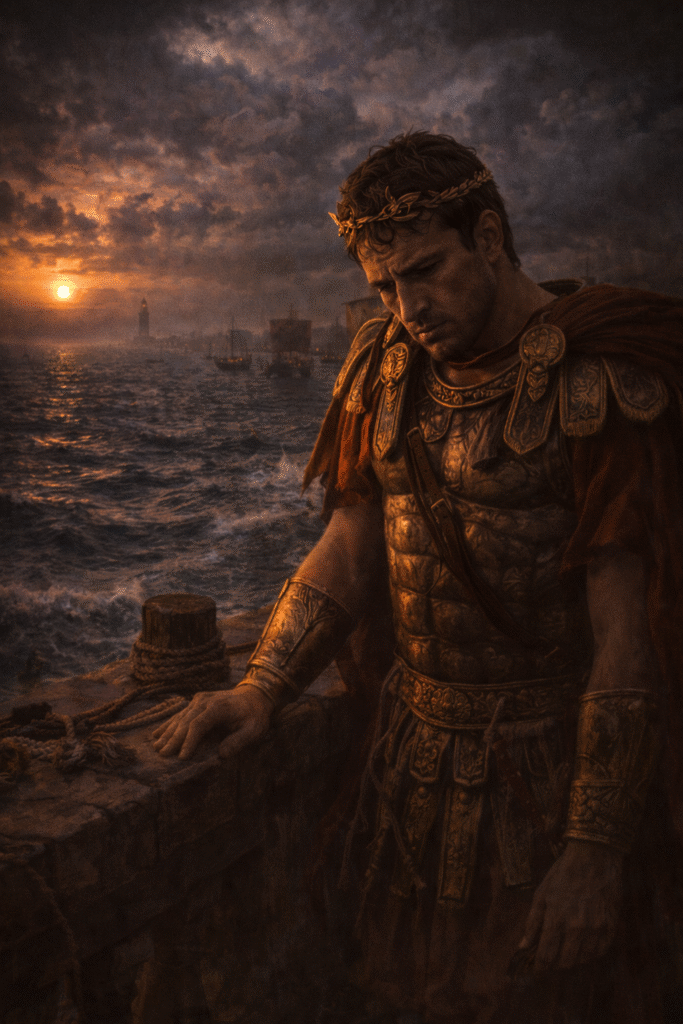
**Prologue — Lions Do Not Fall in a Roar.
They Fall in a Whisper.**
History lies,
as it often does.
It says Antony fell
in one moment
of cowardice.
One moment
of betrayal.
One moment
of despair.
But that is not how lions fall.
They fall in pieces—
quietly,
slowly,
one wound at a time:
a betrayal here,
a lost battle there,
a whisper in Rome,
a rumor in Alexandria,
a failing supply line,
a thinning army,
a breaking heart.
By the time they collapse,
they have already been falling
for a very long time.
This Scroll
is the truth
of how a great man
lost the world
one breath at a time.
PART I — Octavian Draws the Noose
Octavian advanced
with terrifying precision.
Not loudly.
Not chaotically.
Not dramatically.
Coldly.
His legions
moved like an iron tide
down the Levantine coast.
City after city
opened its gates.
Not from loyalty.
From fear.
Pelusium fell first—
Egypt’s front door.
A betrayal
from within its walls.
I still do not know
which commander
opened the gates
to Rome.
But when I received word
that Pelusium had surrendered
without a fight,
Antony said nothing.
He simply
closed his eyes.
A lion
sensing the hunter’s breath
for the first time.
PART II — Antony’s Army Shrinks
Every day,
the numbers dwindled.
Veterans
who once swore
they would die for Antony
now deserted
under the cover of night.
Mercenaries
counted their coin
and chose Rome.
Supplies ran thin.
Grain stores vanished.
Drinkable water
had to be rationed.
Antony tried
to inspire the men.
He trained with them.
He marched with them.
He slept among them.
But he could not
fight shadows.
And Octavian’s greatest weapon
was shadow.
He flooded the region
with leaflets
promising pardons
for defectors.
“Return to Rome.
Keep your families.
Keep your lives.”
It worked.
The lion’s army
became bones.
PART III — The Argument That Was Not About Anger
One night,
Antony and I
argued.
Not about strategy.
About truth.
He paced the chamber,
hands trembling.
“Your fleet,” he said,
“your decisions—
I cannot carry it all!”
“My fleet saved us,”
I countered.
“And decisions must be made
by rulers who still see clearly.”
He turned on me
with fury—
not at me,
but at the world.
“I see clearly!
I see Rome crushing down
on everything we built!”
“Yes,” I said quietly.
“But you see it too late.”
He froze.
“I,” he whispered,
“am the reason we fail.”
“No,” I said, stepping closer.
“Rome chose this.
Rome wants Egypt.
Rome wants Caesarion dead.
Rome wants me erased.
You are their excuse—
not their cause.”
He looked at me
with eyes full of
ancient grief.
“I was once
the equal of Caesar,”
he said.
“You still are,”
I whispered.
He shook his head.
“No.
I am the shadow
of what I once was.”
And for the first time,
I saw a fracture.
A break
in the foundation
of the lion.
PART IV — The Battle at the Gates of Alexandria
Octavian reached
the Canopic Gate
before dawn.
Antony rode out
to meet him
with what remained
of his cavalry.
The clash
was brutal.
Short.
Hopeless.
Dust rose
like smoke.
Swords flashed
in the early light.
Horses screamed.
Men fell.
But there was a moment—
a single moment—
when Antony turned the tide.
He broke through
Octavian’s front line
with the strength
of the general
he used to be.
For a heartbeat,
victory seemed possible.
But a heartbeat
is not a lifetime.
Octavian’s reserves
swarmed the flanks.
Antony’s men—
exhausted, starving,
half their normal number—
broke.
Antony returned
to the palace
covered in dust and blood.
I met him
in the courtyard.
He dismounted heavily.
His armor hung loose.
His face hollow.
He looked at me
with a strange,
haunting calm.
“Cleopatra,”
he said softly,
“We cannot win.”
**PART V — Caesarion’s Question,
the One I Feared Most**
That night,
Caesarion asked:
“If Rome comes,
will I die?”
The world
spun.
“No,” I said,
voice steady.
“Octavian kills heirs,”
he whispered.
“He killed the son of Pompey.
He killed any who threatened Caesar’s line.”
The fear
in my boy’s voice
cut deeper
than any Roman blade.
I pulled him close.
“You are not a threat,”
I lied gently.
“You are Egypt.”
But inside,
I burned with truth:
Octavian would not
let him live.
And I would not
let Octavian
touch him.
No matter what it cost.
PART VI — Antony’s Last March
The next morning,
Antony donned his armor
one final time.
Not polished.
Not ceremonial.
War-stained.
Bent at the ribs.
Scored by Actium’s fire.
He kissed each child
on the forehead.
He lingered
over Caesarion.
“You are brave,”
he whispered.
He lingered
over Selene.
“You are brilliant.”
He lingered
over Helios.
“You are strong.”
He lingered
over Philadelphos.
“You are beloved.”
Then he turned to me.
His voice
was a broken vessel.
“Forgive me,”
he said.
“There is nothing
to forgive,”
I replied.
“Forgive me,”
he repeated
as if he needed
the words
to hold himself together.
I took his hands.
“We face this
together,”
I said.
He kissed my forehead.
For the first time
in all the years
I knew him—
he let go of my hands
before I let go of his.
And he walked away.
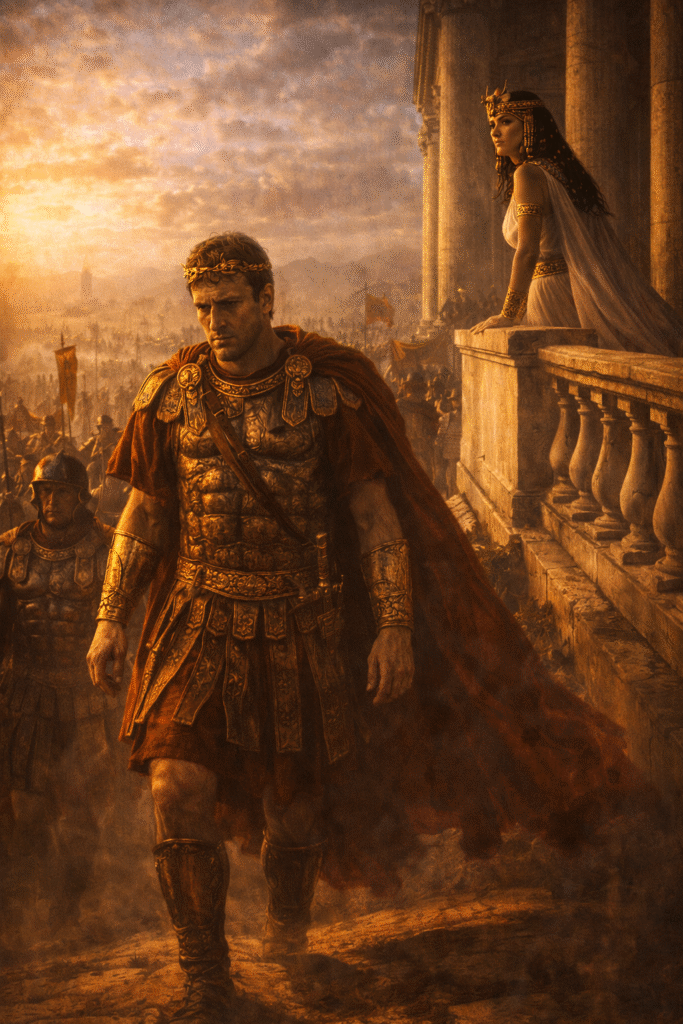
PART VII — The Collapse of the Lion
The battle
lasted minutes.
Not hours.
Not days.
Minutes.
Antony charged
at the head of his cavalry
with desperate brilliance.
But his army
—outnumbered, exhausted, broken—
collapsed around him.
When he returned,
he was carried
by two loyal soldiers.
I met him
in the same courtyard
where I had met him
the night before.
His helmet
fell from his hand.
He looked at me
with eyes
that had seen
the truth.
“Cleopatra…”
he whispered.
I had prepared
for this moment
in my mind.
But not in my heart.
His breath rattled.
His legs buckled.
“Cleopatra…”
he tried again.
I caught him
before he fell.
“You are Antony,”
I said fiercely.
“You are still Antony.”
But he shook his head.
“No.
I am the ruin
of Antony.”
His body trembled.
And the lion
finally fell.
Not in glory.
Not in rage.
In grief.
Grief
for the man
he had been.
Grief
for the world
we tried to build.
Grief
for the future
we could no longer hold.
I lowered him
to the ground.
My hands
were steady.
My heart
was not.
PART VIII — What Rome Never Understood
Rome thought Antony fell
because of love.
Fools.
He fell
because the world changed
into something
he was never built for.
A world
where battles
were won with propaganda.
Where loyalty
was bought with coin.
Where truth
was whatever Rome
needed it to be.
Antony
was a warrior
in an age
that no longer valued
warriors.
He was a lion
in a world
that now belonged
to serpents.
He did not fall
for Cleopatra.
He fell
because he could not
become Octavian.
And no one
should ever have to.
PART IX — The Night Before the End Began
I stayed by Antony’s side
as he drifted
between consciousness
and sleep.
There were no speeches.
No declarations.
No gods descending.
No poetry.
Just breathing.
Shallow.
Uneven.
Fading.
I held his hand.
He whispered once:
“Cleopatra…
live.”
And then—
silence.
Not the silence
of abandonment.
The silence
of endings.
The silence
before the beginning
of my own.
Ancient Questioner’s Desk — The Lion Edition
A student asked:
“Why did Antony fall?”
The elder replied:
“Because the world
outgrew the kind of man
he was born to be.”
Another asked:
“Did Cleopatra cause his ruin?”
The historian wrote:
“No.
Rome caused his ruin.
She merely witnessed it.”
A traveler wondered:
“Was Antony still a hero
at the end?”
The scribe answered:
“Yes.
But heroes die
when the world
no longer has room
for their kind.”
A final question came:
“What is the meaning of a lion’s fall?”
The old master said:
“That the jungle
was replaced
by an empire.”
FINAL CTA — Stand Where the Lion Took His Last Breath
This Scroll ends here—
in the dust of Alexandria’s courtyards,
in the final heartbeat
of Rome’s greatest general,
in the quiet agony
of a queen losing the last ally
between her and the empire.
If you want to walk
the palace stones
that bore the weight
of Antony’s final moments,
the walls that echoed his last words,
the city that mourned
its adopted lion—
walk them with ENA.
Journey with ENA.
Lions do not fall alone.
They take the world’s breath with them.