Scroll XXVIII – When the gods Turned Their Faces Away
Alexandria — Winter 31 BCE to Spring 30 BCE
Translated and restored for the modern traveler.
Prologue — Before a Kingdom Falls, Its Silence Speaks First
After Actium,
people think the world collapsed all at once.
It didn’t.
Kingdoms don’t fall
like toppled statues.
They erode
like shorelines.
Slowly.
Painfully.
Relentlessly.
This Scroll
is the erosion.
The quiet.
The dread.
The unraveling
of alliances,
certainty,
faith.
It is not the moment the gods abandoned us.
It is the moment
we realized
we would have to save ourselves.
PART I — The Return to a City That Did Not Cheer
When Antony and I
returned to Alexandria,
there were no celebrations.
No dancers.
No petals.
No cheers.
Just silence.
A silence
so heavy
the city seemed to sag under it.
People bowed,
but their eyes
carried questions:
“What happened?”
“Did we win?”
“Are we safe?”
“Is Rome coming?”
Children stared
with open confusion.
Elders lowered their gazes.
My palace gates
closed behind us
with a dull echo.
The Nile
did not greet us with breeze.
The sky
did not brighten.
It was as if Egypt
already knew.
The gods
did not turn away that day.
They simply
did not intervene.
PART II — Antony’s Shame
Antony crumbled
slowly.
Not in rage.
Not in violence.
But in silence.
He avoided court.
He avoided councils.
He avoided me.
Not because he blamed me.
Because he blamed himself.
Actium
haunted him.
He relived it
night after night:
the smoke,
the screams,
the collapsing formation,
the sight of my ship
cutting through flame.
His pride
—once a mountain—
fractured.
He drank.
He raged at shadows.
He paced the palace halls
with a lion’s grief.
I found him once
sitting in the war room
staring at the Actium map.
“It should have been victory,”
he whispered.
“It should have been survival,”
I corrected gently.
He shook his head.
“They will call it betrayal.
They will say I fled.
They will say I chose you
over Rome.”
“They will lie,” I said.
He looked at me
with eyes hollowed
by months of torment.
“Lies win wars, Cleopatra.
They always have.”
He was right.
And that truth
cut deeper
than any Roman sword.
PART III — The Desertion Begins
Octavian’s envoys
swept across the Mediterranean.
Cities bent the knee.
Allies defected.
Supplies evaporated.
Mercenaries vanished
in the dead of night.
One by one,
the pillars of our strategy
crumbled.
A letter arrived
from Cyprus:
“We must side with Rome.
Forgive us.”
From Syria:
“Our forts cannot stand
against Octavian’s will.”
From Crete:
“We can no longer honor
your daughter’s titles.”
Another from a trusted general
in Armenia:
“Octavian offers pardons
and gold.
I have a family.”
Antony read these letters
in silence.
His hands trembled
only once.
When the letter came
from Athens—
a city he adored,
a place where he had been welcomed
as hero and patron.
“We submit to Rome.”
He stared at the words
for a long time.
Then he said quietly:
“Even Athens.”
And I felt
the world contract
around us.
PART IV — The People’s Fear
Fear
is a river.
Once it begins to flow,
it touches everything.
In Alexandria:
Merchants
closed their stalls early.
Mothers
kept children home.
Fishermen
avoided the harbor
after dusk.
Priests
performed rituals
twice as often.
One night,
I walked the marketplace
in plain linen,
unannounced.
A basket-weaver
recognized me
and seized my hand.
“Majesty,”
she whispered,
“must we flee Egypt?”
“No,”
I said.
But my voice
did not reach her eyes.
Fear listens
only to itself.
PART V — The Gods Grow Quiet
Egypt’s gods
are ancient and enduring.
They do not abandon lightly.
But the signs
grew troubling:
The Nile
flooded late.
Temple fires
smoked without wind.
Sacred animals
grew restless.
Omens
shifted from bright
to ambiguous.
Priestesses
entered my chambers
with pale faces.
“Majesty,”
they said,
“The gods are not angry—
only watching.”
Watching
is worse.
Watching
means the burden
is ours alone.
That night,
I lit a lamp
at the shrine of Isis.
Not as queen.
As woman.
As mother.
As someone
who felt the weight
of an entire nation
pressing against her ribs.
I whispered:
“If you see us,
give us strength.”
The flame
flickered once.
Twice.
Then held steady.
Enough.
PART VI — Antony’s Final Hope
Despite everything,
Antony clung
to one final hope:
That his veteran legions
in Cyrene and Armenia
might yet return
to his side.
He waited for letters.
Reports.
Footsteps.
None came.
Every day
hope withered.
One morning,
I found him
standing over the harbor
as the sun rose.
He looked older
than he had a year before.
More mortal.
“Cleopatra,”
he said quietly,
“I am no longer Antony.”
“You are,”
I said.
“Rome has not taken that.”
He shook his head.
“They have taken everything
that believed in me.”
He meant
the soldiers
who once would have died
at his command.
He meant
the cities
that once opened gates
at the sight of his standard.
He meant
the pride
that once held him upright.
He touched the railing.
The stone
trembled beneath his hand.
Or perhaps
it was only him.
PART VII — Caesarion’s Questions
My son—
ever perceptive—
sensed the tension.
“Mother,”
he asked one night,
“why do the people whisper?”
I sat beside him.
“Because change
moves through Egypt
like wind.”
“And is the wind dangerous?”
“Only if we do not brace
against it.”
He frowned.
“Will Rome take Egypt?”
I chose my words carefully.
“Rome will try.”
“And we will fight?”
“We will survive,”
I said,
“whatever that requires.”
He nodded.
Children
accept truth
more honestly
than adults.
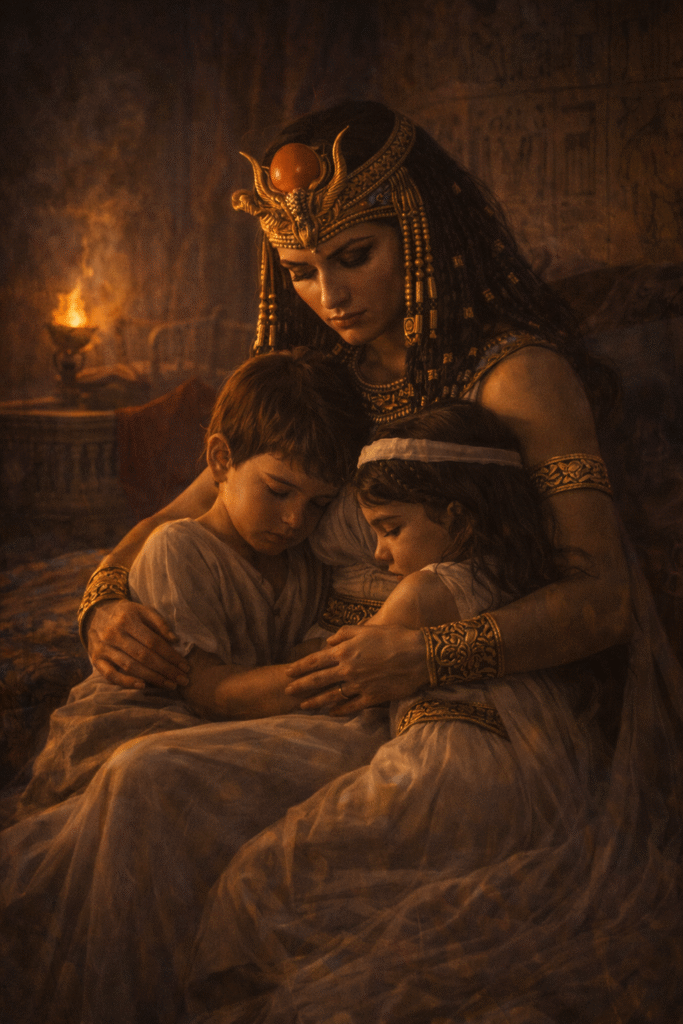
Selene,
listening from the doorway,
asked:
“Mother…
are the gods watching us?”
I looked at her
—my moon child—
and said:
“They always watch.
But sometimes
they wait to see
what we will do.”
PART VIII — The Letters from Rome
Three letters
arrived in one week.
Each worse
than the last.
Letter One — From Octavian
Cold.
Precise.
Unyielding.
“Submit,
and Egypt shall retain
its dignity.”
A lie.
Letter Two — From Rome’s Senate
Cowardly.
“Deliver Cleopatra
and Caesarion
into Roman custody,
and Antony will be spared.”
An insult.
Letter Three — From a Roman general
Borderline threatening.
“Alexandria will burn
if Egypt resists.”
A promise.
I read these letters
in my solar,
hands steady
though my heart
pounded like war drums.
I burned all three.
PART IX — The Night the Stars Went Dark
In early spring,
a shadow passed over the moon.
Not a full eclipse.
A partial darkening—
a smear of shadow
across silver.
Priests gasped.
Astronomers fell silent.
Selene whispered:
“Mother…
the moon is wounded.”
I wrapped my arms
around her.
“It is only shadow,”
I said.
But shadows
mean something
in Egypt.
They mean
the balance is shifting.
That night,
the palace torches
burned low
though they were well-tended.
The sea
lay black and flat.
No breeze.
No movement.
It felt
as if the world
held its breath.
Waiting.
For what—
I did not yet know.
PART X — What It Means When the Gods Are Silent
I have been asked
many times
if the gods
truly turned away.
Here is the truth:
The gods
do not abandon nations.
Nations
abandon themselves
when they forget
their strength.
The gods
were not punishing us.
They were showing us
the limits
of our alliances,
our ambitions,
our failures
to read Rome’s hunger.
They were showing us
that survival
would not be given.
It would be taken.
By will.
By clarity.
By sacrifice.
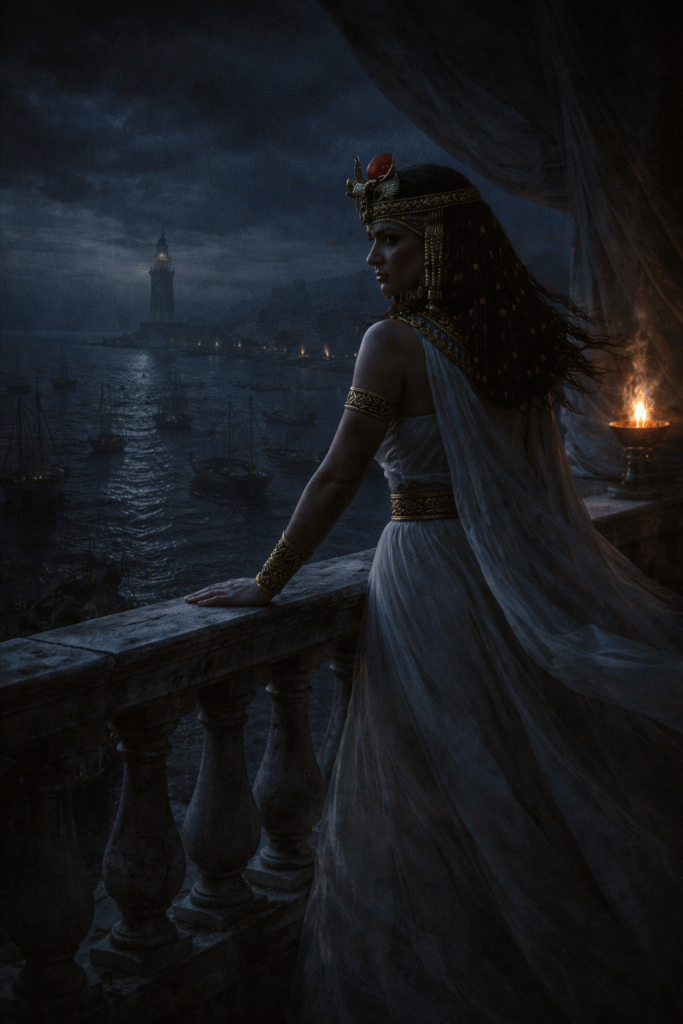
I stood on the balcony
as Alexandria slept
in uneasy dreams.
I whispered:
“We are not finished.”
Even if the gods
watched in silence.
Even if the sea
remembered Actium.
Even if Octavian
marched with inevitability.
Even if Antony
shrank under the weight
of his own name.
Even if the world
had begun
to unmake itself.
“We are not finished.”
The wind
did not answer.
But I did not need it to.
Because the next scroll
—dark as it will be—
is not about surrender.
It is about
the last stand
of a dynasty
that refused
to kneel.
Ancient Questioner’s Desk — The Silence Edition
A student asked:
“Did Cleopatra believe the gods abandoned her?”
The elder replied:
“No.
She believed
the world had fallen out of balance—
and she had to restore it.”
Another asked:
“Was Antony broken?”
The historian wrote:
“He was not broken.
He was ashamed.”
A traveler wondered:
“Why did Egypt lose so many allies?”
The scribe answered:
“Fear travels faster than armies.”
A final question came:
“What did this silence mean?”
The old master said:
“It meant the storm
was about to break.”
FINAL CTA — Walk the Quiet Before History Shattered
This Scroll ends here—
in the empty harbors of Alexandria,
in the trembling silence of a city waiting,
in the palace halls
where hope thinned
but did not die,
in the hearts of rulers
strained by fate.
If you want to stand
in the shadowed days
before the final dawn,
on the threshold
of the world’s greatest turning—
walk it with ENA.
Journey with ENA.
Even when gods fall silent,
queens do not.