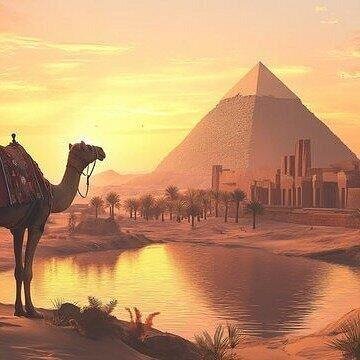
Scroll XXIII – The Children of the Sun and Moon
Alexandria — 40–34 BCE
Translated and restored for the modern traveler.
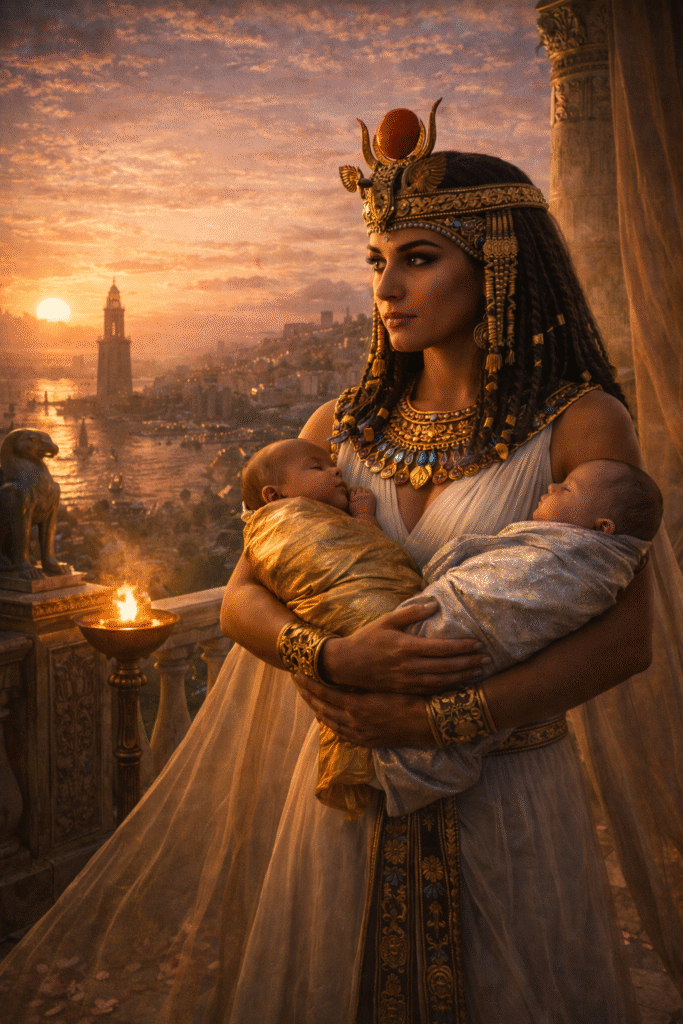
Prologue — Children Are Not Born Into Peace. They Are Born Into Futures.
When my twins were born,
the Alexandrian sky
bruised purple
before dawn.
A color
that priests call
the moment between worlds.
A threshold.
Alexander Helios.
Cleopatra Selene.
Sun and Moon.
They arrived
not as heirs
to a peaceful kingdom—
but as symbols
in a world
splitting along fault lines.
Rome fractured.
Octavian ascended.
Antony waged wars.
Kings fell.
Borders shifted.
The future trembled.
And into this trembling world
came two children
who would embody
the fate of empires.
This Scroll
is their beginning.
Not myth.
Legacy.
PART I — The Night of the Twin Births
Labor began
during the Festival of Hathor.
Priestesses whispered
that twins
were a blessing
born of divine symmetry.
But blessings
in royal houses
are also burdens.
Hours passed
in pain and focus.
The air thickened
with incense.
My midwives
spoke softly,
their hands steady.
Then—
a cry.
My son.
Warm, fierce, alert.
Then—
another cry.
My daughter.
Small, bright-eyed,
her fists curled
as if grasping future stars.
The priestess leaned close.
“Majesty,”
she whispered,
“your children come
bearing ancient signs.”
“Sun and Moon?”
I asked.
She nodded.
“Balance.”
Ma’at
made flesh.
PART II — Their Names: Symbols Set Upon the World
In the days that followed,
Alexandria buzzed
with rumor and reverence.
A boy and a girl.
Twins.
Born to the Queen of Egypt
and the Roman warlord
who ruled the East.
Their names
were not chosen lightly.
Alexander Helios
Helios: Sun
Symbol of kingship, strength, expansion.
His birth was a declaration
that light would rise again
over the Eastern Mediterranean.
Cleopatra Selene
Selene: Moon
Symbol of continuity, reflection, cycles.
Her birth was a declaration
that Egypt’s line
was endless.
Their identities
were more than titles.
They were architecture.
Part of the vision
Antony and I were building:
A stabilized East.
A cultural renaissance.
A dynasty that transcended Rome.
My children
were the blueprint
of that world.
And Rome felt it.
Whispers traveled:
“Cleopatra builds a new empire.”
“Antony rejects Rome’s heartland.”
“These twins will divide the world.”
Rome feared potential
before it feared armies.
And these children
were pure potential.
PART III — Antony Meets His Children
Antony returned to Alexandria
in midsummer.
The palace
was alive with anticipation.
When he entered my chamber
and saw the twins,
his expression changed—
not soft,
not sentimental,
but awestruck.
He lifted Alexander Helios
in his arms.
“By the gods,”
he whispered,
“He has your eyes.”
“And your stubbornness,”
I said.
Then he held
Cleopatra Selene.
“Little moon,”
he murmured,
“She will outthink us both.”
He was right.
Antony
may have been fire—
but with his children,
he was gentled flame.
The twins reached for him
without hesitation.
Children
see truth
before politics.
They knew him
not as general,
not as Roman,
but as father.
And in that moment,
the palace
felt lighter
than it had in years.
Even if the world
began darkening elsewhere.
PART IV — Egypt Welcomes the Sun and Moon
The naming ceremony
was held at the Temple of Isis.
A golden morning.
Perfumed air.
Priests chanting
hymns older
than any Roman dynasty.
Each child
was raised
to the sun
and to the moon
in turn.
Not as gods.
As symbols.
When Alexander Helios
was lifted,
a shaft of sunlight
pierced the courtyard.
The priests murmured:
“Hor-em-akhet
smiles upon him.”
When Cleopatra Selene
was lifted,
a cool breeze
swept through the hall.
The priestess whispered:
“The goddess
walks beside her.”
These were not miracles.
Not omens.
They were moments
when nature
and symbolism
aligned.
And Egypt
recognized
its future.
PART V — Raising Children Under Two Civilizations
My children
were raised
with dual heritage:
Egyptian
in faith,
ritual,
kingly duty,
respect for the Nile,
Ma’at,
balance.
Hellenistic
in scholarship,
mathematics,
philosophy,
astronomy,
language.
Roman
in discipline,
strategy,
politics,
military structure.
A single child
must learn to rule.
But children
of two worlds
must learn to
understand
those worlds.
I taught them languages
before toys:
Egyptian,
Greek,
Latin,
Aramaic.
By age four,
Alexander Helios
could recite
the titles of kings.
By age four,
Cleopatra Selene
could name constellations
and explain
why the Nile rose
in summer months.
Their lessons
were not burdens.
They were destinies.
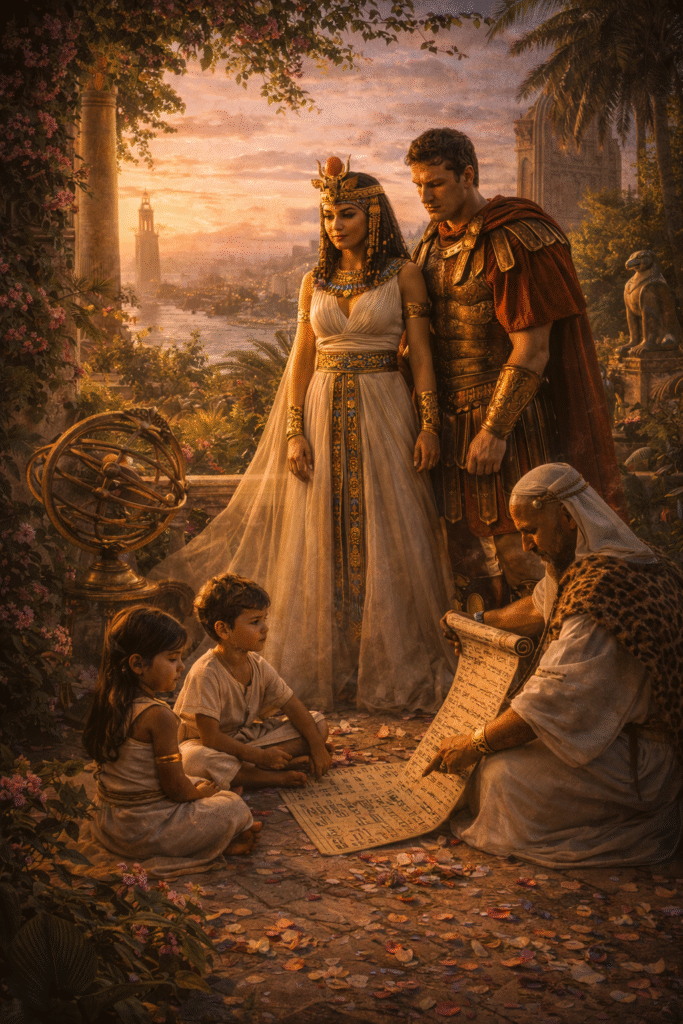
PART VI — Rome’s Fear Becomes Reactivation
Not everyone
welcomed their birth.
Octavian’s spies
sent letters
filled with venom:
“Antony has fathered
Eastern heirs!”
“Cleopatra builds
a counter-Rome!”
“These twins
will fracture the Republic!”
To Rome,
their birth
was not joy.
It was threat.
A threat
to Octavian’s claim
as sole heir
of Caesar’s legacy.
My son Caesarion
was already
a living challenge.
Now two more children
represented a future
in which Eastern sovereignty
—my sovereignty—
did not depend
on Rome’s approval.
Octavian sharpened
his rhetoric
and his knives.
He began speaking publicly
of “the dangerous queen”
and her “brood of serpents.”
But venom
is the weapon of the cornered.
Rome feared
what it could not control.
And Octavian
could not control
the world Antony and I
were shaping.
PART VII — The Donation of Alexandria
The political earthquake
that defined this era
came years later—
but its logic
began with the twins.
In a grand ceremony
in Alexandria,
Antony formally declared:
Alexander Helios
King of Armenia, Media, and Parthia.
Cleopatra Selene
Queen of Cyrene and Crete.
Little Ptolemy Philadelphos
(born later)
King of Syria and Cilicia.
My own titles
expanded:
“Queen of Kings.”
“New Isis.”
Historians
misunderstand this moment.
They see arrogance.
Hubris.
Overreach.
But they miss the truth:
Antony and I
were establishing
order in the East.
A stable lineage.
Competent future.
Continuity of power.
This was not fantasy.
This was strategy.
And Rome
saw it clearly:
A new dynasty
was rising.
Not Roman.
Egyptian-led.
Greek-supported.
Multicultural.
Sophisticated.
Powerful.
The East
was no longer
a province.
It was an alternative.
PART VIII — The Children Who Understood Their Roles
My twins
grew not as pampered heirs
but as children
who understood history.
I watched them often:
Helios
running through the courtyard
with a wooden sword,
declaring himself
protector of the East.
Selene
sitting beneath a fig tree,
drawing maps
in the dust,
quietly calculating borders
with the precision
of a seasoned diplomat.
One day,
I overheard Helios ask:
“Mother,
will the Sun and Moon
rule together?”
I smiled.
“Only if they remember
that they rise
for Egypt.”
Selene looked up.
“And for each other.”
She was wise.
Wise enough
to understand
that siblings
shape dynasties
as much as battles.
Antony joined us then
and laughed.
“My children,”
he said,
“will unite the world.”
I raised a brow.
“Or be devoured by it.”
He paused.
Then nodded.
He knew the truth.
We both did.
PART IX — The Shadow Over Their Future
Even as Alexandria blossomed:
theaters,
libraries,
granaries,
harbors expanding,
temples rising—
a shadow grew.
Octavian.
Cold.
Methodical.
Patient.
He sent propaganda
across Italy:
“Antony has given Rome
to a foreign queen!”
“He crowns his children
as rulers over Roman lands!”
“He rejects Roman values!”
“He builds an empire
from the East!”
He stoked fear.
He painted our children
as enemies.
He spoke
not like a statesman—
but like a man
preparing his people
for war.
And I knew—
the future of my children
would be written
on the battlefield
as much as in the palace.
I held Selene one night
as she slept
curled against my chest.
I whispered:
“I will give you
every chance
to outlive the world
that fears you.”
I looked at Helios
sleeping beside her.
“And you—
I will give you
the sun.”
Then I prayed—
not to Isis
or Hathor
or Ma’at—
but to the river
that raised me.
“Protect them,”
I whispered.
“Let them shine.”
PART X — What the World Saw vs. What We Knew
The world saw:
Luxury.
Opulence.
Gold.
Spectacle.
Dionysian courts.
Scandal.
Historians
repeated these lies
for centuries.
But here is the truth:
The palace
was a school.
A university.
A diplomatic hub.
A library
of living knowledge.
Our children
were not ornaments.
They were heirs
to a carefully built
Eastern world order—
one meant to counter
the rising Roman Empire.
They were
the future.
And Octavian
knew it.
Which meant
he would come for them.
And for me.
And for everything
we built.
But this scroll
is not about the fall.
It is about
what was worth falling for.
Ancient Questioner’s Desk — The Sun & Moon Edition
A student asked:
“Did Cleopatra love her children?”
The elder replied:
“She loved them
as a queen loves—
fiercely,
strategically,
and with a vision
larger than a single life.”
Another asked:
“Were they born of romance
or politics?”
The historian wrote:
“They were born
of both—
and destined
for more.”
A traveler wondered:
“Why Sun and Moon?”
The scribe answered:
“Because the world
needed balance.”
A final question came:
“What did their birth change?”
The old master smiled.
“Everything Rome feared.”
FINAL CTA — Walk the Chambers Where a Dynasty Was Born
This Scroll ends here—
in the birthing chamber
where twins cried at dawn,
in the temple
where names became symbols,
in the palace gardens
where children learned
to read the future,
and in the great ceremony
where the East
was reimagined.
If you want to walk
the halls
where the Sun and Moon
were raised,
where dynasties were planned,
where the fate of empires
was shaped by tiny hands—
walk them with ENA.
Journey with ENA.
Some children inherit crowns.
Others inherit worlds.