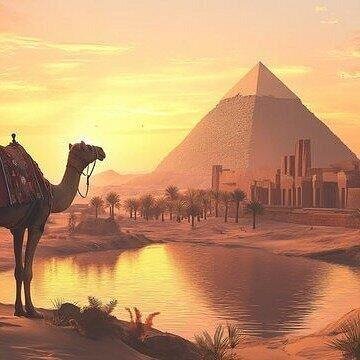
Scroll XXII – The Alliance of Fire and Stone
Tarsus → Antioch → Alexandria — 41–40 BCE
Translated and restored for the modern traveler.
Prologue — Alliances Are Not Born in Passion. They Are Born in Purpose.
History lies.
It tells you we were lovers first,
all indulgence and spectacle —
as if the fate of nations
rests on seduction.
No.
Before passion
came strategy.
Before affection
came alignment.
Antony and I
did not come together
because we were swept away.
We came together
because the world
was breaking into two pieces—
and we knew
we could shape one of them.
This Scroll
is the forging
of an alliance
that shook empires.
PART I — The First Conversation Without an Audience
The morning after the Tarsus banquet,
Antony asked to speak privately.
We met
on the terrace of the river palace,
where heat shimmered on the water
and the smell of cypress drifted in waves.
He dismissed his attendants.
I dismissed mine.
We stood facing each other
not as symbols,
but as rulers.
“Cleopatra,” he said,
“You came to Tarsus
not to answer charges—
but to negotiate terms.”
“Yes,” I replied.
“As equals.”
He laughed softly.
“Not even Caesar
treated me as an equal.”
“Then Caesar
underestimated you,”
I said.
His smile faded.
“You understand power,”
he murmured.
“I understand survival,”
I corrected.
“Then let us speak plainly,” he said.
And we did.
For hours.
We mapped the Mediterranean in words:
Who controlled Syria,
who commanded fleets,
who governed Judea,
who threatened Asia Minor,
what Rome’s legions needed,
what Egypt demanded.
We talked of Octavian—
his cold ambition,
his calculated patience.
We recognized him
as the true storm on the horizon.
Antony leaned on the railing
and said quietly:
“If we do not stand together,
we will both fall.”
“Yes,” I said.
“But not as master and subject.
As partners.”
He nodded.
Fire met stone.
And neither broke.
PART II — The Pact Not Written on Papyrus
Formal treaties
are written in ink.
True alliances
are written in clarity.
Our pact took shape
not in a single moment,
but over a sequence of understandings:
1. Antony needed Egypt’s wealth.
To pay legions,
arm fleets,
win provinces,
outmaneuver Octavian.
2. I needed Antony’s armies.
To protect Egypt,
defend Caesarion’s future,
and keep Rome’s hunger
directed elsewhere.
3. We both needed legitimacy.
My throne was secure—
but Rome’s shadow was long.
Antony’s authority in the East
was constantly challenged—
but Egypt’s stability was unshakable.
4. Our enemies overlapped.
Mine: instability and Roman overreach.
His: Octavian and the Senate factions.
5. Our strengths complemented each other.
Antony was action.
I was architecture.
He moved armies.
I moved nations.
He understood loyalty.
I understood vision.
This was not love.
This was balance.
This was Ma’at
in its political form.
PART III — The Journey to Antioch
Antony invited me
to continue our discussions
in Antioch—
not command,
just invitation.
I agreed.
We traveled north
along the Levantine coast.
The Mediterranean wind
was cool at dawn,
fierce at midday.
At night,
we spoke under the stars—
of war,
trade,
philosophy,
astronomy,
Egyptian theology,
Roman politics.
He was surprised
that I could recite
Greek poetry from memory.
I was surprised
that he knew
the names of every soldier
under his command.
He respected loyalty
as religion.
I respected justice
as mandate.
Different hearts.
Aligned purposes.
Antioch welcomed us
with heat and stone
and the scent of pine.
There,
our alliance
crystallized.
PART IV — The Division of the East
In Antioch,
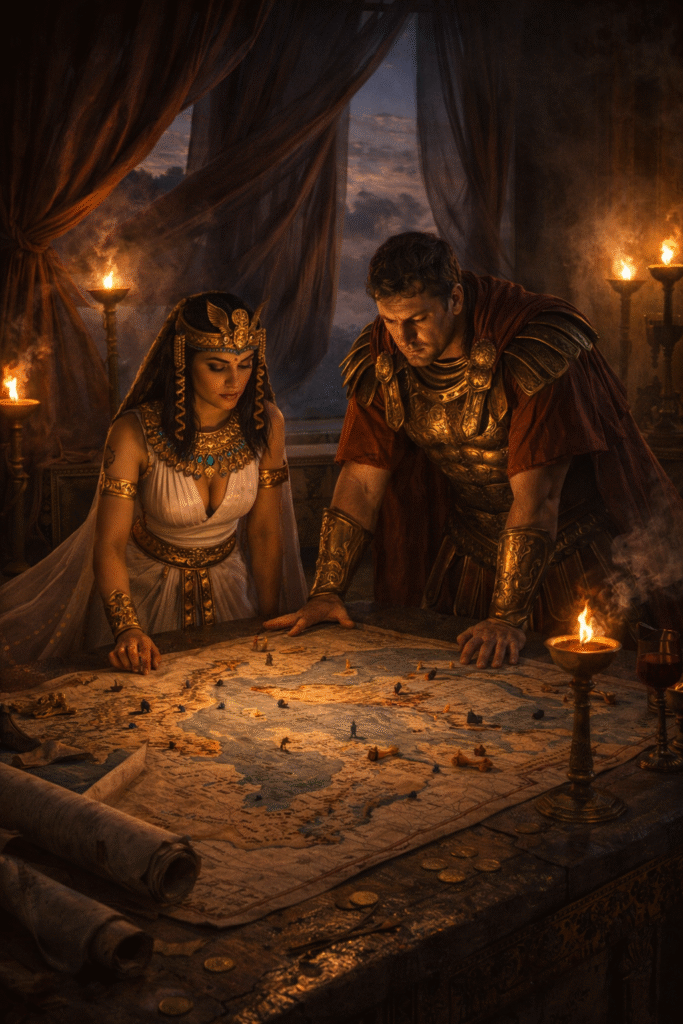
Antony spread a large map
across a marble table.
His generals stood behind him,
arms crossed,
suspicious.
I stood across from him—
alone,
unintimidated.
He tapped Syria.
“I claim this.”
I nodded.
He tapped Cilicia.
“I need this.”
“Granted,” I said.
He tapped Cyprus.
“Will Egypt relinquish it?”
“No,” I said.
“It remains mine.”
The generals bristled.
Antony raised a hand.
“Cleopatra,” he said calmly,
“What do you want?”
I placed my finger
on the territories
that had historically
belonged to Egypt
before Rome carved the map
into convenient shapes:
Cyprus.
Phoenicia.
Portions of Coele-Syria.
Coastal holdings
stretching toward Judea.
Antony studied me.
“Rome will resist this.”
“You are Rome’s East,” I said.
“With your command,
it will stand.”
“And what do you offer
in return?”
“Stability,” I said.
“Grain.
Gold.
Ships.
And the loyalty
of a civilization
older than Rome itself.”
He leaned back.
“We are rewriting
centuries of borders,”
he murmured.
“No,” I said.
“We are restoring them.”
For the first time,
his eyes softened
not with admiration—
with understanding.
“This,” he said,
“is why Caesar trusted you.”
“Caesar understood the world,”
I replied.
“You understand people.”
“And you?” he asked.
“I understand history.”
He smiled.
A genuine smile.
And we signed nothing—
because true agreements
are living things,
not ink.
PART V — Alexandria Receives Antony
When Antony arrived
in Alexandria months later,
Egypt welcomed him
not as conqueror,
but as guest.
He expected opulence.
He found something deeper.
A civilization
older than his nation.
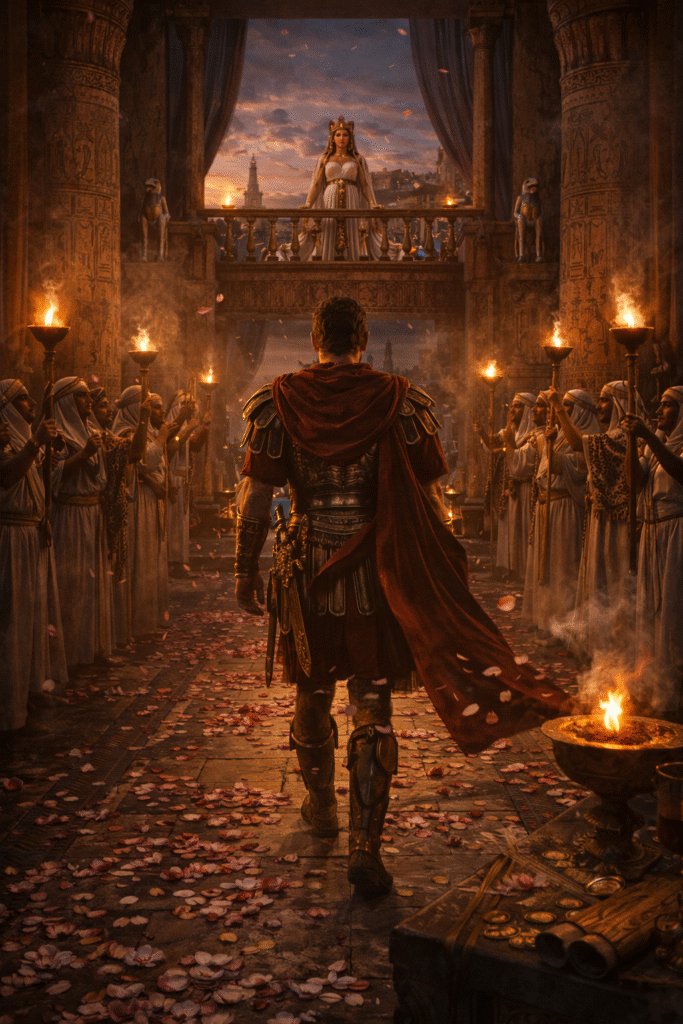
Priests greeted him
with hymns
older than Latin.
Merchants
showered the streets
with lotus petals.
Children
ran alongside his procession
calling his name
with awe rather than fear.
He stepped
into the palace courtyard
and looked up
at the painted ceilings,
the carved pillars,
the gardens
bursting with jasmine.
“This,” he whispered,
“is not a kingdom.”
“No,” I said.
“This is Egypt.”
He turned to me.
“And now it is my home.”
I did not correct him.
But I knew—
Antony had found
his place in the world.
A place
where he felt powerful,
respected,
liberated from Rome’s judgment.
He mistook that feeling
for love.
In truth—
it was belonging.
PART VI — Fire and Stone
Our alliance
earned its name
long before historians
used it.
Antony was fire—
passionate,
impulsive,
brilliant,
destructive.
I was stone—
measured,
enduring,
strategic,
unbreakable.
When he burned,
I cooled him.
When I planned,
he moved.
When he faltered,
I steadied him.
When I hesitated,
he ignited me.
The world
misunderstood us.
They saw scandal.
I saw structure.
They saw indulgence.
I saw infrastructure.
They saw romance.
I saw alliance.
Fire and stone
do not merge.
They reinforce.
PART VII — The Winter in Alexandria
Antony spent the winter
in Alexandria.
Not in decadence—
but in growth.
He studied Egyptian customs.
He learned temple rituals.
He trained
in the Palestra
each morning.
He debated philosophers
each evening.
He played with Caesarion
in the gardens.
He laughed
in a way
Rome had never seen.
Free.
Unafraid.
Alive.
But the world
does not allow
such moments to last.
For even as we planned,
built,
restored,
and dreamed—
Octavian
was writing letters
across Italy,
painting Antony
as traitor,
as hedonist,
as slave to a queen,
and painting me
as the foreign witch
who had bewitched
Rome’s greatest general.
Lies.
Propaganda.
Poison.
And the storm
tightened.
PART VIII — The Pact of Alexandria
The most important decision
of our alliance
was not made in public.
It was made
in my private council room,
with doors locked,
lamps low,
and the scent of papyrus
and ink thick in the air.
I said:
“Octavian is not content
to share power.”
Antony nodded.
“He grows
by eliminating rivals.”
“Then,” I said,
“we must grow
by strengthening bonds.”
He leaned forward.
“You propose
division of territory.”
“I propose
a shared future
that terrifies our enemies.”
He exhaled.
“Yes.”
We agreed
that the East
would be governed
from Alexandria—
not from Rome.
We agreed
that Egypt
would remain sovereign.
We agreed
that our children
would be recognized
as heirs
to regions under our control.
These decisions
were not romantic.
They were geopolitical
detonators.
Octavian
would not let this stand.
But it was necessary.
Because the world
was shifting.
And we needed
to shape the shift.
PART IX — What the Alliance Truly Was
Not scandal.
Not seduction.
A blueprint.
A vision.
A structuring
of two immense powers
against a rising force
that would one day
become the Roman Empire.
Antony offered armies.
I offered civilization.
Antony offered strength.
I offered legacy.
Antony offered loyalty.
I offered continuity.
Together—
we offered something
Octavian feared more
than all the legions in Rome:
A united East
with a future brighter
than his ambitions.
And so,
our alliance
became inevitable.
Fire.
Stone.
Purpose.
Ancient Questioner’s Desk — The Alliance Edition
A student asked:
“Was their alliance romantic or political?”
The elder replied:
“In ancient courts,
those two were never separate—
but one always led.
With Cleopatra and Antony,
politics led.”
Another asked:
“What did Cleopatra truly gain?”
The historian wrote:
“Sovereignty.
Security.
Legacy.”
A traveler wondered:
“What did Antony gain?”
The scribe answered:
“A civilization
that made him feel
like more than Rome’s leftover.”
A final question came:
“Why fire and stone?”
The old master smiled.
“Because one burns bright.
And one endures.”
FINAL CTA — Walk the Birthplace of a World-Shaking Alliance
This Scroll ends here—
in the strategy halls of Tarsus,
in the palaces of Antioch,
in the golden light of Alexandria
where two rulers
aligned their fates
and reshaped the Mediterranean.
If you want to walk
the halls
where alliance became legacy,
where rulers met as equals,
where decisions carved history—
walk them with ENA.
Journey with ENA.
Some alliances ignite nations.
Others reshape the world.
Historical Context
Cleopatra and Mark Antony formed a political and military alliance that shaped the eastern Mediterranean during Rome’s civil wars.
This scroll uses metaphor to describe strategic alignment rather than claiming a single defining moment.