
Scroll XXII – The Fall
Year: 1440 BCE — Waset (Luxor), Karnak, The Palace of the Southern Sanctuary, and Deir el-Bahari
Translated and restored for the modern traveler.
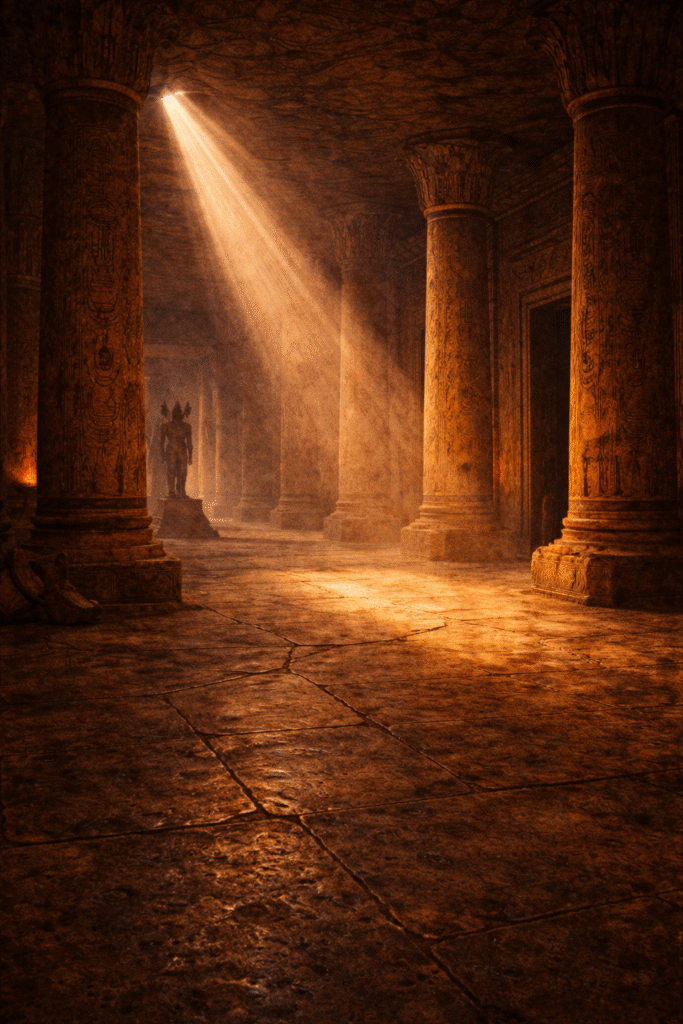
Prologue — A Fall Has Two Voices
A reign does not fall in one language.
It falls in two:
The language of stone
and
the language of silence.
Stone speaks in ritual,
in divine approval,
in the carved certainty
that a ruler is chosen by the gods.
Silence speaks in bureaucracy—
in missing scrolls,
in unsigned decrees,
in courtiers who bow correctly
but look over your shoulder
to see if someone else is approaching.
When both stone and silence
turn away from you…
That is the fall.
This is the Scroll
of the morning the temples
stopped calling my name,
and the afternoon the palace
stopped needing my signature.
This is the day
I lost a kingdom
I was still standing inside.
PART I — The Silent Accounts
It began at dawn.
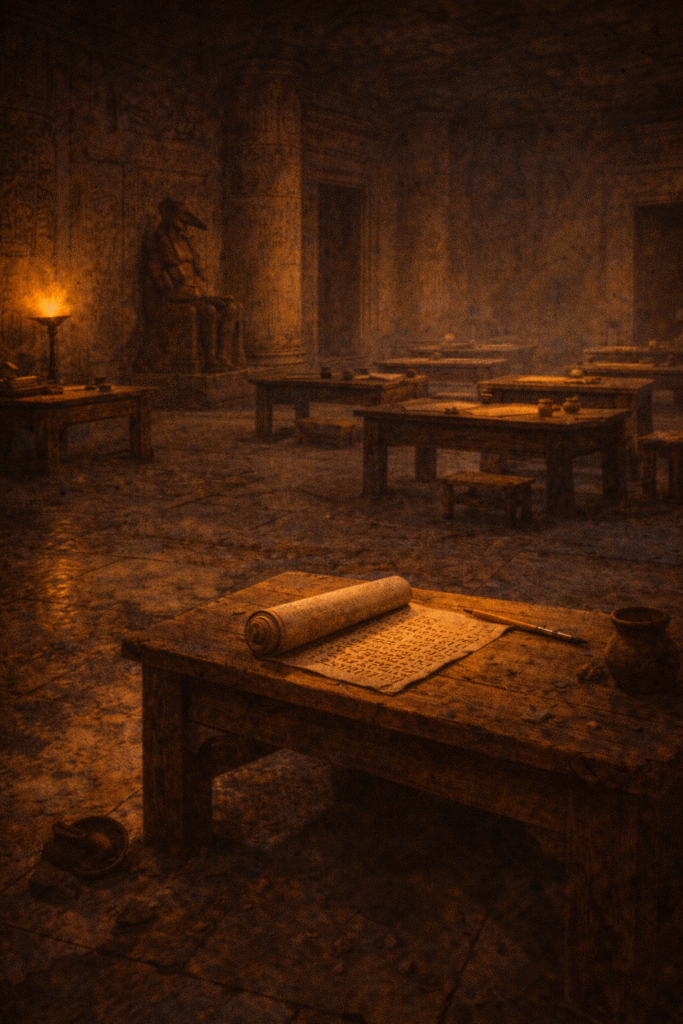
A treasury scribe entered my chambers
with an expression I had never seen on him—
a mix of fear, loyalty,
and something like apology.
He held a scroll in both hands.
“Majesty,” he whispered,
“I bring the accounts…
but there is a problem.”
“What problem?”
He unrolled the scroll.
Columns of numbers—
grain, gold, incense, livestock—
should have been followed
by confirmed allocation notes.
Instead:
Blank space.
No signatures.
No seals.
No verification from governors.
“Why are these unsigned?” I asked.
He swallowed.
“There was…
an instruction.”
“From whom?”
The scribe’s voice shook.
“The temple overseers said
that allocations must now be reviewed
by His Majesty Thutmose
before being enacted.”
I studied him.
He trembled under the weight of his confession.
“And what did the palace say?” I asked.
He closed his eyes.
“The palace said the same.”
There.
The beginning of the political fall.
A ritual not of the gods,
but of paper.
A queen still in power
whose power
was no longer processed.
Once, bureaucracy flowed through me
like the Nile through its valley.
Now it pooled
in stagnant corners.
I rolled the scroll closed.
“Thank you,” I said.
He looked startled.
“No punishment?”
“You have delivered truth,” I replied.
“Truth is not punishable.”
But truth is a knife.
PART II — The Temple’s New Tone
Later that morning,
I walked to Karnak
for the daily rites.
The sun was still low,
casting long shadows
between the pillars.
The priests bowed low
as I entered—
but I could feel
their reverence thinning.
Not gone.
Just… stretched.
A single string pulled too tight.
The high priest approached.
His face was composed,
but his eyes betrayed
a kind of sorrow.
“Majesty,” he said softly,
“we must discuss
a matter of ritual alignment.”
Ritual alignment.
A phrase engineered
to soften a blow.
“What alignment?” I asked.
He inhaled deeply—
a breath of someone
preparing to wound.
“Amun’s oracle
has spoken.”
Ah.
The oracle.
That carefully constructed voice
that always reflects
the political winds
before the divine ones.
“What did the god say?” I asked.
He hesitated.
Then:
“That the kingship
must now be singular.”
Singular.
Not shared.
Not dual.
Not balanced.
Singular.
“To whom does the singleness belong?”
I asked, though I already knew.
“Amun has placed
his future blessing
upon His Majesty Thutmose.”
There it was.
The temple fall.
A divine withdrawal
spoken in words
soft as down
and sharp as knives.
I remained still.
“And what then becomes
of the ritual texts
that name me?”
The priest looked stricken.
“We…
we must review them.”
Review.
The beginning of erasure
always comes dressed
as revision.
“And what of the rites
I am meant to lead today?”
He bowed his head.
“The god
has requested
the young king
for today’s invocations.”
Requested.
As if gods
ask for men
the way men request
golden cups at banquets.
I let the silence expand.
And then finally,
I nodded once.
“Very well.”
The high priest exhaled—
relief
and grief
bound together.
PART III — The Barque That Did Not Wait for Me
I walked
to the inner courtyard.
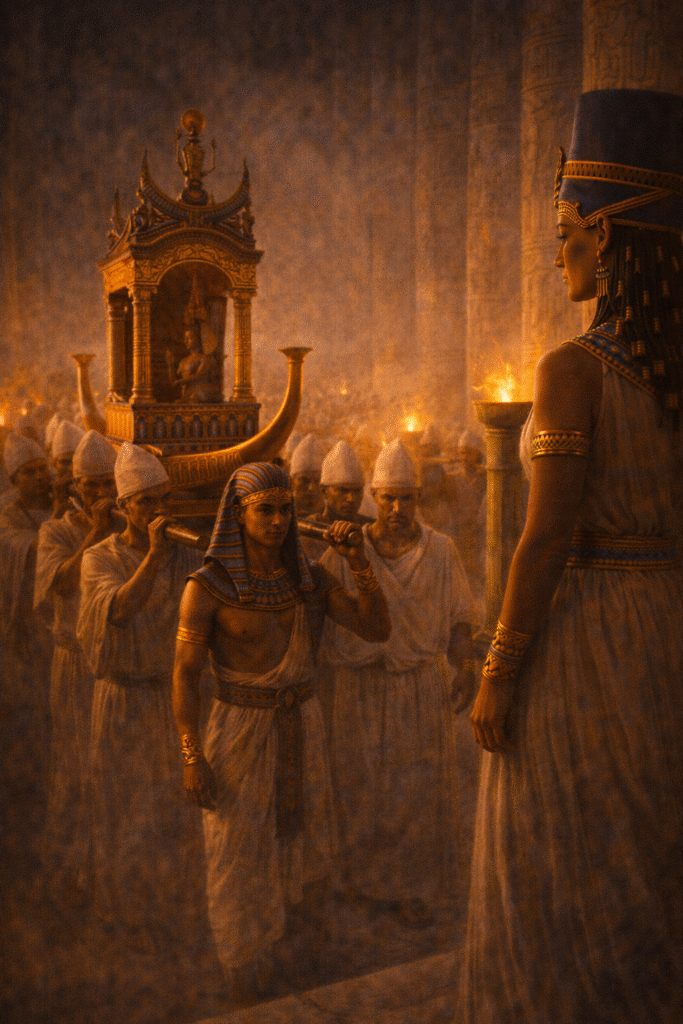
A dozen priests
already stood ready
to lift the sacred barque of Amun.
The altar smoked
with incense.
The drums thrummed softly.
The air felt tight.
Thutmose arrived
from the eastern corridor.
When he saw me,
he slowed.
“holy mother,” he said quietly,
“I did not know—”
“I know,” I said.
“I am not here
to lead.”
We stood side by side.
Two rulers.
One future.
The high priest lifted his staff.
“Let the god’s barque
be carried forward,”
he proclaimed.
Then he turned
not to me—
but to Thutmose.
“Lead us,
Son of Amun.”
Thutmose stiffened,
looking torn.
But he stepped forward.
Because he had to.
Because the priests
were already kneeling.
Because the barque bearers
were already lowering their shoulders.
Because the courtyard
had already accepted
its new configuration.
He placed his hands
on the gilded handles.
The drums changed rhythm.
The priests chanted.
The god moved.
And I—
for the first time
in my reign—
stood at the side
of a ceremony
that once required
my presence.
No one told me to move.
No one told me to stay.
No one dared look at me.
That is what a fall feels like:
Not hands pushing.
Not voices shouting.
Just a ritual
moving forward
without you.
PART IV — The Council Without a Seat
After the ritual,
I was summoned
to a council meeting.
Or so I thought.
When I entered
the Hall of Two Thrones,
there were chairs arranged
in a semicircle.
One for each noble
and advisor.
At the head—
a single elevated seat.
Thutmose’s.
My own seat
was not present.
Not moved.
Not relocated.
Missing.
As if it had never existed.
The chamberlain
looked pale
as he approached me.
“Majesty,”
he whispered,
“the council was…
told you would not be attending.”
“Told by whom?” I asked.
He swallowed hard.
“By the High Steward.
He believed
you would be engaged
in temple matters.”
Temple matters.
An elegant euphemism
for displacement.
I stood
in the doorway
of a room
I once led.
Nobles shifted uneasily.
Some stood.
Some bowed.
Some looked away.
Thutmose rose immediately.
“holy mother,” he said,
“your seat—”
I raised a hand.
“It is fine.”
“It is NOT,” he insisted.
But it was too late.
The room
had seen the truth already.
A council
that did not prepare
a chair for a queen
has already chosen
its ruler.
I stepped back.
“I will not disrupt the session,”
I said calmly.
The nobles exhaled
in collective relief—
and that
told me everything.
I left the hall.
Walking out
was not the fall.
Realizing
no one followed
was.
PART V — The Royal Seal That No Longer Opened Doors
For twenty years,
my seal
opened every gate
between Memphis and Nubia.
But that afternoon,
when I sent an order
to the fortress at Sile
to investigate border movement—
a routine matter—
the courier returned
with trembling hands.
“Majesty,”
he whispered,
“the garrison commander
refuses your decree.”
I turned slowly.
“Refuses?”
“He says orders
must now be confirmed
by His Majesty Thutmose
for the sake of
‘military alignment.’”
A phrase
that sliced
through the air.
“And did he confirm it?” I asked.
The courier swallowed.
“He…
has not yet responded.”
There it was:
Authority
molding itself
around someone else.
The bureaucracy
had broken.
Not dramatically.
Not publicly.
But functionally.
Which is worse.
When the machinery
of a kingdom
quietly reassigns
its own loyalties,
the reign is already over.
PART VI — The Oracle’s Verdict
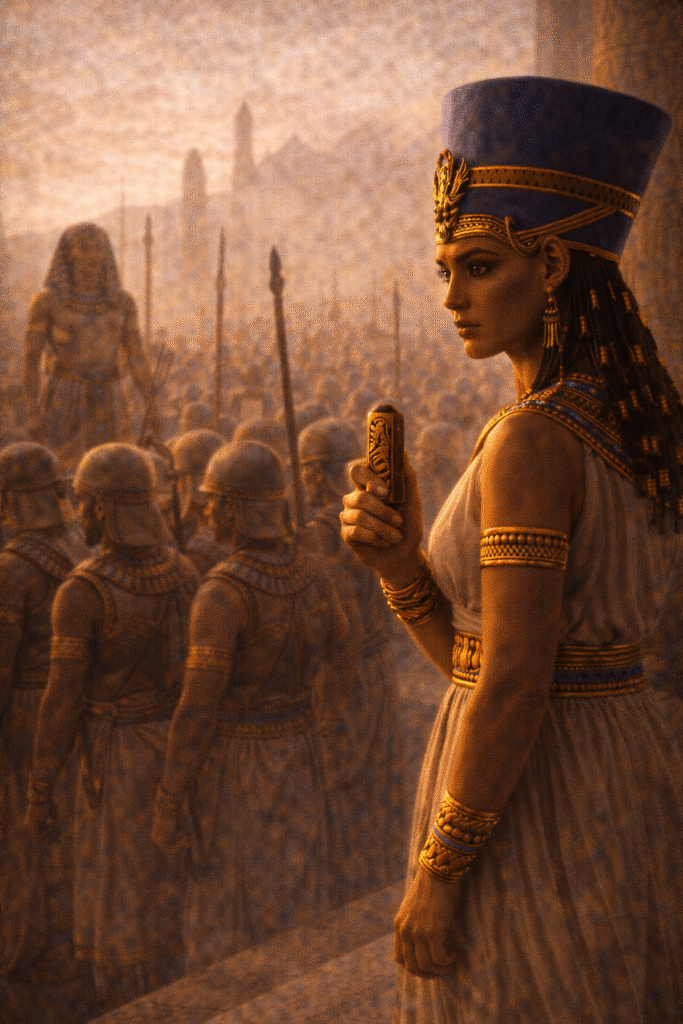
Three days later,
the temple summoned me again.
The high priest
looked exhausted.
He did not want
to say what he had come
to say.
“Majesty,” he whispered,
“We have consulted
the god’s oracle
in the chamber of purification.”
“And?”
He hesitated.
Then:
“Amun
did not speak
your king-name.”
I inhaled slowly.
“And what did he say?”
“A phrase.”
“What phrase?”
He shut his eyes.
“One sun
must rise
unshadowed.”
A poetic way
of saying:
One king.
One future.
One face
for the god to bless.
The message
was unmistakable.
Divine legitimacy
had shifted.
And the priests
were moving with it.
Not out of malice.
Out of survival.
A temple
cannot serve two suns
once it decides
which one warms the land.
PART VII — Thutmose’s Breaking Point
That evening,
Thutmose entered my chambers.
He did not bow.
He collapsed
to his knees.
“holy mother,”
he whispered,
his voice cracking,
“this is not what I wanted.”
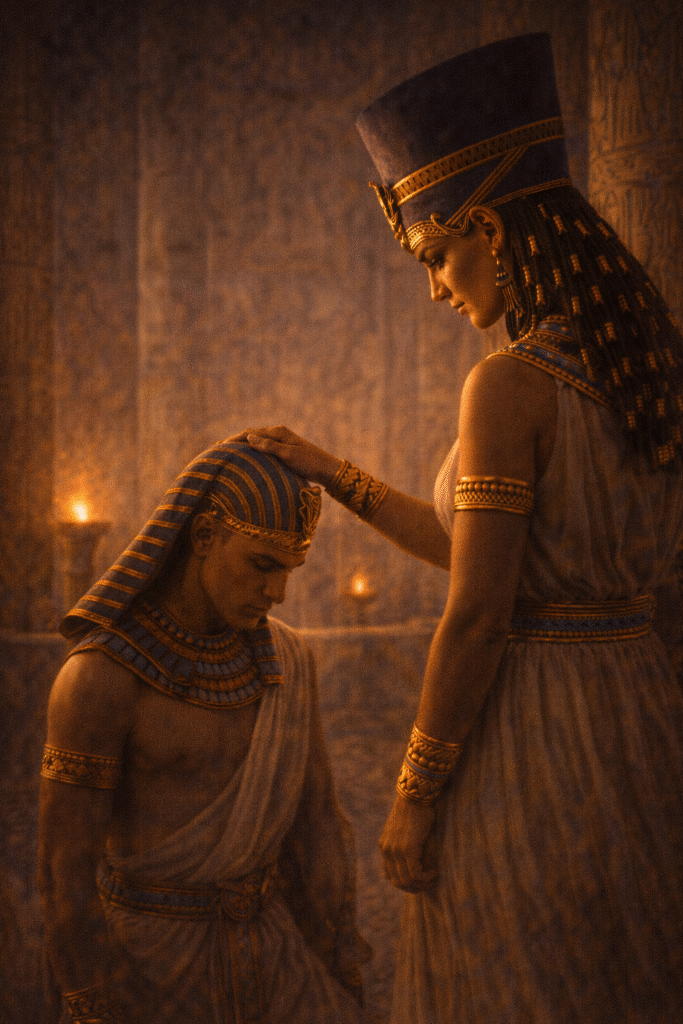
I placed my hand
on his head.
“I know.”
“They removed your chair,”
he said, shaking.
“Yes.”
“They denied your decrees.”
“Yes.”
“They took your rites.”
“Yes.”
He looked up at me—
eyes bright with grief.
“What do I do?” he whispered.
“Rule,” I said simply.
He blinked.
“No,” he whispered.
“Not like this.”
“There is no other way,”
I said.
He bowed his head
against my lap
like he once did as a child.
And I—
for the first time
in many years—
felt the sting of tears.
Not for myself.
For him.
For the burden
that had just become his.
Because a fall
is not only the end
of a reign.
It is the beginning
of another.
And beginnings
are heavy.
PART VIII — The Temple That Unnamed Me
At dawn,
I walked alone
to Karnak.
The temple
was strangely quiet.
Priests whispered
in corners
but did not approach.
I entered the inner hall.
And there I saw it.
A new inscription
had been carved
on a wall adjacent
to one I commissioned.
It was an invocation
to Amun-Re.
It listed the offerings
of the ruling king.
The cartouche
held only one name:
Thutmose.
My name
was not removed.
It was never added.
I stood before it
in absolute stillness.
This is what a fall is:
Not being struck.
Not being dethroned.
Not being killed.
A wall
that simply forgets
to include you.
Stone
that writes the future
as if you were
already dust.
PART IX — Deir el-Bahari: The Moment I Understood
At sunset,
I returned
to the terraces
I built with my own heart.
Deir el-Bahari glowed
with soft gold.
The cliffs held me
in their long, ancient embrace.
I walked
to the upper colonnade
where my story
was carved
in color and stone.
I touched
the relief
of my birth narrative.
I traced
the painted lines
of my expedition to Punt.
I pressed my palm
to the carved image
of myself
kneeling before Amun.
And I felt it—
The break.
Not a fracture.
Not a shattering.
A release.
Like a breath
I had been holding
for twenty years.
“It is done,”
I whispered to the stone.
“Not my reign.
But the world
that required it.”
I looked
at my own image
on the wall
and did not feel fear.
I felt
completion.
This temple—
my masterpiece—
would outlast
every political turn,
every priest,
every council,
every scribe.
My story
was carved too deep
to be erased entirely.
Even if they tried.
Especially if they tried.
A fall
is not the end of a legacy.
It is merely
the moment the world
turns its face
toward another sun.
The stone
turned with me.
But the memory
stayed.
If you have ever lost
your place
not through failure
but through inevitability—
If you’ve ever felt
the world shift
in a direction
you could not follow—
If you’ve ever watched
your authority dissolve
not through rebellion
but through silence—
Then you know this Scroll.
Walk with us
to the terraces of Deir el-Bahari,
to the halls of Karnak,
to the rooms
where a queen
stood alone
and understood
her reign had changed shape.
Journey with Explore ENA.
Some falls
echo for millennia.
PART X — The Ancient Questioner’s Desk
A student once asked:
“Did she fight her fall?”
The historian replied:
“No.
She recognized it.”
Another asked:
“Was she forced out?”
The scribe wrote:
“No.
The world simply moved on.”
A traveler wondered:
“Was Thutmose cruel?”
The scholar answered:
“Cruelty was not required.
Inevitability did the work.”
A final question came:
“What is a fall?”
The old master smiled sadly.
“A fall
is when the world
stops needing you—
even if you are still standing.”
The Scroll ends here—
with walls that forget,
with councils that drift,
with gods that choose anew.
With a queen
who did not shatter
but stepped back
to watch the fate
she shaped
become the future
she could not carry.
If you felt her fall—
not in violence,
but in silence—
then you walk beside her now.
Come stand
where her footsteps ended
and her legacy began.
Journey with Explore ENA.
Some thrones fall—
but some stories
cannot be erased.