
Scroll XVIII – The Temple Walls Begin to Speak
Year: 1444 BCE — Waset (Luxor), Karnak, Deir el-Bahari, and the Sculptors’ Yards
Translated and restored for the modern traveler.
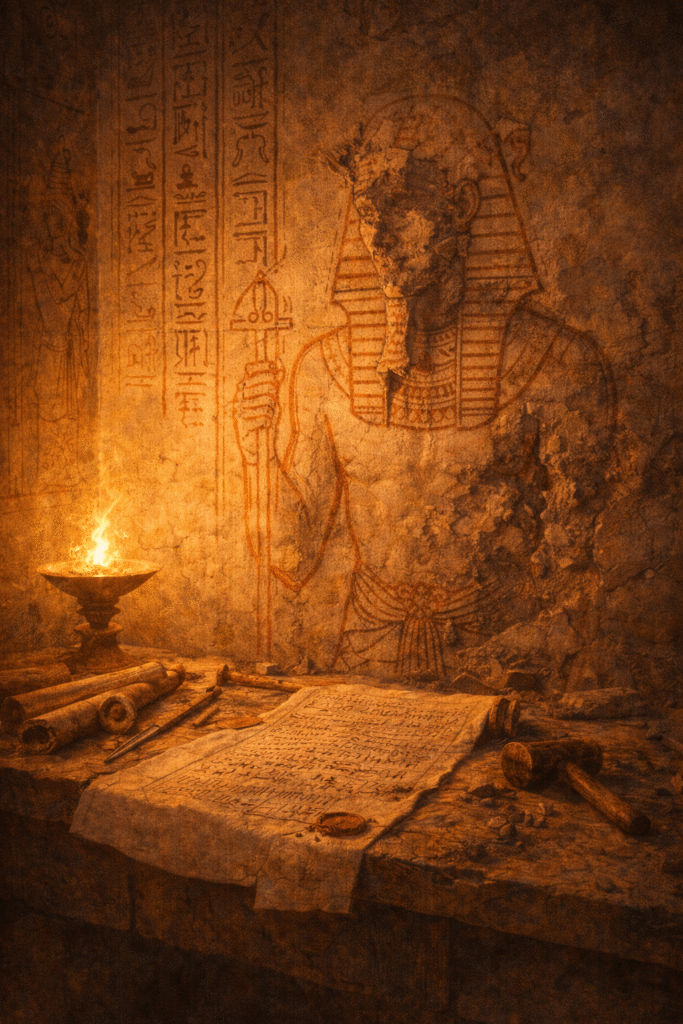
Prologue — Stone Knows Before People Do
I have always believed
that stone remembers
longer than breath.
It remembers
the hands that shape it,
the prayers whispered to it,
the resonance of footsteps
carried across its surface.
It remembers
truth,
and it remembers
lies.
But what I learned in these years—
the years when the walls
began to shift beneath history’s fingertips—
is that stone also remembers
fear.
Not the sharp fear
that sends armies running.
The quiet fear.
The political fear.
The fear of aligning with the wrong legacy
when the winds are changing direction.
This Scroll
is not the record
of the great erasure—
that comes later.
This is the first breath of it.
The whisper.
The faint scrape of a chisel
hesitating against limestone.
The beginning of the moment
when my story
stopped being mine
and became
theirs.
PART I — The First Missing Name
It began
with a single cartouche.
Small.
Unassuming.
Almost forgettable.
I was reviewing inscriptions
on a new chapel wall
in the rear precinct of Karnak—
a place where reliefs
recorded offerings
to Amun-Ra.
The priests walked ahead,
naming each panel
with practiced ease:
Thutmose this,
Amun that,
priests in procession,
blessings,
ritual scenes.
Then they reached it—
a panel of a king
offering incense.
A scene I had ordered.
A scene I had designed.
The priest gestured proudly.
“His Majesty Thutmose,” he said.
I studied the carving.
The posture
was the one usually assigned to me—
back straight,
arm slightly extended,
the angle of the vessel precise.
But the headdress was altered.
And the cartouche—
The cartouche at the top,
where my name should have been—
held only Thutmose’s.
No room for two.
No faint trace of correction.
No palimpsest.
Just a single name
where there had always been two.
I turned to the priest.
“This scene,” I said,
“was meant to show us both.”
He smiled politely,
hands folded.
“Majesty,
the artisans said
you gave no such instruction.”
I looked at the artisan in charge—
a young man,
nervous,
eyes darting.
“Is this true?” I asked.
He swallowed.
“No, Majesty.
The instruction…
was given later.”
“By whom?”
The priest beside him
cleared his throat.
“The temple council…
felt it better
to simplify the scene.”
Simplify.
The most dangerous word
in the lexicon
of erasure.
Not destroy.
Not deface.
Simplify.
As if removing me from a wall
were as harmless
as removing a duplicate line.
I nodded once—
a gesture so small
no one but the artisan
saw the storm behind it.
PART II — The Sculptor with the Shaking Hands
Weeks later,
I visited the sculptors’ yard
where new statues
for festivals
were being shaped.
Stone dust floated in the air
like pale smoke.
The ringing of chisels
echoed against the palace walls.
As I approached,
the artisans stood
and bowed.
But one older sculptor—
a man I trusted for years—
did not meet my eyes.
He looked sick.
“Show me your current work,”
I said.
He hesitated.
“Majesty…
perhaps you would prefer—”
“Show me.”
He stepped aside.
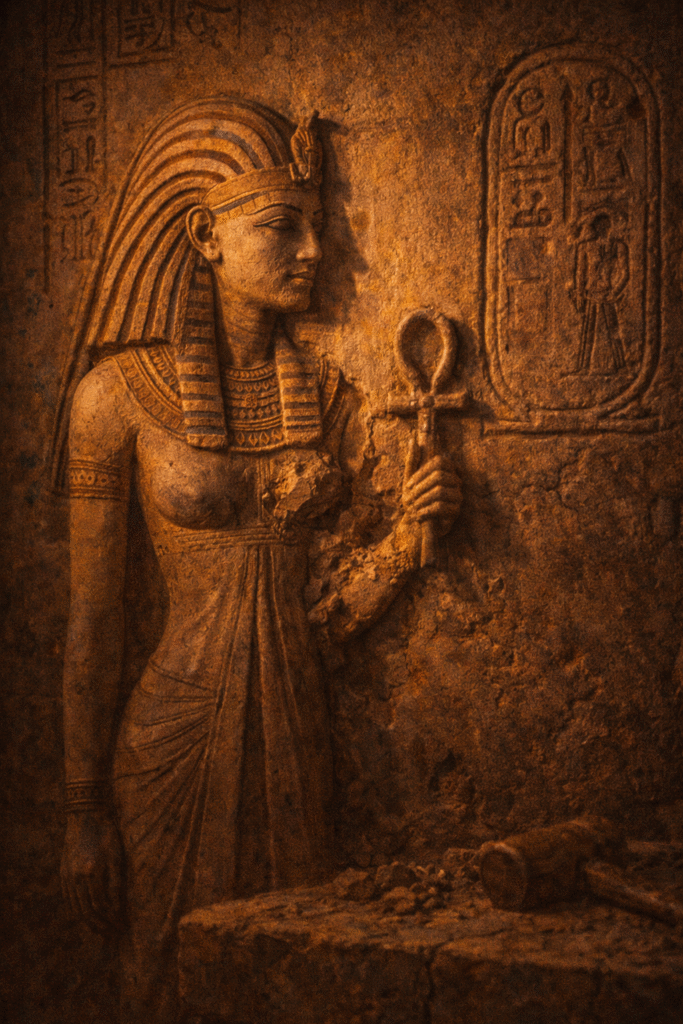
The statue before him
was nearly complete.
It was meant to be me.
I recognized the posture,
the slender hands,
the curve of the jaw
he always softened
in deference to gentleness.
But the head—
the headdress—
was wrong.
Instead of the striped nemes,
he had carved
the Blue Crown.
Thutmose’s crown.
The war crown.
And the face—
still feminine beneath the strong lines—
was being slowly,
carefully,
reshaped.
Not fully erased.
Not yet.
Just altered.
Enough to make the viewer pause.
Enough to make the viewer ask:
Whose likeness was this meant to be?
I touched the stone cheek.
“When did you begin
altering the features?”
His hands shook.
“Majesty…
the priests…
they instructed…”
I looked at him.
He broke instantly.
Tears dripped into the stone dust.
“They told us
you would not mind,”
he whispered,
“so long as the temple
still honored your name.”
Ah.
There it was.
The beginning of the lie.
“That your likeness
was unnecessary.
That the king’s presence
was enough.”
I did not move.
He continued,
voice trembling.
“They said
the future
must be prepared
for His Majesty Thutmose
to stand alone…
and that we must begin
to train our hands
to see him everywhere.”
I placed my hand
over his trembling one.
“Did you believe them?”
I asked.
He sobbed once.
“No.
But I feared
disobeying them.”
I nodded.
Fear
is a sharper chisel
than any he held.
PART III — The Council of “Corrections”
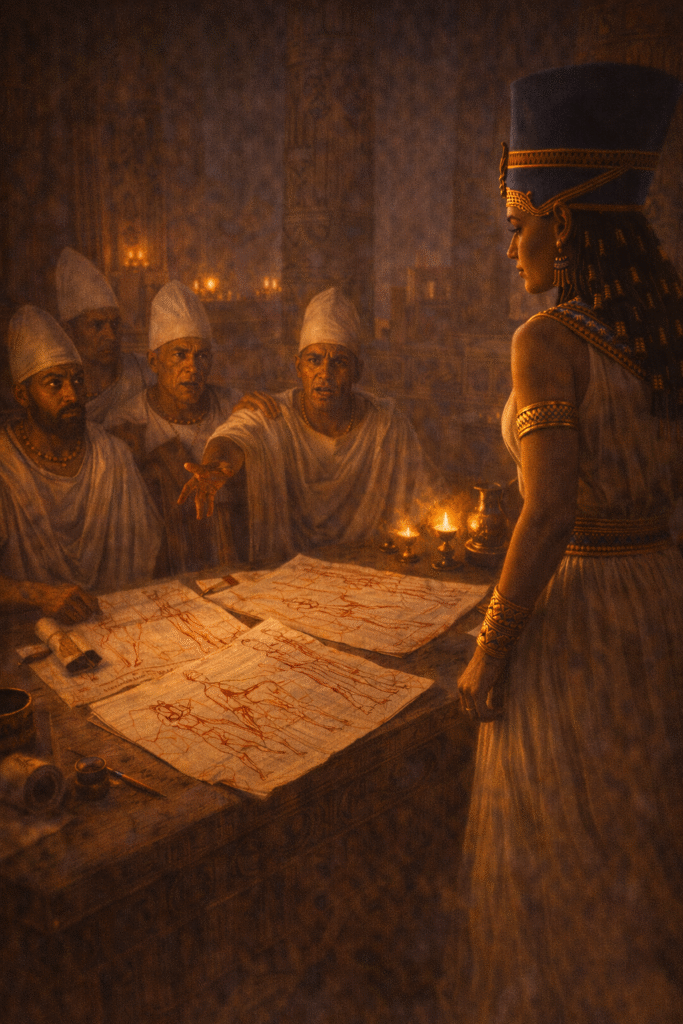
The temple council
requested my presence
soon after.
I entered the hall—
cool stone,
flickering lamplight,
a scent of incense
that barely hid
the nervous sweat
of men who feared
their own actions.
“Majesty,”
the high priest said,
“We wish to clarify
certain misunderstandings.”
The word misunderstanding
is always the prelude
to a lie that prefers
not to name itself.
He gestured
to several scrolls
spread across the table.
“These,”
he said,
“are scenes
we believe require correction.”
Correction.
Another dangerous word.
I unrolled the first scroll.
A depiction
of a festival procession.
My figure
was drawn tall,
confident,
crowned.
Beside me:
Thutmose,
smaller.
The high priest tapped the image.
“It is confusing,”
he said.
“The people
need clarity.”
“Clarity,” I echoed.
“Yes,” he said.
“A single representation
of kingship
is more…
stable.”
I looked at him.
“And when,”
I asked softly,
“did stability
require erasing
a ruling Pharaoh?”
He flinched.
“Majesty—
we erase nothing.”
“No,”
I said.
“You simply remove.”
He swallowed.
“The times are shifting.
We must allow the walls
to reflect the future
without dishonoring the past.”
A clever lie.
“Then why,”
I said,
“is the past
being softened
while the future
is carved in stone?”
Silence.
The entire council
avoided my eyes.
That was answer enough.
PART IV — The Wall That Was Not Mine
One morning,
I walked alone
into a small chamber
on the north side of Karnak—
a place where
minor festival scenes
were usually carved.
A new panel
was half-completed.
My name was present.
But the figure
representing the king
was clearly Thutmose.
Not me.
And behind him—
empty space
where a second figure
should have stood.
The artisan
working on the wall
looked up
when he heard my breath catch.
His chisel froze.
“Majesty,”
he whispered,
“I—
I was told—”
I stepped closer.
“Told what?”
“That your image
was not required
in this cycle.”
“Not required,”
I repeated.
He nodded shakily.
“The direction came
from the temple scribes.”
I traced the carved edge
of Thutmose’s figure.
The lines
were strong,
intentional.
“Did they say why
my image was omitted?”
He hesitated.
“They said…
it was time
to carry forward
a single kingship.”
A single kingship.
The first time
the phrase
had been spoken aloud.
Not a shared throne.
Not a dual rule.
A single kingship.
It tasted
like prophecy
and prelude.
I turned to the artisan.
“Finish your work,”
I said.
His shoulders fell.
“Forgive me—”
“There is nothing to forgive,”
I said softly.
Because the truth
was not his burden.
It was mine.
PART V — The Night of Oil Lamps and Sanded Stone
That night,
I returned to Deir el-Bahari.
Alone.
The priests
had retired.
The workers
gone home.
The terraces
were silent.
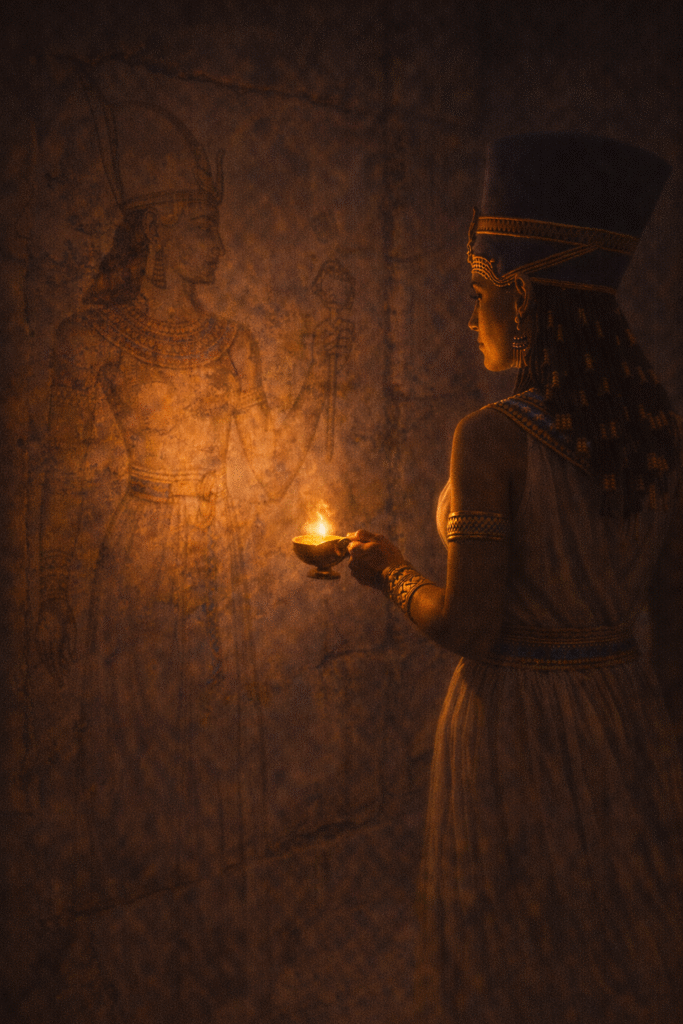
I brought
a single oil lamp
and walked
the painted corridors
that told my story—
my birth narrative,
my expedition to Punt,
my offerings to Amun.
Every scene
felt alive.
Every color
burned with truth.
Then I turned
into a chamber
and saw it.
A single panel
where my face
had been lightly sanded.
Not destroyed.
Not gouged.
Not defaced.
Softened.
The features
blurred at the edges.
The jaw
shaped subtly downward.
The eyebrow
heavy enough
to obscure femininity.
The beginnings
of a transformation
that would later
become complete.
For a long moment,
I stood still.
The oil lamp
flickered.
The shadows danced
on the wall
where my image
had begun to vanish.
Then I placed my palm
against the cool stone.
“You can speak,”
I whispered to the wall,
“but I know
the original sound.”
My voice
did not shake.
But my hand
remembered
what my heart
refused to admit:
Stone
was beginning
to forget me.
PART VI — The Modern Traveler at a Wall That Remembers
Traveler,
you may not know this—
but some temple walls
still show
the early erasures.
Subtle sanding.
Shifted lines.
Figures reassigned.
Cartouches altered
in ways only experts
or lovers of history
can detect.
When you walk with us,
we will place your hand
on these places—
the exact stones
where my image
was softened,
not yet destroyed.
You will see
the faint marks
where chisels hesitated,
uncertain
whether they carved
the future
or betrayed
the present.
You will feel
the coldness
of a truth
I once felt alone:
Erasure begins
with hesitation.
It becomes destruction
only once fear
decides it must.
If you’ve ever been written out quietly—
if you’ve ever seen your contribution
softened,
blurred,
or credited to someone else…
If you’ve ever watched
your legacy shift
in real time…
Then you understand
this Scroll
deeply.
Come walk beside these walls with us.
Let us show you
the earliest edits,
the faintest erasures,
the subtle beginnings
of a rewriting.
This is not just archaeology.
It is empathy.
Journey with Explore ENA.
Let the walls tell you
their first whisper.
PART VII — A Conversation in the Hall of Echoes
I confronted Thutmose
only once
about the changes.
We stood
in a long, quiet hall
of the palace—
columns rising like reeds,
torchlight warm
on cool stone.
“Thutmose,”
I said,
“what do you know
of the changes
in the temple reliefs?”
He stiffened.
“I know of some,”
he said.
“And approve?”
“I do not encourage them.”
“That is not an answer.”
He drew a slow breath.
“The priests believe
the future
must be prepared—
that the gods
look to a single king.”
“The priests,”
I said,
“serve the winds
they feel shifting.”
He looked at me.
“Do you think
the future
should not shift?”
“I think,”
I said,
“that truth
should not shift
until truth arrives.”
We held each other’s gaze.
Then—
quietly,
painfully—
he said the closest thing
to an apology
I would ever receive.
“I do not ask
for your walls
to change,”
he said.
“But I cannot stop
those who believe
they are serving
what comes next.”
I stepped closer.
“Do you want
what comes next?”
He closed his eyes.
“I want a kingdom
that does not tear itself
for my sake
or yours.”
“And the walls?”
“They are not tearing,”
he said softly.
“They are…
adjusting.”
The word
struck harder
than any blow.
Adjusting.
As if I were a line
on a map
redrawn
for clarity.
Or convenience.
But he meant it.
And he meant well.
That was the bitter truth.
He was not my enemy.
But his rise
created the space
in which others
rewrote me.
Not through malice.
Through inevitability.
PART VIII — The Scribe with the Memory of Ink
One evening
near the end of the year,
a senior scribe—
old, bent,
eyes clouded with age—
came privately to my chambers.
He carried
a bundle of tablets.
“What is this?”
I asked.
“Your record,”
he said.
“Unedited.”
He set them down gently.
“These are the drafts
before the temple council
revised them.”
Drafts
that showed my name
where now
his name stood alone.
Drafts
that showed my figure
beside his.
Drafts
where the truth
was still visible.
He bowed deeply.
“I am old,”
he said.
“I will not live
to see how the story ends.
But I want you to know
that some of us
preserve
what we can.”
I touched the tablets.
Ink faded.
Lines delicate.
Truth fragile.
He hesitated.
“Majesty,”
he whispered,
“They call it
a correction.
But stone does not correct.
It replaces.”
I looked at him.
“Keep these,”
I said.
“Hide them.
Protect them.
Someday,
someone will need
to remember.”
He bowed.
And that night,
I realized:
Even as stone forgot me,
ink had quietly
decided not to.
PART IX — The Ancient Questioner’s Desk
A student asked:
“When did the erasure begin?”
The scholar replied:
“When the first artisan
hesitated.”
Another asked:
“Was Thutmose responsible?”
The scribe answered:
“He was the future.
The future never asks
permission.”
A traveler wondered:
“Did she fight the edits?”
The historian wrote:
“She fought by remembering.
Not by breaking the hands
that carved.”
A final question came:
“Why start so softly?”
The old master answered:
“Because the loud edits
require justification.
The soft ones
require nothing.”
The Scroll ends here—
with chisels hesitating,
with cartouches shifting,
with images softened
but not yet erased.
If you have ever felt
history bending around you,
if you’ve ever sensed
your identity blurred
in someone else’s story—
if you’ve ever witnessed
the beginning of the rewrite…
then you walk beside her now.
Come stand with us
before the first altered wall.
Touch the stone
that tried to forget.
Feel the weight
of memory
pressing back against silence.
Journey with Explore ENA.
Some stories begin
with a whisper
and end in stone.