
Scroll XIV – The Veil Begins to Thin
Year: 1453 BCE — Waset (Luxor), The Palace and the Temple Courts
Translated and restored for the modern traveler.
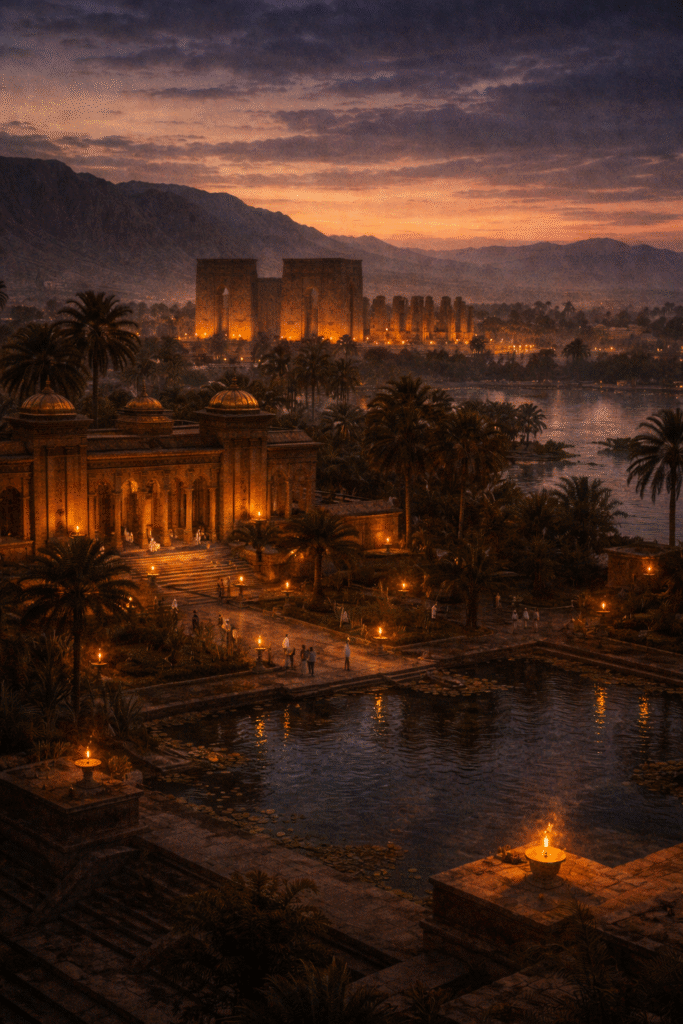
Prologue — When a Queen Feels the Room Turn
There is a very particular feeling
that comes over a ruler
when power does not leave,
but moves.
It is not like a storm.
Storms arrive with noise.
They lash, they break, they announce.
This is quieter.
It is like entering a familiar room
and sensing that every object
has shifted
a finger’s width to the left.
Nothing looks wrong.
Nothing is broken.
And yet,
nothing is exactly
where you remember it.
You wonder:
Is it the room that changed…
or your memory?
This is the feeling
that settled over my reign
in the years after
the shadows first spoke at court.
My throne was not taken from me.
My name remained in prayers.
No messenger came
with a declaration of deposition.
But the center of gravity
began to slide.
Not by decree.
By drift.
This Scroll is not
the story of a fall.
It is the story
of a shift.
A veil drawn slowly,
almost gently,
between the ruler I had been
and the place history would prepare for me.
PART I — The Morning of Two Salutes
The first clear sign
came at morning drill.
It was a day like a hundred others—
sun already hot by the second hour,
dust hanging low over the barracks courtyard,
soldiers’ sandals scuffing the packed earth
to the rhythm of shouted orders.
I went to review
the young contingents of infantry—
not because I needed to,
but because I liked to see
the spine of Egypt
with my own eyes.
Thutmose walked beside me,
armor catching the light,
his stride measured.
He had grown into his frame.
The boy was gone.
The hawk had wings now.
As we entered the courtyard,
the command rang out:
“Present spears!”
The line of soldiers
snapped to attention,
spears lifted,
backs straight.
They were supposed to salute us
together.
That is the tradition
when two crowns share the sky.
Instead,
something different happened.
First,
as one body,
they struck their fists
to their chests
toward Thutmose.
A fraction of a breath later,
almost as an afterthought,
they repeated the gesture
toward me.
Two salutes.
One in instinct.
One in duty.
The captain did not notice.
Thutmose did.
So did I.
Our eyes met briefly
before he remembered himself
and bowed his head slightly toward me
in front of the troops.
He was trying
to give back
what the moment had taken.
But some things,
once seen,
cannot be unseen.
The men
had not disrespected me.
They still obeyed my commands.
They still shouted blessings
when I passed.
But their bodies
had answered a question
their mouths
had not yet spoken:
Who leads you into battle?
In their hearts,
their answer was him.
And in time,
he would lead them.
Of this I had no doubt.
But that day,
standing in the white glare
of the Waset sun,
I felt the veil thin.
Not tear.
Not drop.
Just thin.
PART II — Letters That Took the Longer Road
Soon after,
another shift began.
Letters.
For many years,
all official correspondence—
from governors, generals, foreign envoys—
had been addressed
first and foremost
to me.
“My Lady of the Two Lands…”
“Throne of Horus…”
“Daughter of Amun…”
Thutmose was mentioned,
when he was mentioned at all,
as “the young falcon”
beside me.
Then,
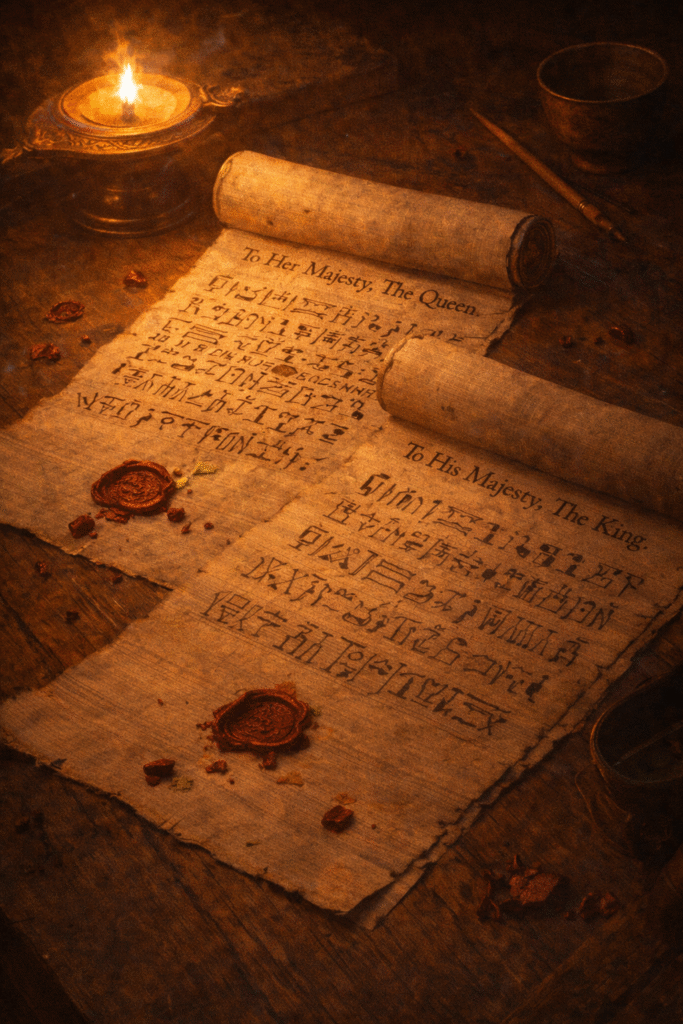
one month,
Thutmose entered the audience hall
holding a sealed scroll
bearing the mark
of a northern garrison.
His expression was guarded.
“This came for me,” he said.
I nodded.
“Then open it.”
He did.
Inside,
the greeting was precise.
“To His Majesty Thutmose,
Strong Bull Arising,
May you live, prosper, and be strong.”
Not Prince.
Not Co-Ruler.
“His Majesty.”
The report was a simple one—
a routine update
on troop rotation
and border patrols.
Nothing treasonous.
Nothing heated.
But it had passed
through channels
that had once reported
only to me.
“Did you request
that they address you directly?”
I asked.
“No,” he answered,
jaw tight.
“This is the first.”
More followed.
Not all.
Not even most.
Just enough
that I noticed a pattern:
Military reports
began to travel north and south
with my name on the outside
and Thutmose’s name
in the margins.
Then—
with his name on the outside
and mine inside.
Then—
some with only his.
When I confronted
one of the scribes
who oversaw the courier lines,
he bowed low.
“Great Lady,” he said,
“we serve both majesties.
The army must know
its future commander.”
“I am not dead,”
I replied.
He flinched.
“No, Majesty.
We mean only to prepare—”
“To prepare,” I cut in,
“or to hasten?”
He did not answer.
He did not have to.
The veil
was now being woven
with ink.
PART III — The Noble Who Bowed Once
There was a noble
from the Delta
named Pamiu—
a man of fields and grain,
not battles.
He had always been loyal.
His tribute had never once
arrived late.
At court,
he had a habit
of bowing so deeply
that the beads of his collar
touched the floor.
It amused me.
It also reassured me.
On the day he returned again
for the annual tribute presentation,
the hall was lit with tall oil lamps,
their flames wavering in the subtle currents
of so many bodies breathing
the same air.
Pamiu entered
carrying a small gold statue
of Hapi,
god of the Nile’s abundance.
He approached the dais.
He bowed.
Once.
Not to me
and then to Thutmose.
But to us both,
at once—
head inclined
in the space between us.
A tiny adjustment.
A new geometry of respect.
Once,
the world bowed first to me
then to him.
Now,
it bowed to both.
Soon,
I knew,
it would bow to him
and mention me
only in passing.
This, too,
is how the veil thins:
Not with the lifting
of one figure
but with the re-centering
of the space between them.
Pamiu rose.
“Great Majesty,” he said,
eyes shifting politely
from me to Thutmose,
“may the Two Lands stand firm
under your combined care.”
Combined.
Such a harmless word.
Such a sharp edge.
PART IV — The Blessing Spoke Out of Order
The priests of Amun
had always known
how to place their words.
It is their true art.
One evening,
during a smaller ritual
in the inner court of Karnak,
we stood before the barque
as incense dragged slow,
thick curls
through the air.
The high priest raised his hands.
“May Amun bless
His Majesty Thutmose,”
he intoned,
“strong in arm,
victorious in step…”
A small,
almost imperceptible pause.
“…and may He continue
to guide
Maatkare Hatshepsut,
His beloved daughter.”
The order
was wrong.
A simple reversal
on the tongue.
Common ears
might have missed it.
The gods did not.
Nor did I.
Nor did Thutmose.
Saints may pretend
indifference
to these things.
Rulers cannot.
The world rearranges itself
first in language
before it does
in stone.
After the ceremony,
as we stepped out
into the cooling air,
Thutmose walked beside me,
eyes forward.
He said nothing.
But the line of his mouth
carried a tightness
I had not seen before.
Not arrogance.
Not satisfaction.
Guilt.
As if he feared
he had stolen something from me
simply by being named first.
“You did not ask for that,”
I said.
“No,” he answered.
“But they did.”
I nodded.
“Do you wish,” I asked softly,
“that they had not?”
He exhaled.
“I do not know what I wish,” he said.
“I only know
that they are beginning
to see me
as what I will be—
and you
as what you have been.”
He did not look at me.
Perhaps he could not.
The veil
was not his doing.
But he, too,
had to walk beneath it.
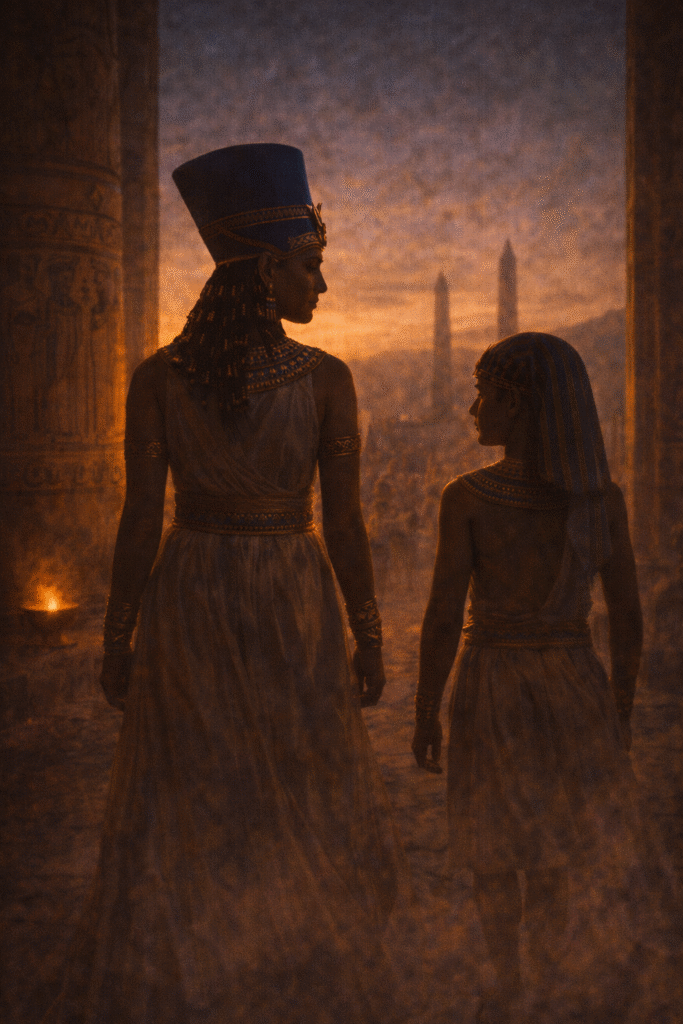
PART V — The Council of Half-Answered Eyes
In the great audience hall,
during a high council
with governors from the south and north,
I posed a question about canal repairs
after a season of difficult flood levels.
The problem was intricate—
requiring knowledge of farmers,
soil,
embankment,
and labor.
I spoke clearly.
“What do you advise?”
I asked the assembled men.
For years,
their eyes would have turned to me
first.
This time,
as if guided
by an unseen hand,
most gazes
slid toward Thutmose.
Not all.
Not brazenly.
But enough.
Thutmose,
to his credit,
did not seize the moment.
He waited—
looked at me first.
I held his gaze,
then nodded slightly.
He spoke.
He spoke well.
He weighed water,
grain,
trade,
labor.
He spoke
like a ruler
shaped by war
and tutored in peace.
The governors listened intently.
When he finished,
there was a murmur
of approval.
One by one,
they bowed their heads—
to him
and then,
almost dutifully,
to me.
Their bodies
had betrayed
their private verdict:
She is the king.
He will be the king.
Soon.
In that moment,
I felt no envy.
Only a slow,
measured ache.
I had done my work
too well.
He was ready
to be what Egypt needed.
And in becoming that,
he had become
what Egypt would prefer.
The veil continued
its slow descent.
PART VI — A Modern Traveler in the Room That Shifted
Now, traveler—
this is where
you step into the story.
When you walk through palace spaces
in Luxor
or stand in reconstructed halls
in museums,
remember this:
Power rarely leaves a room
with drama.
It drains away
like water
from a cracked jar.
Stand in a broad hall—
real or imagined—
and picture:
A woman on a throne,
serene,
seasoned,
steady.
Beside her,
a man growing into himself,
fire banked
but visible.
Around them,
men with scrolls,
men with swords,
men with incense.
Watch where their eyes go
when questions are asked.
In your own life,
you have seen this:
New leadership rising
while the old still lives.
Teachers watching their students
become masters.
Founders watching successors
reshape what they built.
There is no villain here.
Only gravity.
When you explore Egypt with us,
we will bring you
into these emotional spaces—
not just the stones,
but the shifts.
Because history
is not only battles
and dates
and crowns.
It is the feeling
that fills a room
when everyone
quietly realizes
things are changing.
If you have ever felt
your own season changing—
if you’ve watched someone younger rise
with both pride and ache—
if you’ve stood in a room
and sensed the attention
lean away from you…
then you already understand
this Scroll.
Walk these stories with us.
We’ll show you
not just where Hatshepsut ruled,
but where she began to let go,
and where Thutmose
began to step in.
When you are ready
to feel the turning of an era
in the very stones—
we’ll be there to guide you.
PART VII — The Decision Not to Fight
Here is the truth
few understand:
I could have fought.
I still had the loyalty
of many.
Old officers
whose careers I had protected.
Priests who had risen
under my patronage.
Scribes who had built
their lives and wealth
within the stability of my reign.
If I had wished
to turn the court into factions
and the temples into battlegrounds,
I could have.
I did not.
Not because I was weak.
Because I was Egyptian.
Ma’at—
the balance of the world—
does not survive
when rulers cling
past their time
like barns to storms.
The veil thinning
was not an act of cruelty
by the gods.
It was the natural course
of a world
that refuses
to stand still.
So I chose,
in a hundred small ways,
to ease my grip.
I let Thutmose take the lead
in more councils.
I allowed his name
to be read first
in some ritual formulas.
I permitted certain statues
to place us side by side
with equal height.
I did this
not out of surrender,
but out of strategy.
If my reign
had to end,
let it end
without tearing Egypt
in two.
I could not stop
the veil descending.
But I could choose
how I stood
as it fell.
PART VIII — The First Omission
And yet,
even as I yielded
where wisdom required,
there were signs
that the future
would not be as gentle
with me
as I was trying to be with it.
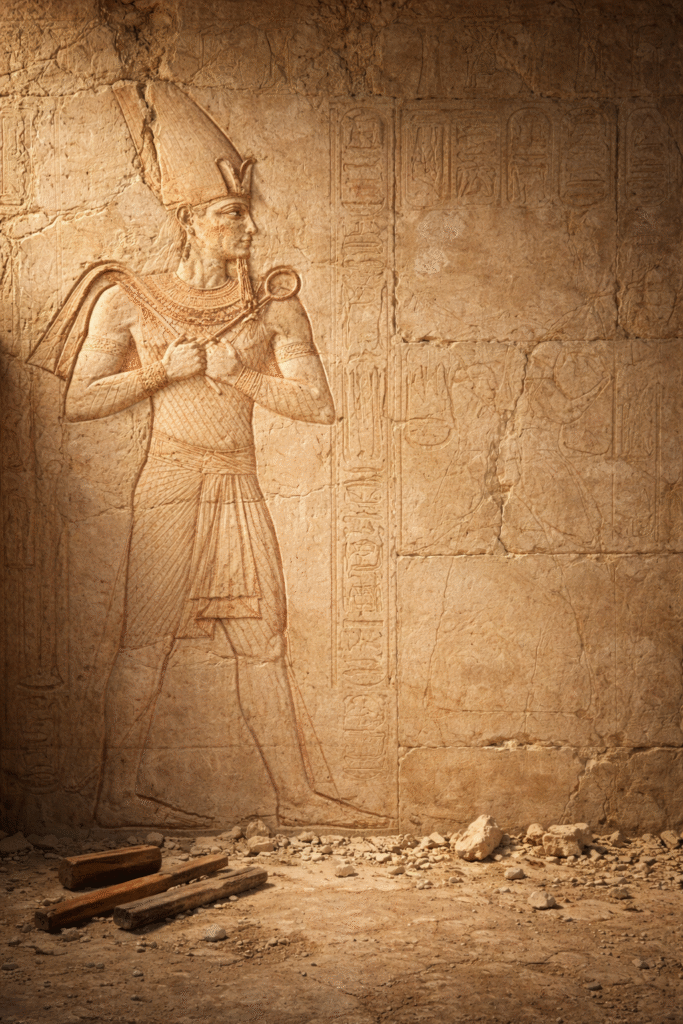
In a small chapel
near the rear of Karnak,
a new wall scene
was being carved—
showing offerings
to Amun.
When I visited
to inspect the work,
I noticed something strange.
Thutmose
stood prominently in the scene,
hands lifted in gesture of piety,
offering maat to the god.
Behind him,
smaller figures were being sketched:
priests,
attendants,
an official or two.
But not me.
For years,
such scenes
had included my image—
either equal in scale,
or paired,
or at least acknowledged
as the reigning power.
Here—
nothing.
I called the sculptor.
“Where am I?” I asked simply.
He paled.
“Majesty,” he stammered,
“the design was presented
by the temple priests—”
“So they requested
I not be shown?” I asked.
He swallowed.
“They said…
the time has come
to emphasize
the young king’s role.”
I ran my fingers
over the still-rough lines.
Soft stone.
Soft betrayal.
“Carve as they instructed,” I said.
He stared at me in disbelief.
“You do not wish…?”
“What I wish,” I replied quietly,
“does not change
what stone is being told to remember.”
He dropped his gaze.
That scene
would not be the last
to leave me out.
Nor the worst.
But it was the first.
The veil,
having thinned in air,
now began to thin
in stone.
PART IX — The Ancient Questioner’s Desk
A young scribe once asked his master,
“When did Hatshepsut truly begin to lose power?”
The master replied:
“When men began to look at the future
while still standing in her present.”
Another asked,
“Did Thutmose betray her?”
He answered:
“No.
He merely stepped into the space
the world was clearing for him.”
A traveler wondered,
“Was there a single moment
when everything changed?”
The historian wrote:
“Not a moment.
A tide.”
A final question came:
“Could she have clung to power longer?”
The scribe smiled sadly:
“Yes.
But then the damage
would have outlived them both.”
The Scroll ends here…
not in collapse,
but in recognition.
The veil has not yet fallen.
But it hangs now,
palpable,
between what was
and what will be.
If you have ever felt
your season changing—
if you’ve watched the world
turn toward another
while still loving you—
if you’ve chosen peace
over clinging—
then you understand
this part of Hatshepsut’s story.
Come walk the courts
where the veil began to thin.
Stand in the chapels
where her image
started to recede.
Trace the stones
that remember a queen
who knew when to hold
and when to yield.
Journey with Explore ENA.
Some of Egypt’s most powerful lessons
are not in its rise or its fall—
but in how it lets go.