
Scroll III – The Weight of the Reed
Years: c. 1485–1483 BCE — The Women’s Courts, The Scribes’ Terrace, The Hall of Scented Oil, and the Shadow of the Throne
Translated and restored for the modern traveler.
Prologue — When the World Began to Lean Toward Me
Before a crown ever touched my brow,
before the priests whispered omens,
before destiny took form in stone,
there was a quieter moment—
when the world
did not yet announce
that it needed me,
but it began
to lean in my direction.
It happened slowly.
In glances.
In the way people paused.
In the way murmurs hushed
when I stepped near ink.
In the way my footsteps
changed the temperature
of a room.
Power does not arrive
all at once.
It arrives
the way the Nile rises:
quiet at first,
then unmistakable,
then impossible
to ignore.
This Scroll
is the story of that rising.
Not the crown—
just the first weight
I ever carried:
the reed of authority,
placed gently,
then firmly,
into my hand.
PART I — The Morning They Dressed Me Differently
I was not yet married.
Not yet regent.
Not yet oracle-touched.
But on one particular morning,
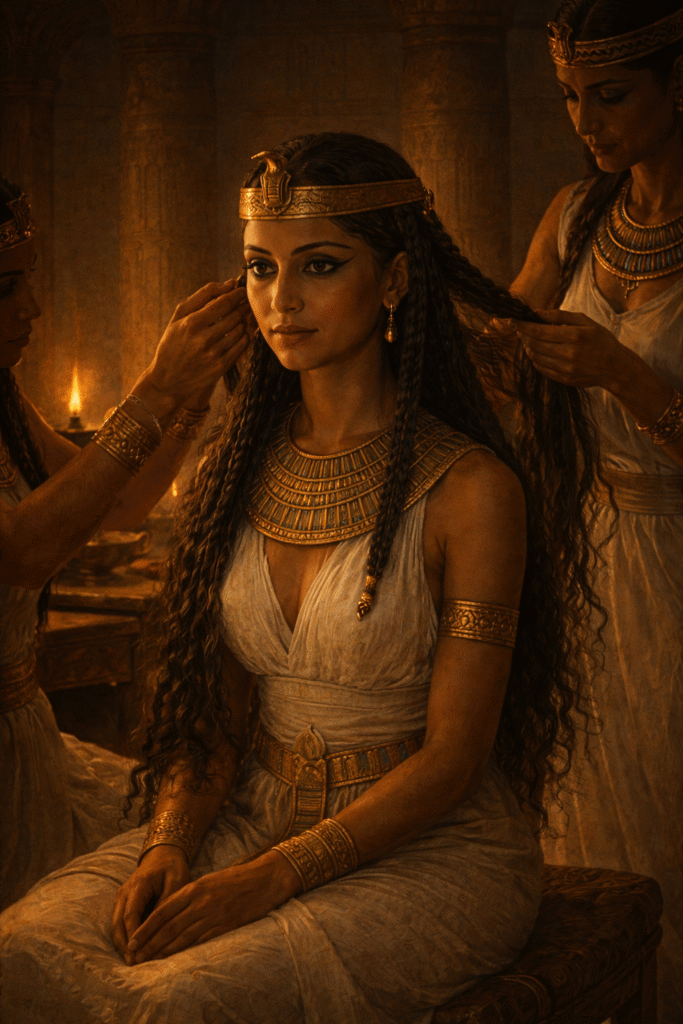
my attendants dressed me
in a linen
of a weight
I had never worn.
Heavier.
Finer.
A garment
associated not with children,
nor mere princesses—
but with women
who stood beside the throne.
I felt the difference
before I understood it.
“Why this?” I asked.
My attendant
—an older woman named Henut—
fastened a broad collar
around my neck.
“Because you are receiving guests today,”
she said simply.
“I always receive guests,” I replied.
“Not like this.”
Her voice softened
in a way that made me still.
“You will be looked at,”
she murmured.
“You must look back.”
I turned to face her.
“What does that mean?”
“That your presence
will begin to carry meaning
to those who are…
curious.”
I frowned.
“Curious about what?”
She hesitated.
“About what the court
might need you to become.”
I did not understand—
not fully.
But when I stepped
into the corridor
and saw three women
bow deeper
than they ever had before,
I felt the shift.
Not ceremonial.
Not accidental.
Intentional.
Not because of who I was—
but who I might become.
PART II — The Scented Hall and the First Petition
In the palace
there was a long,
sunlit chamber
used for preparing oils
for the god’s statues.
I liked this room:
the scent of lotus,
the soft clink of jars,
the warm glow on the walls.
On that day
three noblewomen
waited there for me—
wives of high officials,
keepers of influence
in households
that controlled
entire districts.
They bowed as I entered.
“Princess,”
the eldest said.
“We come with a matter
of considerable weight.”
I blinked.
Matters of weight
were for my mother
or the king—
not for me.
“What is the matter?” I asked.
A young woman stepped forward,
eyes troubled.
“It is my son,” she whispered.
“He is being considered
for the priesthood at Abydos.”
A prestigious path.
But she trembled.
“They say
only those with
temple favor
will be chosen.”
I understood.
She had come
to ask for influence.
“Princess,”
she said softly,
“will you speak for him?
Will you place your word
where it will be heard?”
My heartbeat drummed.
I was not yet
in a position
to offer such things.
And yet—
I felt their expectation
pressing gently toward me.
Henut’s voice
echoed in my memory:
You will be looked at.
You must look back.
I inhaled.
“I cannot promise placement,”
I said slowly,
“but I can ensure
that he is not overlooked.”
Their relief
was immediate,
visible,
almost desperate.
“Thank you,”
they breathed.
“You honor us.”
They bowed again.
When they left,
Henut whispered:
“That was your first petition.”
“My first?” I asked.
She smiled faintly.
“Princess—
there will be many.”
She was right.
Requests
found their way
to my feet
long before crowns did.
Not because I held power—
but because the world
suspected
I one day would.
PART III — The Lesson Beneath the Scribes’ Terrace
Later that afternoon,
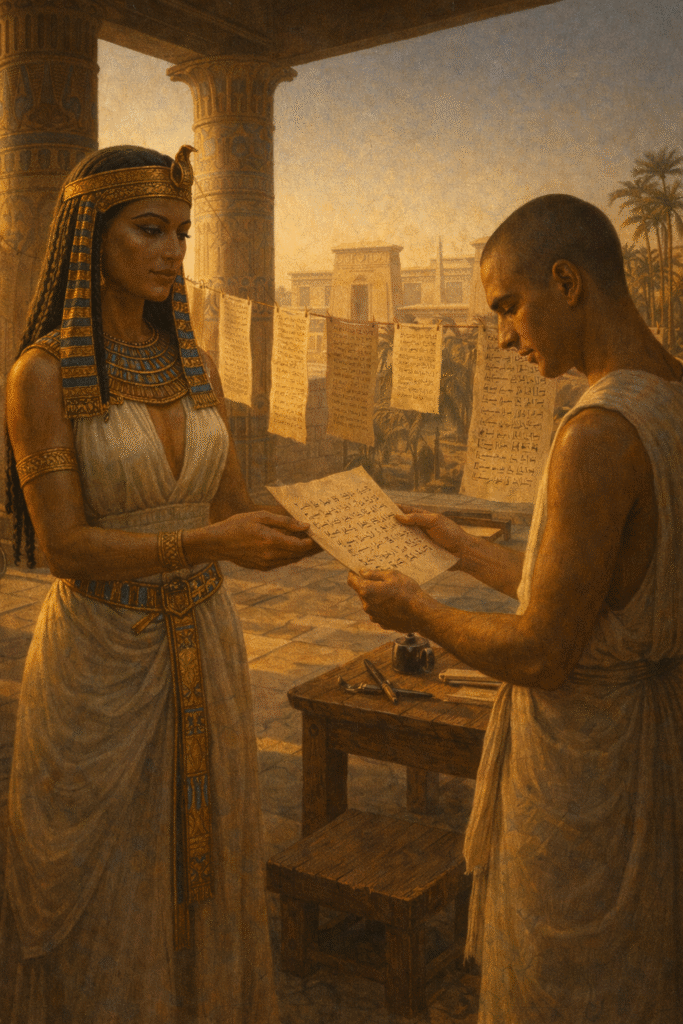
I stood on the terrace
where scribes dried papyri
in the sun.
A young scribe
named Nakht
approached nervously.
He held a scroll.
Not an official record.
Not a list.
Not a temple note.
A poem.
“Princess,” he said,
bowing so low
his hair brushed the floor,
“I… wrote this.”
“For whom?”
“For…
you.”
He flushed
to the ears.
I unrolled it.
It was clumsy,
sweet,
and unexpectedly insightful.
He wrote of:
- the way I walked
with deliberate grace
as if balancing
two futures
in my hands - the way the court
paused around me
when I entered - the way the light
caught the blue beads
in my collar
like stars strung across dawn
I looked up at him.
“Why give this to me?” I asked.
His voice wavered.
“Because I think—
I think the kingdom
sees something in you
that it does not yet
know how to name.”
A soft wind
passed between us.
I rolled the papyrus.
“Thank you,”
I said quietly.
He bowed again,
and fled
before courage
could fail him.
That poem
was the first time
I realized
that even strangers
saw me
as part of Egypt’s
unfolding future.
That knowledge
was heavier
than any jewelry
placed on me.
It was the first time
I felt the weight
of the reed.
PART IV — The Corridor Where Men Forgot to Whisper
Some lessons
the court taught me
without meaning to.
I once walked
down the side corridor
that connected
the storerooms
to the scribal hall.
Two officials
were speaking there.
They did not see me.
“…the king grows weak,”
one murmured.
“The throne could pass
more firmly
through marriage
than through blood.”
The other snorted.
“Or through her,”
he whispered.
“The princess watches
with eyes sharper
than her father’s.”
A pause.
“Do you fear her?”
“I fear
what she might become.”
My breath froze.
Their voices dropped lower,
but I caught the last part.
“The gods
sometimes choose strangely.”
I stepped away silently.
My sandals made
no sound on stone.
I went to the courtyard
and sat beneath a palm tree.
The air tasted
like dust and sunlight.
They were speaking
in speculation.
And yet—
I understood more
in that moment
than I could admit:
Some feared I might rise.
Some hoped it.
Some expected it.
But no one
dismissed the possibility.
I was no longer
just “daughter.”
I had become
a question.
Questions
are more dangerous
than answers.
And more powerful.
PART V — The Night My Mother Told Me the Truth
That evening
I found my mother
in the women’s quarters.
She was seated
on a low stool,
her hair unbraided,
speaking softly
with her ladies.
When she saw my face,
she dismissed them.
“What did you hear?”
she asked gently.
I told her.
She listened,
eyes steady,
hands still.
When I finished,
she said:
“Good.”
I blinked.
“Good?” I repeated.
She nodded.
“It is better
to know
you are being weighed
than to discover it
when the scale
is already balanced
against you.”
She placed her hands
over mine.
“The court
is shifting,”
she said.
“It happens
every generation.”
“Shifting toward what?”
“Toward possibility.”
She stroked my cheek.
“You must decide
whether to rise
when the ground moves.”
I swallowed.
“It frightens me.”
“Then let it,”
she whispered.
“Only fools
are unafraid of power.”
Her voice softened.
“Remember:
before you are queen,
before you are regent,
before you are king—
you are daughter
to a dynasty
that has never
produced an ordinary woman.”
Her confidence
did not erase my fear.
But it made space
for something else
beside it:
Wonder.
What might I become
if the ground
kept shifting
this way?
The Beginning of Becoming
If you have ever felt
the world watching you
before you were ready—
If you’ve ever stood
in the quiet
between childhood and destiny,
feeling something build
but not yet knowing its shape—
If you remember
the moment you realized
people expected things of you
that you had never dared to
expect of yourself—
then this Scroll
is your mirror.
Come walk
the halls of Luxor
with Explore ENA
at the hour
when the palace shifts
from day’s noise
to night’s knowing.
Stand where she stood
when she first felt
the world lean slightly
toward her.
Journey with Explore ENA.
All great stories
begin with a weight
placed gently in the hand.
PART VI — The First Time the Throne Looked Empty
A few days later,
I walked into
the great audience hall.
The throne—
tall-backed,
gold-inlaid,
lion-armed—
stood empty.
It was waiting
for the king.
But for one breath,
one quiet moment,
I saw it differently.
Not as a seat.
As a question.
I felt warmth
on the back of my neck.
Someone was watching.
It was the high priest
of Amun—
the same man
who would later call me
into the inner shrine.
He approached slowly.
“Princess,”
he murmured.
I bowed my head slightly.
He studied my face.
“Do you feel
the weight of this room?”
I nodded.
“And the weight
of that throne?”
“Yes.”
He stepped closer,
voice low.
“Good,”
he whispered.
“It must call to you
before the crowns do.”
Goosebumps rose
along my arms.
He smiled faintly—
not kindly,
not cruelly—
curiously.
“There are some,”
he said,
“who sit
and never feel
the throne’s breath.”
He paused.
“You are not one of them.”
He left me there—
standing before the empty throne,
heart pounding.
I did not touch it.
But I stood
until my shadow
fell across its steps.
PART VII — The Reed That Became Mine
When I returned
to my chamber that evening,
a reed pen
lay across my writing board.
Not placed
carelessly.
Placed
with intention.
Someone
had left it there:
- a symbol
- a suggestion
- a whisper
The reed
was how decrees began.
How orders spread.
How stories survived.
How futures changed.
I picked it up.
It was lighter
than any crown.
And heavier.
I understood then:
I had already
begun to rule—
not with decrees,
not with edicts,
but with presence.
People
were adjusting themselves
around me.
Watching.
Whispering.
Testing.
Asking.
The reed in my hand
felt like an escort
to the path ahead.
I did not yet know
that priestly omens
would soon confirm it.
Or that my life
would tilt
in ways
no one could foresee.
But that night,
holding the reed,
I understood
that becoming Pharaoh
began long
before the coronation.
It began
the moment
the world
started seeing
what you might be.
Ancient Questioner’s Desk — Before the Rise
A student asked:
“When did she first know?”
The elder replied:
“When the world
began whispering
around her.”
Another asked:
“Was she chosen
or did she choose?”
The historian wrote:
“Yes.”
A traveler wondered:
“Did she seek the throne?”
The scribe answered:
“She sought only
to understand the weight
placed in her hand.”
A final question came:
“Was this enough
to make her Pharaoh?”
The old master smiled.
“It was enough
to begin.”
Step Into the Rising
This Scroll ends here—
in thresholds,
shadows,
unspoken invitations.
Before gods chose.
Before the court confirmed.
Before the palace shifted.
This is the moment
the reeds of authority
trembled in her hand
for the first time.
If you want to stand
in the rooms
where destinies
first stretch awake—
come walk them with us.
Journey with Explore ENA.
The rise begins long
before the crowns do.