
Scroll IV – The First Sign the gods Chose Me
Years: c. 1484–1482 BCE — The Inner Chambers of Karnak, The Oracle Court, and the Night of the Opet Dream
Translated and restored for the modern traveler.
Prologue — A god’s Voice or a Court’s Design?
Before I ruled,
before I wore the crowns,
before the priests sang my cartouche
in the morning invocations—
there was a night
when I learned
what it meant
for destiny
to be given.
A sign from Amun.
A whisper from stone.
A vision in a dark room.
A procession interrupted
by a word
not meant to be spoken.
From this moment on,
a path began beneath my feet.
A path others believed
the gods chose.
A path I later learned
men had also shaped.
But in that first moment—
in that first sign—
I felt something
that was half fear,
half exaltation:
The world
was turning
toward me.
Even if I did not yet know
whether the gods
or the court
were turning it.
This Scroll
tells the moment
that opened the door.
PART I — The Night Karnak Held Its Breath
It was the eve of Opet—
the great festival
when Amun,
in his gilded portable shrine,
traveled from Karnak
to Luxor Temple.
The priests were restless.
Servants rushed in and out
with incense and embroidered linens.
Musicians tuned their harps.
The air shimmered
with anticipation.
I was still young—
newly a wife,
not yet queen,
not yet regent.
A woman
with a foot in two worlds—
royal blood
but not yet
royal authority.
My father had died
not long before.
The kingdom
was still adjusting.
Some priests saw
my brother-husband
as the clear successor.
Others whispered
of “dual destinies.”
But those whispers
had not yet reached the temple.
Not until this night.
I stood near the sanctuary
with the high priest’s acolytes,
waiting to witness
the purification rites.
Then—
a bell chimed.
A deep, resonant sound
that silenced the frenzy.
The high priest
stepped from the inner shrine—
face pale,
eyes wide.
“Stillness,” he commanded.
Even the torches
seemed to obey.
“Amun has spoken.”
A ripple of shock
passed through the hall.
This was not scheduled.
Not part of the ritual.
I tightened my grip
on my linen sash.
The high priest’s gaze
swept the room
and landed on me.
My breath caught.
“The god
has asked
for the presence
of the King’s Daughter.”
A murmur spread.
The King’s Daughter.
Not
the King’s Wife.
Not
the Crown Prince.
Not
the Heir Apparent.
Me.
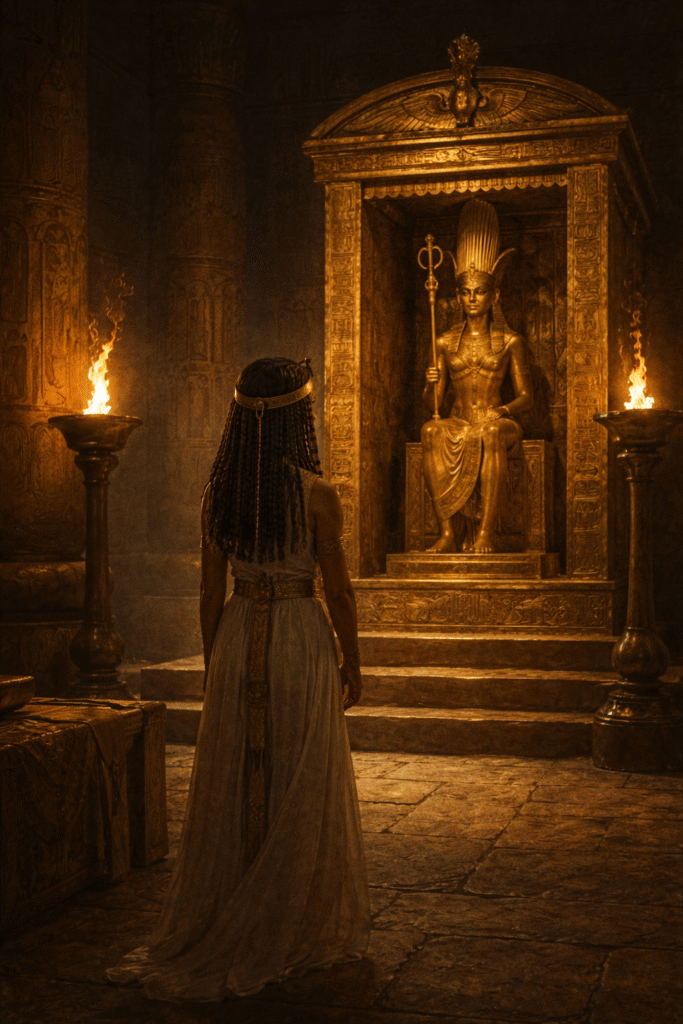
PART II — The Chamber Behind the Chamber
I followed the high priest
into the innermost sanctuary—
a room few entered
and fewer remembered.
Dark.
Heavy with incense.
Walls painted deep blue
with gold stars.
The shrine of Amun
stood in the center:
a gilded naos
with door panels
closed tight.
A place
that felt alive
in a way
no room should.
The high priest
placed a hand on my shoulder.
“Do not fear,”
he said softly.
“The god sees clearly.”
I was not afraid
of the god.
I was afraid
of the priests.
Because in Egypt,
a god’s voice
was never just
a god’s voice.
It was politics.
It was narrative.
It was guidance
and manipulation
woven together
until no human
could separate them.
“Step forward,”
the priest whispered.
I did.
He opened the doors
of the shrine.
The interior
glowed from reflected torchlight—
Amun seated,
skin of gold,
eyes inlaid with lapis.
I lowered my head.
The priest inhaled sharply.
“He nods.”
I looked up.
The statue
had not moved.
But he announced it again—
“He nods!
Amun nods to the King’s Daughter!”
The acolytes gasped.
I felt the air
shift around me.
“And now,”
the priest said,
voice trembling,
“the god speaks.”
He leaned close
to the statue’s lips.
A long silence
filled the chamber.
Thick.
Pressurized.
Waiting.
Then the high priest
spoke into the air—
not loudly,
but with a certainty
that landed like stone:
“She will lead.”
I froze.
He turned toward me,
eyes strange and shining.
“Amun has said it,”
he whispered.
“A destiny
not of your choosing…
but of Egypt’s.”
PART III — The Oracle That No One Expected
After the shrine,
I was led
to the Oracle Court.
The portable barque
of Amun
would be carried out
by priests
in preparation for Opet.
Crowds waited
in the courtyard beyond
to hear the first words
spoken on behalf of the god.
Tradition dictated
that the oracle
would answer questions
asked by the priests—
questions carefully selected
to reaffirm the order
of the kingdom.
But this time
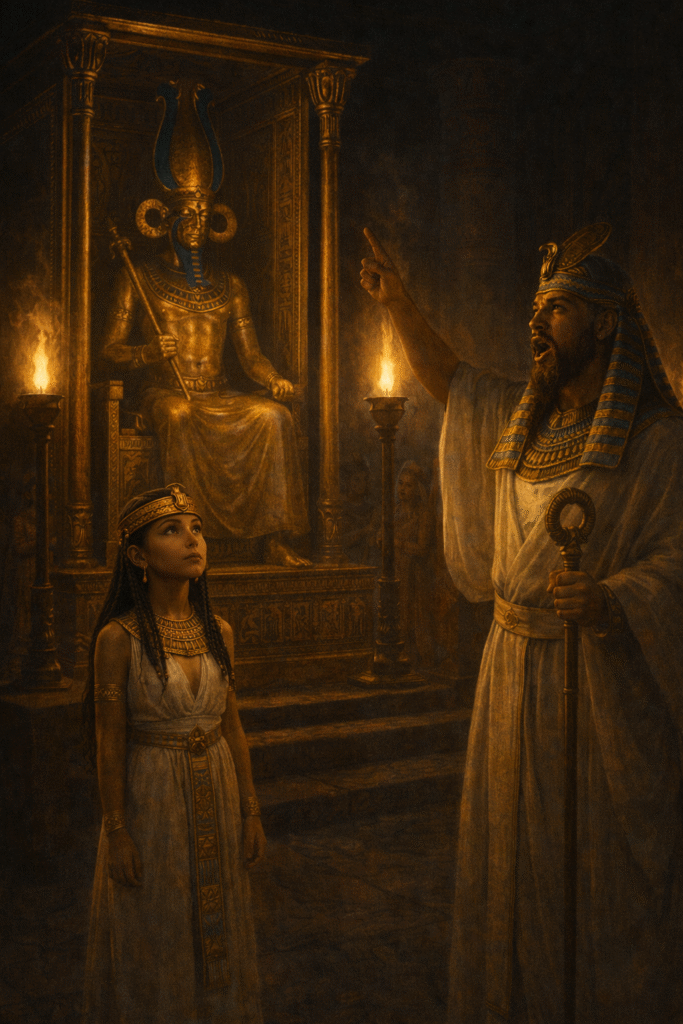
the high priest
looked at me
before raising the staff.
“Amun has chosen
to speak of succession,”
he proclaimed.
A visible intake
of breath rippled
through the priests.
This was not normal.
Succession
was the most dangerous
topic a god
could ever address.
“A question has arisen,”
he intoned.
“Whom does Amun bless
for the path ahead?”
A junior priest stepped forward.
He asked the question
in ceremonial form:
“Does the god bless
the King’s Son?”
A pause.
Drums trembled.
Silence.
Murmurs spread.
The high priest
lifted his staff again.
“And does the god bless
the King’s Daughter?”
He turned toward me.
The barque bearers
shifted—
ever so slightly.
A tilt
of the shrine.
An acknowledgement.
The crowd gasped.
It was a tiny movement.
Almost imperceptible.
But the priests
interpreted it instantly.
“The god responds!”
the high priest cried.
“She receives his blessing!”
My heart slammed.
The hierarchy
had shifted
in a single breath.
Women near the courtyard
whispered.
Scribes exchanged looks.
Priests stared
as if they’d witnessed
something monumental.
And then,
as if to seal the moment,
the high priest proclaimed:
“Amun has spoken.
The King’s Daughter
is the one
whose path
shines before him.”
The words echoed
against stone.
Not royal decree.
Not coronation.
But a sign.
A sign powerful enough
that no one
would forget it.
Least of all me.
Even as I wondered—
had Amun truly chosen me?
Or had the priests
seen something in me
that they wished
to encourage?
Had the god spoken—
or had the court
tested a possibility?
I did not know then.
But I felt
the path shift.
PART IV — What My Mother Saw in the Oracle
That night
I sat with my mother,
Queen Ahmose.
She listened silently
as I recounted
the priest’s words.
When I finished,
she poured
cool lotus-scented water
into my cup.
“You are frightened,”
she said.
I nodded.
She took my hand.
“Power,” she murmured,
“comes to those
who see the world
clearly.”
“Did Amun really choose me?”
I whispered.
She smiled—
sadly,
wisely.
“Amun chooses
through the hands
of men
who speak for him.”
She brushed my cheek.
“But also,” she whispered,
“you are who you are.”
I looked at her.
“And who is that?”
Her eyes shone
with something like pride
and fear combined.
“A woman
the kingdom
will not be able
to ignore.”
She leaned closer.
“But listen, daughter—
a sign is not a crown.
It is only an opening.”
I felt my heartbeat
steady.
“And what should I do
with such an opening?”
She smiled faintly.
“Remember it.
Carry it.
Do not use it—
not yet.
Let others whisper.
Let others wonder.
Let others fear
what it may mean.”
She squeezed my hand.
“And when the moment comes—
you will step into it.”
Her confidence
became my foundation.
PART V — The Priest Who Warned Me What It Meant
A few days later,
the high priest
summoned me privately.
He dismissed
the acolytes.
Only the two of us
stood
in the quiet half-light
of a small shrine court.
“Princess,”
he said gently,
“you know
what this sign means.”
I did not answer.
“It means
eyes will turn toward you
with expectation—
and with suspicion.”
I remained silent.
“Some will want
to lift you,”
he continued.
“Some
will wish to stop you.”
I met his gaze.
“Which are you?”
I asked.
He bowed.
“Neither,”
he said.
“I only serve the god.”
A diplomatic answer.
A safe answer.
But I heard
what he did not say:
He served
whatever future
he believed
Amun intended.
Or the future
he believed
was strategically wise.
He leaned closer.
“If you walk
the path he illuminated—
you must walk it
with open eyes.”
I inhaled deeply.
“And what do you see?”
I asked.
His eyes shone
with a strange mixture
of awe
and apprehension.
“I see a woman,”
he said quietly,
“who will reshape
this court.”
A chill
ran down my spine.
Not of fear.
Of recognition.
For the Traveler Seeking Origins of Destiny
If you have ever stood
in a place
where you felt
your future tilt—
If a moment of insight,
a sign,
a whisper,
or a meeting
ever changed your trajectory—
If you’ve wondered
whether destiny
is chosen by gods
or made by human hands—
then this Scroll
is for you.
Come with us
into the inner sanctuaries
of Karnak.
Stand where Amun’s barque moved.
Touch the walls
where priests announced
the unthinkable.
Journey with Explore ENA.
Some destinies begin
with a whisper.
PART VI — The Attempt to Quiet the Sign
Not everyone
was pleased.
Some nobles whispered
in protests:
“A woman cannot lead.”
Some generals muttered:
“Let Amun choose valor,
not bloodline.”
Some scribes
furrowed their brows,
considering
how dangerous
a female successor
could become.
The high priest
himself
was questioned
by his own order.
I heard
the echoes
in the corridors:
“Are you certain
of the god’s words?”
“The barque
tilted of its own weight.”
“The princess
stood too near the shrine.”
“Perhaps
the acolytes misread.”
The court
was trying
to smother the spark.
To return
the world
to what was predictable.
But sparks
become flames
when they reach
the right tinder.
And though many
wished to forget
the oracle—
others
would not.
Women murmured prayers
using my name.
Merchants
spoke of the omen
as they prepared offerings
for Opet.
Priests
hesitated
before reciting
the King’s Son
as the only blessed heir.
Powerful men
might resist the sign.
But the people
heard it differently:
A god
had whispered
possibility.
Possibility
is dangerous.
Possibility
is fertile.
Possibility
cannot be undone
once spoken.
PART VII — What I Carried from That Night
From that night on,
I carried the sign with me.
Not as proof.
Not as entitlement.
Not as a claim.
As a reminder.
A reminder that:
- the court was watching me
- the priesthood would test me
- the people might accept me
- and the gods
—or those who spoke for them—
had already shaped
a path beneath my feet
I did not yet know
how that path would twist
into triumph
and tragedy
and silence
and resurrection.
But I sensed—
deep in my bones—
that whatever life
awaited me
would not be
a quiet one.
The sign
was not a crown.
It was a threshold.
And once crossed—
there would be
no stepping back.
PART VIII — What This Means for You, Traveler
When you walk with us
through Karnak
and reach the inner sanctuaries,
you will stand
on the stones
where the oracle
was once announced.
You will see
the pillars
that vibrated
with the shock
of Amun’s words.
You will stand
in the court
where the barque tilted.
You will feel
the weight
of a destiny
that began
in a single moment
of silence
and smoke
and expectation.
And you will understand
that history
is not always shaped
in public halls
or on battlefields—
sometimes it is shaped
in a dark sanctuary
where a young woman
hears her future whisper
from a statue’s still lips.
Ancient Questioner’s Desk — Destiny Edition
A novice asked:
“Did Amun truly choose her?”
The elder replied:
“The god chooses
through men’s courage
and fear alike.”
Another asked:
“Was the tilt of the barque
a miracle?”
The historian wrote:
“Miracles often happen
when the moment
requires them.”
A traveler wondered:
“Did she believe the omen?”
The scribe answered:
“She believed
it was a door.”
A final question came:
“Was destiny real?”
The old master said:
“Destiny
is simply the path
you notice
when the world
starts watching you.”
The Beginning of Destiny
The Scroll ends here—
in a shrine
lit by torches,
in an oracle court
heavy with incense,
in the breathless silence
after a god’s name
was invoked
beside my own.
If you seek
the moment
that began my rise,
the seed
of everything
that would come—
walk with us
into Karnak’s inner chambers.
Journey with Explore ENA.
Some destinies are spoken
long before they are lived.
Historical Context
Egyptian kingship relied heavily on divine legitimacy, often expressed through temple rituals, oracles, and public proclamations. Hatshepsut later recorded that the god Amun affirmed her right to rule, a claim preserved in temple inscriptions.
The specific moments, dialogue, and emotional framing in this scroll are reconstructed to represent how divine endorsement functioned politically and culturally, rather than to depict a recorded eyewitness scene.