
Scroll II – The Court That Raised Me
Years: c. 1490–1485 BCE — Waset (Luxor), The Palace of the Southern City, Karnak, and the River Road
Translated and restored for the modern traveler.
Prologue — A Kingdom Made of Rooms
Before I was Pharaoh,
I was a child
who learned the kingdom
by learning its rooms.
The audience hall,
where men chose their words
like offerings.
The scribal chamber,
where ink decided
what the future would remember.
The temple courts,
where the gods were invoked
but politics was negotiated.
The women’s quarters,
where alliances were woven
in whispers softer than linen.
If you wish to understand
how I became what I became,
you must first understand
the court that raised me.
I was not shaped
only by blood or birthright.
I was shaped
by corridors,
by voices,
by glances across incense-smoke
in rooms where truth
was rarely spoken directly.
This Scroll
is not about victory or fall.
It is about formation.
The long, golden,
beautiful and dangerous court
that taught me
how power moves
long before anyone
placed the crowns upon me.
PART I — The First Time I Saw the Hall of Two Thrones
My earliest clear memory
is not of a toy,
or a song,
or a story.
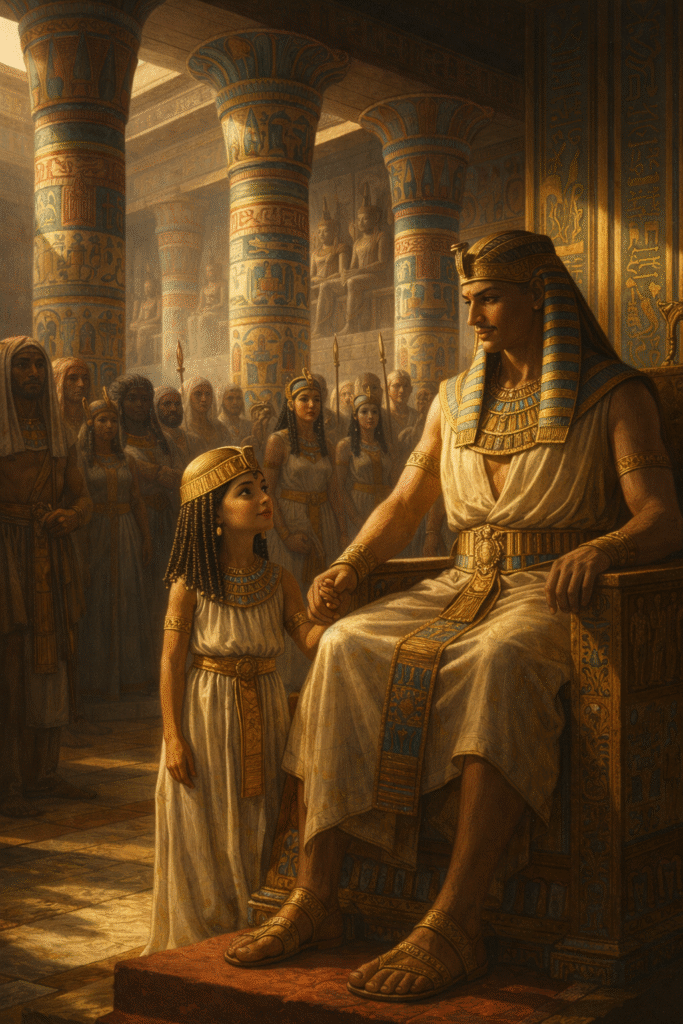
It is of walking
into the great audience hall
of the palace at Waset—
my hand held firmly
inside my father’s.
Thutmose,
King of Upper and Lower Egypt,
Beloved of Amun,
Lord of Appearances.
To me then,
simply:
Father.
The hall was taller
than any space
my young eyes could comprehend.
Columns painted
with lotus and papyrus.
Floor cool beneath my bare feet.
Light pouring in
from high apertures
like liquid gold.
Men bowed
as we passed.
Not to me.
Not yet.
To him.
But I watched the bowing.
How low each man went.
How quickly he straightened.
How sincerely his eyes followed.
I noticed
that some bowed deep
but their shoulders
stayed tense.
Others bowed less
but their eyes warmed.
I did not yet know the words
for loyalty
and calculation.
But I could feel them.
Father squeezed my hand.
“Look,” he murmured,
so quietly only I could hear,
“and remember
who lowers their head
for power
and who lowers it
for duty.”
I tried to.
Even as a child,
I understood
that this hall
was not just a room.
It was a map
of Egypt’s heart.
PART II — Four Currents Under a Golden Surface
As I grew,
I learned that this court—
glittering,
scented,
carefully arranged—
was not one thing.
It was four currents
flowing through each other,
each believing itself
the Nile’s true course.
I did not learn this
from speeches.
I learned it
by standing quietly
in corners
people forgot I was in.
There was the Crown—
my father,
and later my brother-husband,
and the royal household.
They spoke of fields,
taxes,
routes,
treaties.
They believed
they grasped the whole.
There was the Temple—
the priests of Amun at Karnak,
white linen glowing,
eyes sharp.
They spoke of oracles,
omens,
the god’s approval.
They believed
they were the axis
around which all kings turned.
There was the Army—
broad-shouldered men
smelling of leather and dust,
more comfortable with spears
than with styluses.
They spoke of Nubia,
of Retjenu,
of fortresses and horses.
They believed
that spears
kept the Two Lands
from breaking.
There were the Scribes and Nobles—
men of ink and estates,
their fingers stained
and their bracelets heavy.
They spoke of records,
of grain,
of land boundaries,
of old promises
and older grudges.
They believed
that what was written
and what was owned
were the only things
that truly existed.
From my place
beside my father’s throne,
I watched them all.
Sometimes they agreed.
Often they did not.
The hall remained beautiful.
The ceremonies stayed smooth.
But beneath the polished floor,
I could sense currents
pulling in different directions.
I realized early:
Ruling was not just
sitting on a throne.
Ruling was learning
to let all four currents flow
without letting them
tear the riverbed apart.
PART III — The Day I Learned Rooms Have Sides
One afternoon,
when I was still barely more
than a girl,
I wandered into
the scribal chamber.
I loved that room.
Tables low,
reed pens resting,
ink cakes laid out
like offerings of night and blood.
Scrolls stacked
in clay jars.
A scribe—
old, thin,
with a back bent
from years of leaning—
looked up and bowed.
“Princess Hatshepsut,”
he murmured.
I picked up a broken reed pen.
“What are you writing?” I asked.
“Nothing of weight,”
he said lightly.
“Field counts.
Border tallies.
Offerings.”
I peered at the lines.
They did not look
like nothing.
They looked
like the bones
of the kingdom.
Behind us,
two younger scribes
whispered.
“Did you see the priests
with the treasury clerks?”
“Again?”
“Yes.
They want more incense allocation
for the next festival.”
“The army won’t like that.
They already claim
they march on empty stores.”
They fell silent
when they noticed me listening.
For the first time,
I understood:
It was not just that rooms
held people.
Rooms held sides.
The same men
who bowed together
in the audience hall
argued with each other
over ink.
And what they wrote
or did not write
changed
what my father could do.
I set the broken reed down.
The old scribe smiled faintly.
“You like to watch,”
he said.
“Yes,” I replied.
“People think
children do not understand
what they overhear.”
He chuckled.
“Then they are foolish,
Princess.”
He dipped his pen.
“Remember this:
the court speaks one language
to the throne
and another language
to itself.”
I remembered.
PART IV — Lessons from My Father
My father was not
an easy man.
He was not cruel,
but he was carved
in sharp lines.
A king
who had extended Egypt’s reach,
pushed its borders,
felt battle in his bones.
Yet some of his
quietest teachings
shaped me most deeply.
Once,
after a long day
of audiences,
he dismissed everyone
except me.
“Stay,” he said.
The hall emptied.
We stood alone.
“Did you see them?”
he asked.
“Who?” I replied.
“The ones
who agreed with me
while planning
to ignore me.”
I hesitated.
“Yes.”
He nodded approvingly.
“You will rule,” he said—not as wish,
but as statement.
“Not just over lands
and offerings,”
he continued,
“but over men
who think their silence
can hide their intent.”
He stepped down
from the throne platform,
eyes level with mine.
“You admire the temples,”
he said.
“You love the god’s houses.”
“Yes,” I admitted.
“Good,” he said.
“But do not forget:
Amun speaks through oracles—
men speak through hesitation.”
“Which should I listen to?”
I asked.
He smiled—
that rare,
swift,
almost boyish smile
that the court never saw.
“Both,” he said.
“And neither
without the other.”
He placed his hand
on my head.
“The court will try
to shape you,”
he murmured.
“Let it teach you—
but not own you.”
I did not yet grasp
how fully
that warning
would define my life.
But the court
kept teaching.
And I kept watching.
PART V — My Mother and the Rooms Without Columns
There were rooms
with painted ceilings
and gilded chairs.
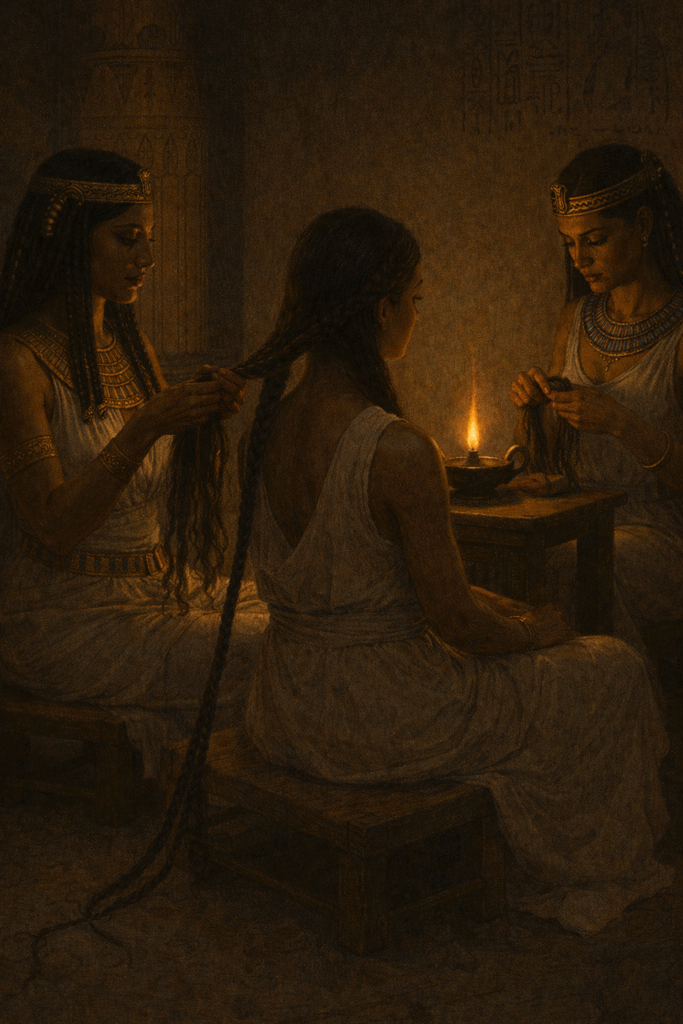
And there were rooms
with woven mats
and low stools,
where women brushed
each other’s hair
and talked
while oil lamps hissed.
It was there—
in the women’s quarters—
that I learned
a different kind of power.
My mother Ahmose
did not sit
on council seats.
She did not command regiments.
She did not speak
in the halls of pillars.
But the wives of generals
came to her.
The daughters of priests.
The sisters of nobles.
They came with petitions
and tears
and sharp, quiet questions.
“Will the king favor
this alliance?”
“Is this marriage
wise?”
“Can I trust
this priest?”
She listened.
She wove.
With words.
With favors.
With introductions
and warnings
that never reached ink
but shaped
what ink would one day say.
One evening,
as she combed my hair,
I asked:
“Is this power too?”
She smiled,
tucking a strand
behind my ear.
“This,” she said,
“is the first kind of power
any kingdom knows.”
I frowned.
“But Father’s halls—”
“Are the second kind,”
she finished.
“In the women’s rooms,
we learn who a man truly is
when he is not standing
before the throne.”
She bent close.
“A king who does not understand
the rooms without columns
does not understand
his own kingdom.”
Later,
when I ruled,
I never forgot.
PART VI — Karnak: Where Devotion and Power Intertwined
The first time
I walked into Karnak
as my father’s daughter,
I nearly forgot to breathe.
The pylons soared.
Flags snapped in the wind.
Incense curled upward
toward painted stars
on deep blue ceilings.
Amun’s house.
But it was more
than a god’s dwelling.
It was
a second court.
Priests greeted us—
heads shaved,
linen impeccable,
eyes clever.
Their bows
were deeper here,
even for the king.
Because in this space,
he needed them.
In the palace,
they needed him.
The high priest
took my hand once
as we walked
around a sacred lake.
“You are observant,
Princess,” he said.
I nodded,
saying nothing.
“The god sees those
who see,”
he added.
I studied his face.
“The god,” I said slowly,
“or the men
who speak for him?”
He laughed softly.
“A wise question,”
he replied.
“One it may not be safe
to ask aloud
in every room.”
But he did not deny it.
In Karnak,
I saw that stone
could be both devotion
and declaration.
A new shrine
was not just worship—
it was a message:
This king builds.
This dynasty stands.
This alliance holds.
When I later
raised my obelisks
and reworked the axis
of this temple,
it was because I understood
what Karnak truly was:
A stone memory
of what rulers wanted
the gods
and the people
to believe.
I learned that here.
As a girl
watching my father
offer wine
to a stone god
while men
in white linen
watched him.
PART VII — The First Time They Tested Me
Power is not granted once.
It is tested
again and again.
The first test
came when my father
was away on campaign.
I was still young—
not yet wife,
not yet regent.
But the court needed
a royal presence.
“Sit on the throne,”
Mother said quietly.
“Receive them
as if your father were here.”
My heart pounded.
The hall felt
too large
for my small body.
The crown they placed on me
was ceremonial,
lighter than the real one—
yet it felt heavy enough.
A governor from the north
stepped forward to speak.
He bowed,
but not quite as deeply
as he bowed to my father.
He glanced sideways
at the priest beside him.
They shared a look.
I understood:
They were searching
for limits.
How far
could they press
a king’s daughter?
How much could they extract
in the absence of the lion?
“Princess,”
the governor said,
“We respectfully request
reduction of our grain tithe
this season.
The floods were unkind.”
I had seen the reports.
The floods
had been generous.
“You request much,”
I said.
He smiled faintly.
“We know you are compassionate.”
The priest beside him
watched my face carefully.
Behind them,
scribes paused
with brushes raised.
I took a breath.
My father’s voice
whispered in memory:
Look for who lowers his head
for power
and who lowers it
for duty.
I looked
at the governor’s eyes.
Not a hint of desperation.
Only calculation.
“In my father’s absence,”
I said slowly,
“it is my duty
to protect his lands
so he returns
to find them whole.”
I kept my gaze steady.
“Your tithe
remains unchanged.
But I will send an inspector
to your region
to verify conditions.”
A flash of irritation—
quickly masked.
The priest bowed
slightly deeper.
“Your wisdom
honors the throne,”
he said.
It was a small decision.
A single audience.
But word traveled.
A princess
had sat on the throne—
and she had not
been swayed.
The court
was beginning to learn
what kind of woman
it was raising.
I was learning too.
For the Traveler Who Loves Origins
If you have ever wondered
how a ruler is made,
not just named—
If you are curious
about the rooms,
the people,
the pressures
that shape a future Pharaoh—
If you want to stand
where a royal child
first watched
a kingdom’s currents
collide beneath a painted ceiling—
then this Scroll
is your doorway.
Walk with us in Luxor.
Stand in the reconstructions
of these audience halls.
Gaze at Karnak’s pylons
with her eyes—
not as a tourist,
but as a girl
who knew one day
she might be asked
to bear their weight.
Journey with Explore ENA.
Every great reign
begins in a room.
PART VIII — The Court’s Quiet Verdict
Years passed.
I changed
from child to woman;
from daughter
to widow and wife;
from princess
to something more ambiguous.
But before any title
was officially placed on me,
the court had already
made its own assessment.
They watched
when I spoke.
They watched
when I kept silent.
They watched
who sought my counsel
even when I was not yet
officially regent.
One evening,
I overheard two nobles
speaking in an arcade.
“She has her father’s spine,”
one said.
“And her mother’s eyes,”
the other replied.
“That is a dangerous combination.”
“Dangerous for whom?”
“For anyone
who underestimates her.”
Their laughter
carried down the stone.
They did not know
I was there.
But I heard the verdict:
Not of gods.
Not of oracles.
Of the court.
The same court
that would one day
challenge my right
to rule as king
had already
acknowledged my capacity.
Long before
they knew
how far I would take it.
PART IX — What the Court Taught Me (And Why It Matters to You)
When you, traveler,
stand among the columns
of palaces and temples,
you may imagine
only the great events:
Coronations.
Decrees.
Military plans.
Festivals.
But the spaces
that shaped me most
were the quieter ones:
- the corner of the scribal hall
where a scribe whispered
that the army hated
losing grain to the temple - the women’s quarters
where my mother counted influence
not in titles
but in who came to her in tears - the shaded walkways of Karnak
where priests tested
the sharpness of my questions
as much as my piety - the audience days
where men tried
to slide small advantages
past a “mere princess”
and failed
The court that raised me
did not intend
to make a female Pharaoh.
It intended
to make a useful daughter
of the royal house.
But it taught me too well.
It showed me
every seam
in the fabric of rule.
Every crack
between temple and palace.
Every tension
between ink and sword.
Every place
where fear or greed
distorted justice.
So when the time came—
when widows and regencies
and a boy too young
to stand alone
created a space—
I knew exactly
how to step into it.
Because the court
had already
taught me
how it worked.
And how it lied.
And how it bent
for those
who understood its language.
Ancient Questioner’s Desk — Origins Edition
A student asked:
“Was Hatshepsut born a ruler?”
The elder replied:
“No.
She was born observant.
The court did the rest.”
Another asked:
“Did she love the palace?”
The scribe wrote:
“She loved what it taught her—
not always how it taught.”
A traveler wondered:
“Could she have walked away?”
The historian answered:
“Not after learning
where every current
in the river ran.”
A final question came:
“When did her reign truly begin?”
The old master smiled.
“The first time
she noticed
who bowed from loyalty
and who bowed
from calculation.”
The Beginning of the Arc
This Scroll ends here—
at the threshold
of everything else.
Before Punt.
Before the terraces.
Before the obelisks.
Before the fall.
Before the stone
had to remember.
Here,
a young girl
walks through halls
of painted columns
and understands
that power is not a crown—
it is a room
full of competing truths.
If you want to feel
how her story truly began,
come stand in those rooms with us.
Journey with Explore ENA.
Every future legend
is once a child
studying the room.